
Tesla has its Nevada robotaxi permit. It is worth reading what the permit actually allows before treating that as the milestone it sounds like.
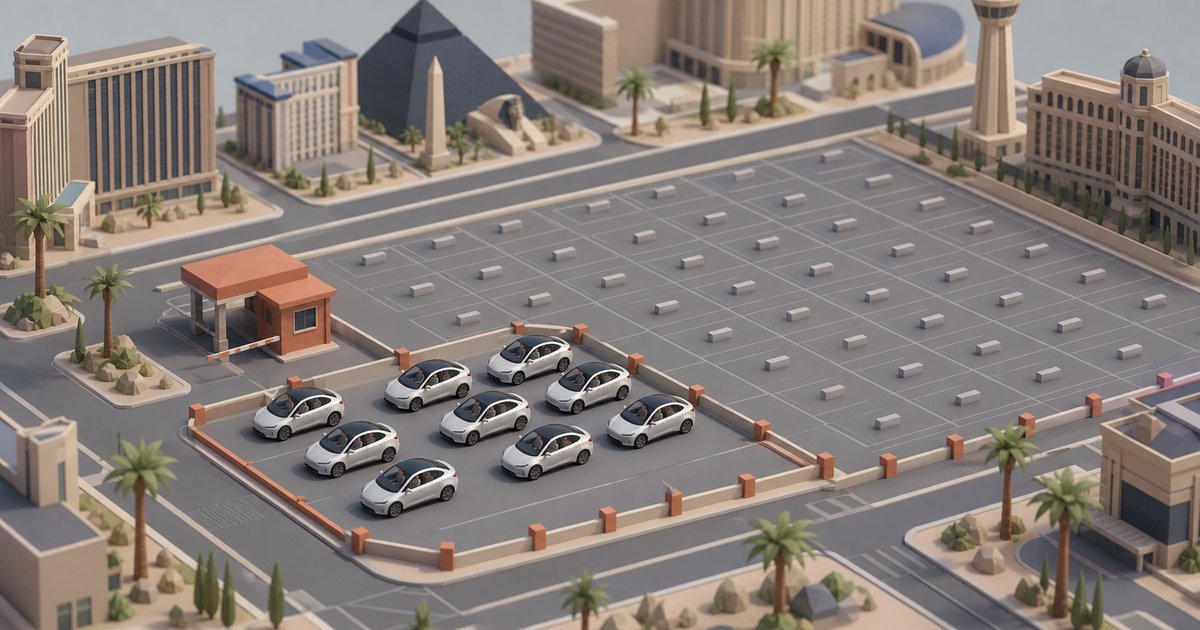
The Nevada Transportation Authority issued AVNC Permit 002 to Tesla Robotaxi, LLC under docket 26-05015, active from 13 August 2026. Tesla filed the application on 5 June, asking for authority to run up to 5,000 vehicles in Clark County during the permit's first twelve months. The regulator approved a maximum fleet of ten.
The conditions attached
The fleet cap is the headline, but it is not the most restrictive term.
| Condition | What the permit says |
|---|---|
| Fleet size | Maximum 10 fully autonomous vehicles |
| Operating area | A defined geofence along the Las Vegas Strip corridor |
| Road types | No roads with a posted limit above 45 mph |
| Supervision | "Appropriate human supervision" required |
| Airport pickups | Barred within a quarter mile of Harry Reid International without separate authorisation |
| Incident reporting | Accidents, system failures and stranded vehicles reported within five business days |
| Vehicle marking | Visible "Robotaxi" markings; riders told before the trip that nobody is driving |
| Expansion | Any larger fleet or wider area needs NTA approval first |
The supervision requirement is the one that changes the character of the service. Nevada is not authorising genuinely driverless operation — a person remains responsible in the vehicle, which puts the Las Vegas service behind what Tesla has been running in Austin. The original application had also covered Henderson Executive Airport alongside Harry Reid; airport access is now the subject of a separate permission Tesla does not yet hold.
The 45 mph ceiling quietly removes the freeway network from the operating area, and with it most of the ways a visitor actually crosses Las Vegas.
Why a regulator grants a permit and then shrinks it
A cap of ten against a request of 5,000 is not a rejection dressed up as an approval. It is the standard shape of autonomous-vehicle licensing: authorise a small validated fleet, require incident data, and make growth conditional on that data. Waymo scaled through the same ratchet in Phoenix and San Francisco, one expansion request at a time.
What it does mean is that the timetable belongs to the NTA rather than to Tesla. Every increase in fleet size and every extension of the geofence needs approval first, and the five-business-day reporting requirement is the mechanism that generates the evidence those decisions will rest on.
What this says to a European reader
Nothing here reaches Europe directly — this is a Nevada permit for a service on the Las Vegas Strip. Its usefulness to a European Tesla owner is as a calibration point.
In Europe, Tesla is not asking for permission to run driverless vehicles at all. It is working through approval for FSD (Supervised), a Level 2 driver-assistance system in which the driver remains legally in control at all times. That has national approval in five countries, and the Dutch RDW said on 30 July that there is no internal timeline for the EU-wide type approval that would extend it, calling the process exceptional and complex.
So the two tracks are further apart than the shared "robotaxi" vocabulary suggests. In the most permissive American jurisdictions Tesla is being granted supervised commercial operation in units of ten cars on a single boulevard. In Europe it is still working to have a supervised assistance feature recognised across the bloc. Neither is a driverless Tesla arriving on a European road, and the Nevada permit does not move that date.
Update: 2026-08-21
On 20 August 2026 the Nevada Transportation Authority approved Tesla's full Autonomous Vehicle Network Company permit, superseding the interim order described above. The ten-vehicle cap and the Las Vegas Strip geofence no longer apply: Tesla is authorised for up to 5,000 driverless vehicles across the whole of Clark County for the next twelve months, and may petition to extend the geofence statewide. Uber and Waymo received comparable authorisations the same day. Commercial rides are expected to begin within about 30 days, subject to vehicle inspections, insurance filings and fare approval, and Tesla told the authority it does not intend to deploy all 5,000 vehicles immediately. Whether the interim permit's human-supervision requirement carries into the full permit has not been stated, so treat that condition as open.
Update: 2026-08-24
Detailed accounts of the 20 August hearing put per-operator numbers on the decision, and they do not sum to the 8,000 robotaxis several outlets reported. TechCrunch lists up to 5,000 vehicles for Tesla, 1,000 for Waymo and 1,000 for Uber — 7,000 in total, alongside the 100 Zoox already holds — while still heading the figure at 8,000, as electrive does too. Tesla's own expectation is lower again. Cybercab chief engineer Eric Early told the hearing that “5,000 has always been a ceiling for us”, that he did not expect Tesla to be in a position to deploy 5,000 by this time next year, and that the constraint is not the technology. About 2,500 would leave Tesla “extremely happy and satisfied”.