
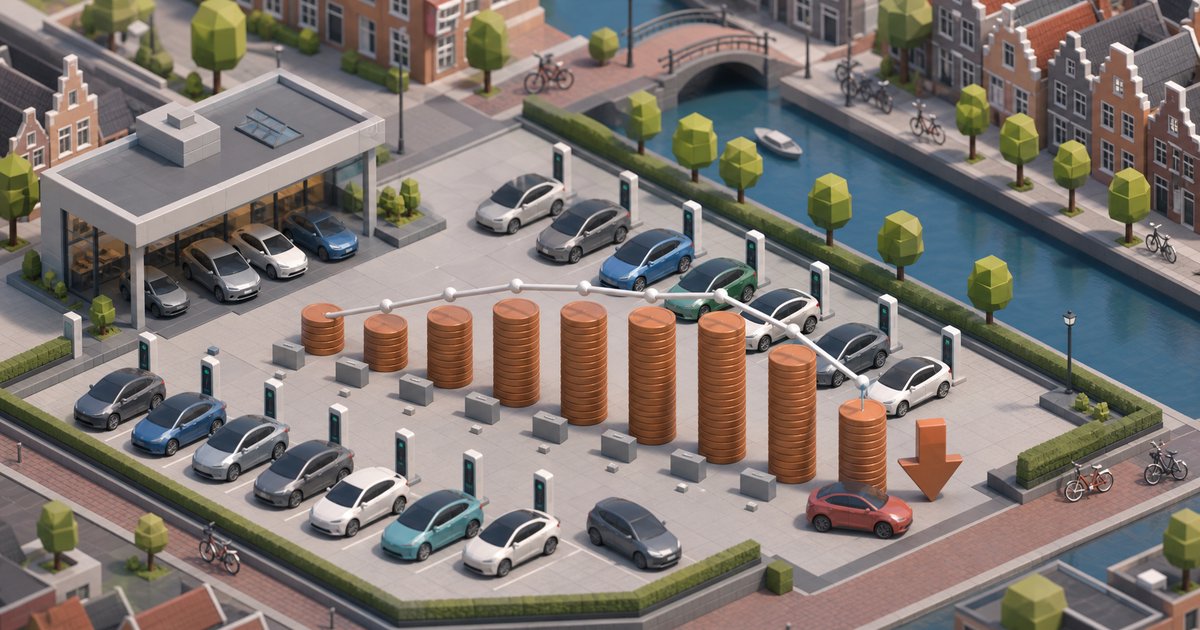
The average asking price for a used electric car in the Netherlands fell 0.41% in July to €37,293, according to AutoScout24's occasion data. It is a small move. It is also the first monthly decline since March, ending a run that had added more than €5,000 to the average in four months.
That run was the anomaly, not the dip. For most of the past three years, used EVs in the Netherlands depreciated hard and predictably — AutoScout24's own figures had them 28% cheaper than in 2022, and January 2026 opened with another 2.8% monthly fall to an average of €32,454. Then the direction reversed.
The numbers behind the reversal
| Period | Average used EV asking price | Change |
|---|---|---|
| January 2026 | €32,454 | −2.8% month on month |
| Q1 2026 | €32,112 | — |
| Q2 2026 | €36,057 | +12.3% on Q1 |
| July 2026 | €37,293 | −0.41% month on month |
A 12.3% quarterly jump in a used-car segment is not normal behaviour. The broader Dutch used market moved in the opposite direction over the same stretch, and continued to in July: the average used car of any powertrain now costs €23,948, down 0.44% on June.
So for several months the Netherlands had a used market where electric cars appreciated relative to everything else on the forecourt — precisely the inverse of what buyers had been taught to expect, and of what made used EVs cheap in the first place.
Why prices went up, and why that is not entirely good news
The mechanism is supply, not desirability. Demand held steady rather than surged: EVs accounted for 12% of all used-car searches on the platform in July, with strong regional variation — Flevoland led at 16.1%.
What changed is the mix. As the cheapest early EVs cleared out of the market and newer, larger, longer-range cars entered it, the average price of what is actually for sale rose. An average asking price measures the stock, not the value of any individual car, and the Dutch used-EV stock has been getting more expensive to buy new.
For a buyer, the effect is the same either way: the bargains thinned out. For an owner, a firmer used market is straightforwardly good — residual values are the quiet half of what an EV costs to run, and they have historically been the weak half.
One month is one month, and European residuals are firming
AutoScout24 is explicit that a single 0.41% move is too small to call a trend, and it is right. The July figure is consistent with a market that has finished re-pricing and is settling, and equally consistent with normal noise.
What makes it worth watching is the timing. Used-EV residuals have been strengthening across several European markets at once, and the used trade's own confidence in electric stock recently hit a four-year high in the UK. If the Dutch dip extends into August and September, it is the first sign that the correction has run its course. If it does not, €37,293 is roughly what a used EV costs in the Netherlands now.