
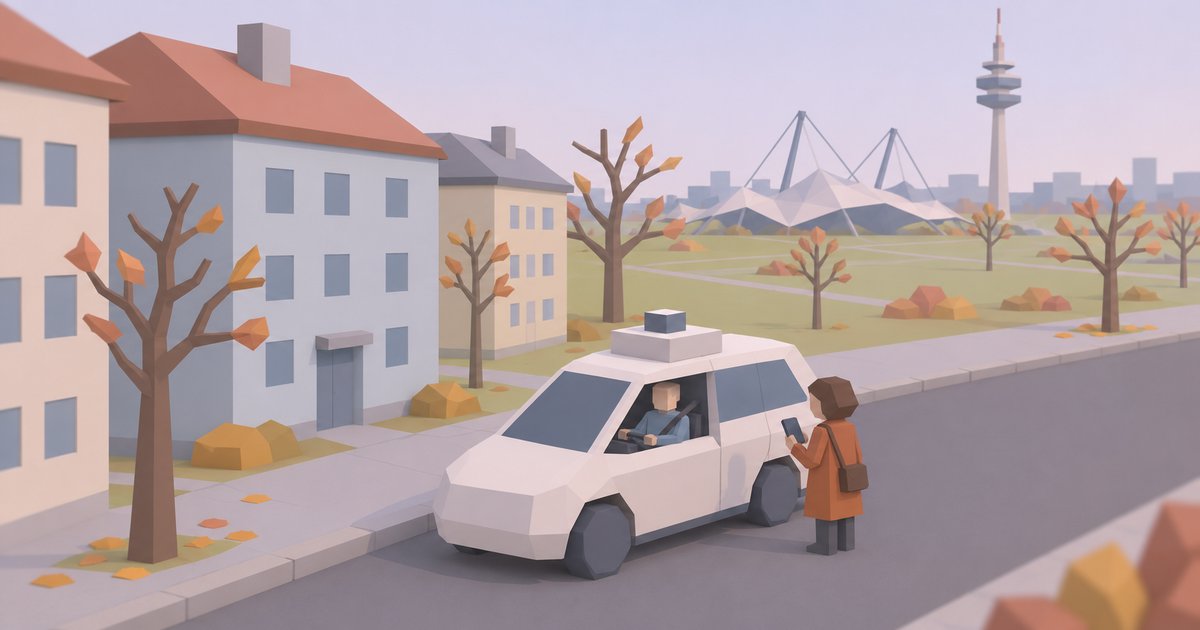
Uber and the Chinese autonomous-driving company Momenta started a supervised robotaxi pilot in Munich on 18 November 2026. It is the first time riders in Germany can book an autonomous ride through the Uber app, the two companies said. The rides are free and non-commercial, and a trained safety operator sits in every car.
How the pilot works
| Detail | Munich pilot |
|---|---|
| Driving system | Momenta |
| Booking | Uber app |
| Area | Large parts of northern Munich, including the area around the Olympic Park |
| Who can ride | Pre-registered, pre-selected riders; interest list open in the app from 18 November |
| How | UberX, Uber Electric and Comfort requests in the area may be offered an autonomous car |
| Stops | Designated pick-up and drop-off points |
| Price | Free; the pilot is non-commercial |
| Safety | One trained safety operator on board every ride |
| Legal basis | Momenta's test permits from the Kraftfahrt-Bundesamt (KBA) |
Access is granted in phases, and the companies will widen the area step by step "within the applicable regulatory framework". The release does not name the car. Car News China identifies the one in Momenta's photo as a second-generation IM LS6, a crossover from SAIC's IM Motors brand.
From test permit to passengers
The pilot builds on the approval Momenta received in July, when the KBA cleared it for Level 4 testing on urban roads across Germany without separate permits city by city. Momenta was the first Chinese company to receive one, and it named Munich, with Uber, as its starting point.
Samarth Kejriwal, head of autonomous mobility operations at Uber, said that launching within Germany's strict regulatory framework sets a high bar for expansion across the region. Xie Shuo, Momenta's robotaxi general manager, said the pilot lays a foundation for a regular service in Germany. Neither company gave a date for paid rides or for rides without a safety operator.
Momenta's driver assistance runs in more than 1.4 million customer cars worldwide, and the company works with Mercedes-Benz, BMW, Audi and Volkswagen. It listed in Hong Kong in July, raising about HK$6.8 billion, and plans to spend roughly a fifth of that on robotaxi commercialisation. Uber added to its stake during the listing.
Where Tesla stands in Germany
A safety operator watching a system that drives itself is also the bargain behind Tesla Assisted Driving, the supervised system Tesla sold in Europe as FSD (Supervised). Germany is not among the 11 EU countries that have recognised its Dutch approval, so German owners are still waiting for an EU-wide decision. Tesla's own driverless plans in Germany are further out: it will build the Cybercab in a new €3 billion hall at Grünheide from 2029.
Uber already runs a similar supervised service with Wayve in London, where passengers have ridden since September.