
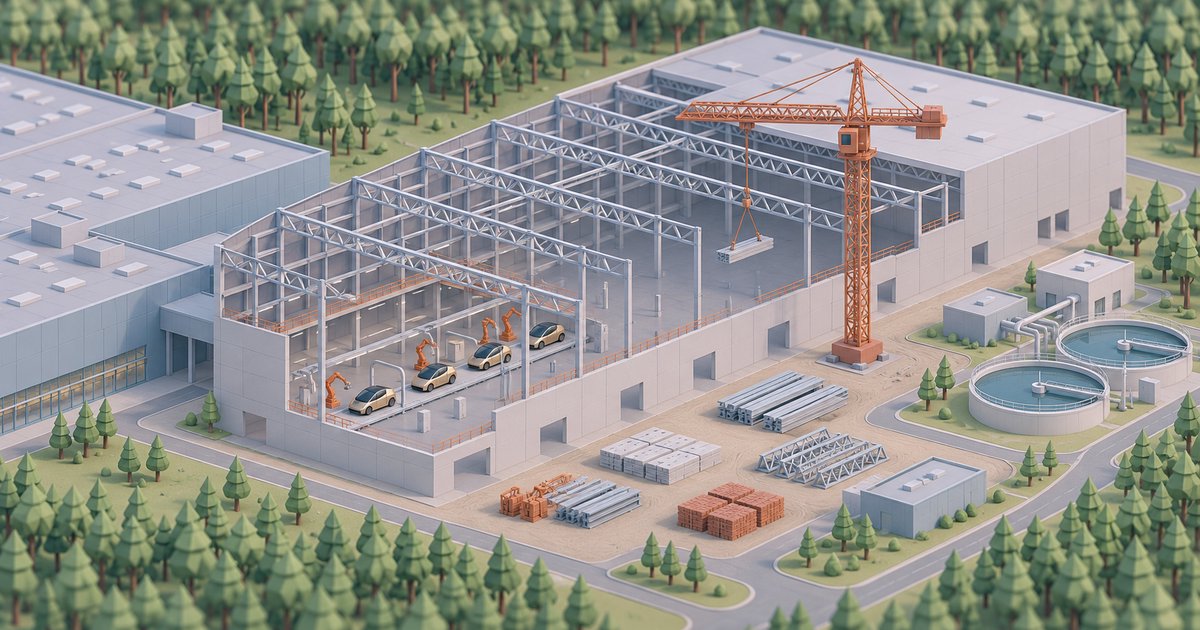
Tesla will spend €3 billion on expanding its factory at Grünheide near Berlin, and the new production building at the centre of the plan is for the Cybercab. The company announced the investment on 16 November 2026, Handelsblatt and the regional broadcaster rbb24 report from a dpa story. The building should later be able to produce up to one million Cybercabs, Tesla's two-seat robotaxi with no steering wheel or pedals. Construction is to start in the first half of 2027, and production in 2029.
"With this we are laying the foundation for the most technologically advanced Tesla factory in the world, here in Grünheide," Tesla said.
What Tesla announced
- Investment: €3 billion, covering the new production building, ancillary buildings and, among other things, another wastewater treatment plant.
- Product: the Cybercab. Tesla's statement names no other vehicle for the building.
- Permit: the application for the building is to be filed before the end of 2026. It builds on Tesla's 2023 application for the whole expansion.
- Jobs: several hundred new hires in construction and production planning.
Tesla did not say whether one million is a yearly figure. The 2023 application covers the whole site at up to 1 million cars a year, double the 500,000 that Grünheide is permitted to build today.
| Step | Date | Stated by |
|---|---|---|
| Expansion application, whole site, up to 1 million cars a year | March 2023 | Tesla, to Brandenburg's environment agency |
| Permit application for the new building | by the end of 2026 | Tesla |
| Construction start | first half of 2027 | Tesla |
| Cell production fully running | mid-2027 | plant manager André Thierig |
| Cybercab production start | 2029 | Tesla |
The question this answers
When RBB reported in October that Tesla would apply for a second production hall of about 536,000 m², Tesla did not say what it would build there, and observers named the Cybercab and the Semi. On 11 November Thierig told an Automobilwoche congress that "if we build another factory there, we will not build another Model Y factory", teslamag reported. The 16 November statement settles it: the hall is for the car that Elon Musk told Grünheide staff in February would "most likely" be the plant's next big product.
The plan had been waiting. Tesla did not drop the expansion during its sales slump, dpa notes, but put it on ice until the market improved. Demand has since recovered. Grünheide employed 12,600 people in October, up from a low of under 11,000, and a spokeswoman said 2,000 had been hired in recent months as the existing hall works towards 7,500 Model Ys a week, about 375,000 a year. Cell production is due to start fully in mid-2027.
Brandenburg's minister-president Dietmar Woidke called the decision "a great day for Brandenburg and a strong signal for Germany as an industrial location", Handelsblatt quotes from his press release.
What it means for European buyers
Nothing changes for a Model Y order. The existing hall keeps building the car, and the new one will produce nothing before 2029. What the announcement does is put Cybercab production in Europe on Tesla's own timetable for the first time.
The Cybercab has no European road approval, and Tesla has not said where Grünheide-built Cybercabs would be sold or used. In the US it went on sale to invited buyers on 13 November at $29,990 plus a $299 monthly subscription. In Europe it is so far only a touring display.
The statement also leaves the Model 3 where it is. Every Model 3 sold in Europe still comes from Shanghai, and Tesla named no other model for Grünheide.
Update: 2026-11-17
On 16 November 2026, Grünheide plant manager André Thierig gave the figure a yearly basis. In a LinkedIn post, he wrote that Cybercab production will start in 2029 and that Tesla intends to ramp it up over time to as many as 1 million vehicles a year. That supersedes this article's statement that Tesla had not said whether one million was a yearly figure; his post on X gave no rate. He also called the roughly €3 billion a first step.
A million Cybercabs a year on top of the existing hall's Model Y target of about 375,000 would exceed the 1 million cars a year that Tesla's 2023 application covers for the whole site. Tesla has not said whether its permit application, due by the end of 2026, will ask for more.
EU rules still allow a fully driverless vehicle type only 1,500 registrations a year. Implementing Regulation (EU) 2026/481 lifted that small-series cap for automated valet parking alone.