
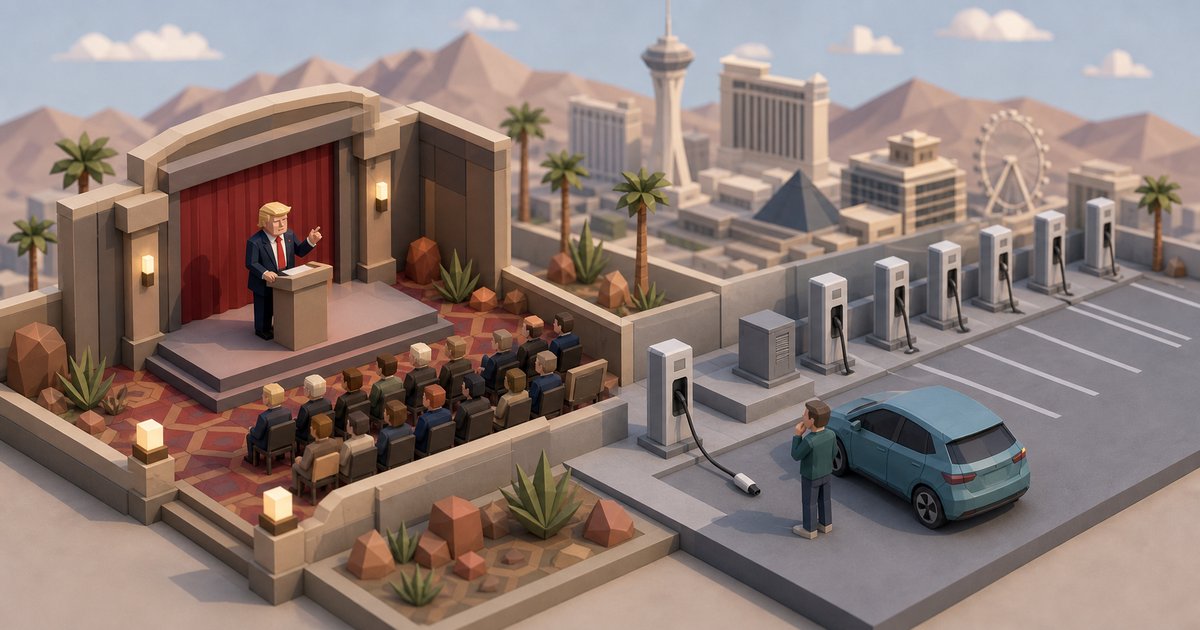
President Donald Trump used a 5 August 2026 speech at the Red Rock Casino in Las Vegas to mock electric-vehicle owners, telling the audience that they "have a disease" and are "crazy".
The remarks came during an address on the administration's tax agenda. Trump did not name the condition he was describing, but the symptoms he listed identify it clearly enough: a driver worrying about where the next charger is while the battery still reads 75%.
"You're driving along in an electric car, they have a disease, you know, it's a disease," he said. "These people are crazy."
Why a rally line is worth reporting
On its own it is a throwaway. What makes it worth a European reader's attention is that it is consistent with what the administration has actually done rather than at odds with it.
Over the past year the US federal EV tax credit has been terminated, EPA emissions standards have been relaxed, and funding for the national fast-charging build-out has been frozen or cut. The rhetoric and the statute point the same way. That is the difference between a politician making a joke about a technology and a government withdrawing support from it.
The specific target — range anxiety at 75% state of charge — is also revealing, because it is the one EV criticism that has aged worst. It describes the 2015 ownership experience, not the 2026 one, in a country that has more than 200,000 public charge points.
The European press noticed
The speech was picked up quickly by EV outlets in France and Italy, which is unusual for a US domestic rally line. Automobile Propre ran it in French and Vaielettrico in Italian, both framing it as another instalment in a running campaign against electric cars rather than an isolated quip.
That interest is not really about Trump. It is about the widening gap between the two markets.
The contrast is now stark
Read the same week's European numbers next to it. France just posted a record 35% battery-electric share for July, driven by an income-targeted leasing scheme aimed squarely at lower-income drivers. Germany's purchase grant had passed 103,500 applications. Both are governments spending money to move buyers toward EVs while the US removes the equivalent support.
Europe is not unanimous — the 2035 engine rules are still being renegotiated, and the argument over how far to soften them is live. But the direction of the argument is about pace, not destination.
For Tesla the split is awkward in a way it is not for other carmakers. It sells into both markets, its chief executive has spent two years closely associated with the US administration, and European buyers already rank the brand worst on perception in the EU largely because of that association. A US president mocking the people who buy electric cars is not a message Tesla benefits from in either market — but it costs more in the one where its share is falling.