
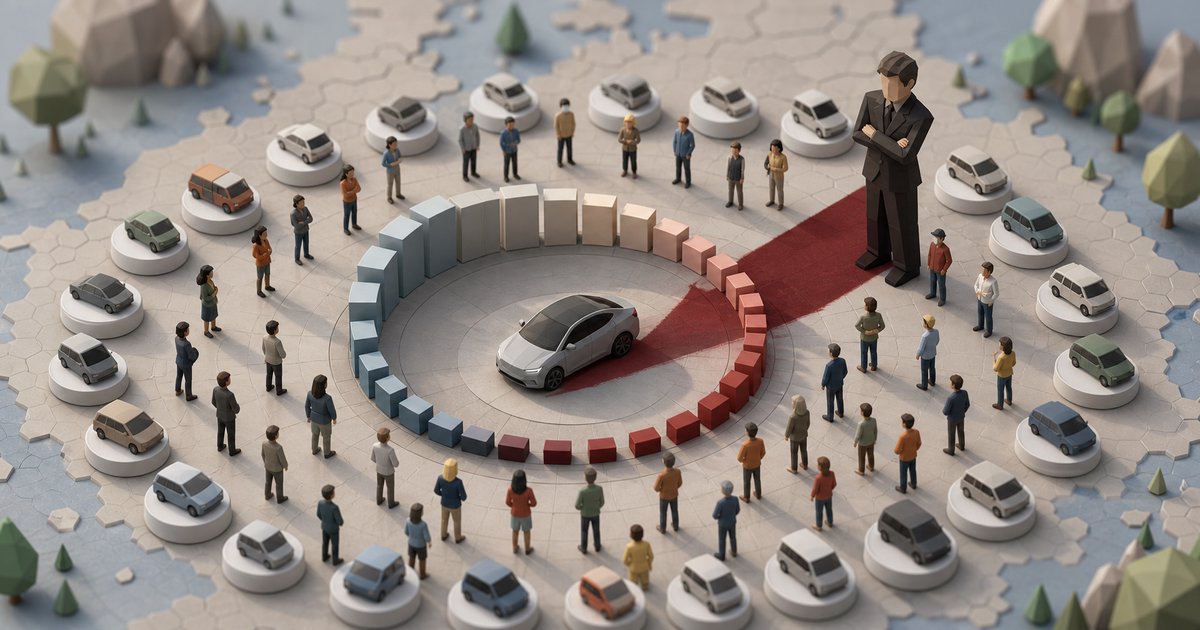
The Electric Vehicle Intelligence Report's July 2026 edition asked 1,861 consumers across all 27 EU member states what they think of 28 car brands. Tesla finished last, with a net favourability score of -4 — behind every legacy manufacturer, every EV-native rival, and the Chinese entrants including BYD and NIO.
The report is direct about the reason: "Tesla is the worst-perceived vehicle brand in the EU."
The numbers
Asked whether Elon Musk affects their perception of Tesla, respondents split:
| Response | Share |
|---|---|
| Negatively | 39% |
| No difference | 35% |
| Positively | 13% |
Musk's personal net favourability among the sample sits at -31. When respondents were reminded of his donations to Donald Trump, it fell to -47 — a 16-point drop from a single prompt.
The prompt moved the brand numbers too, not just the man's. After it, Tesla's brand popularity read -42 and stated purchase likelihood -40. That second figure is the one with commercial consequences: favourability is an opinion, purchase likelihood is a forecast.
The comparison that stings
The survey also measured what BYD's relationship with the Chinese state does to BYD's standing among EU consumers. That came in at -13.
Set against Musk's -47, the finding is blunt: a Western brand's own CEO is a heavier reputational liability in Europe than a Chinese competitor's government ties. For a company that has spent two years watching BYD close the gap on it in Europe — the two brands matched market share for the first time in H1 2026 — that is an uncomfortable place to be.
Sentiment and sales are not the same thing
Two cautions on reading this too hard.
First, the report itself notes that Tesla's European sales have been improving in recent months after last year's sharp decline. Brand sentiment surveys measure what people say, and car buying is driven by price, range, charging and lease rates as much as by what a buyer thinks of a chief executive.
Second, the picture across Europe is not uniform. Tesla's July was catastrophic in one major market and unremarkable elsewhere — German registrations fell 67% to 367 cars while Norway saw just 24 Teslas registered, yet other European markets held steady. A single EU-wide favourability number flattens that variation.
What the survey does establish is that the sentiment problem is measurable, EU-wide, and specifically attributable rather than diffuse. Thirty-five percent of respondents say Musk makes no difference to how they see Tesla, which is the number the company would most like to grow. The 39% who say he makes it worse is roughly three times the 13% who say he helps — and unlike range or price, it is not something a product update can fix.