
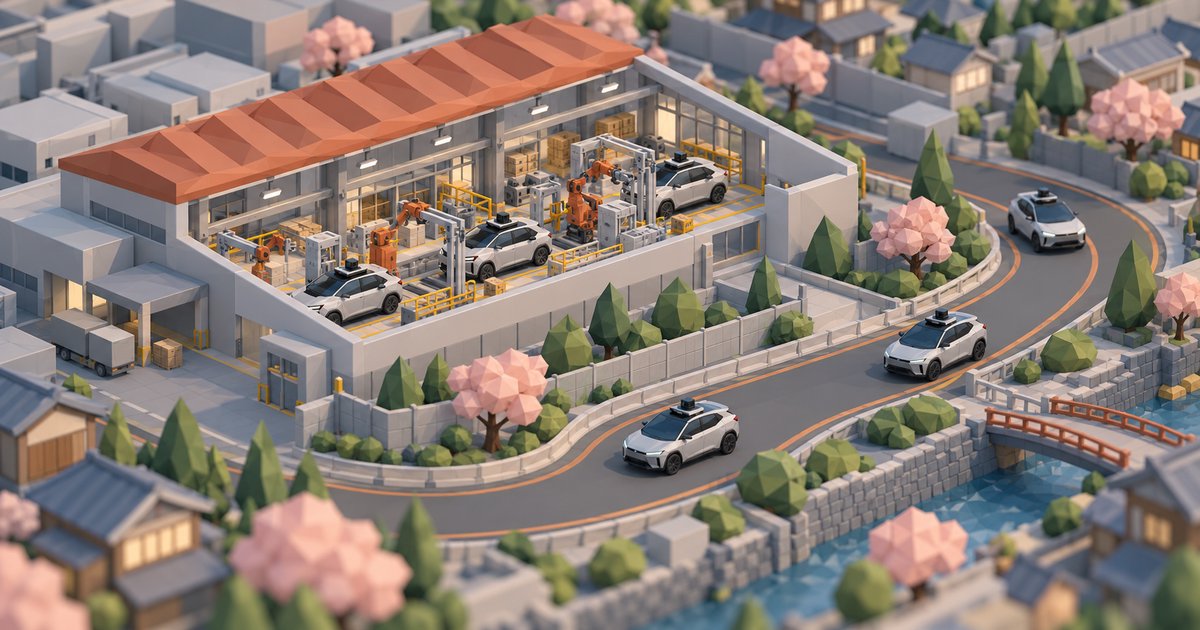
Toyota will build robotaxis for Waymo. The two companies said on 30 October 2026 that an autonomous version of the bZ4X, Toyota's electric SUV, will be made at Toyota's Takaoka plant in Toyota City, Aichi, "under one roof, from assembling the base vehicle to integrating Waymo's AV hardware" (Waymo, Toyota). Initial operations to test and validate a bZ4X fleet start in Japan in 2027, "with deployment to the United Kingdom and other Waymo-serviced markets planned for the following years."
From a memorandum to a factory
In April 2025 the two companies signed a preliminary agreement to explore working together. It named no vehicle, plant, market or date. This announcement names all four:
| Item | Announced on 30 October 2026 |
|---|---|
| Vehicle | Custom-outfitted Toyota bZ4X |
| Factory | Takaoka plant, Toyota City, Japan |
| Japan | Test and validation operations from 2027 |
| United Kingdom and other Waymo markets | "The following years" |
| Autonomy level | Level 4 (fully autonomous) |
The cabin is set up for passengers, with generous rear legroom, automatic doors, a power liftgate and ambient lighting. The companies call it Japan's first fully autonomous ride-hailing service using "high-volume, domestically manufactured vehicles". They did not name a city, a fleet size or fares. They will also keep studying autonomy for privately owned Toyotas and, with Woven by Toyota, how Waymo's operating data could improve road safety more widely.
Waymo co-CEO Dmitri Dolgov repeated the company's claim that where it operates it is "up to 20x safer than human drivers when it comes to serious crash injuries". Toyota executive vice president Hiroki Nakajima said safety technology "makes the biggest difference when it reaches as many people as possible".
Why it matters for Tesla
Scale is the case Tesla makes for Cybercab: a purpose-built robotaxi from its own factory, without the import bill Waymo pays on its China-built Ojai. Waymo now has the world's largest carmaker building a car for it. Tesla is already running its own: the Texas register listed 573 Cybercabs and 507 Model Ys on 30 October, as TeslAnt reported.
Japan is a second front. Tesla Japan still aims to switch on FSD (Supervised) there before the end of 2026, but its president said this month that it cannot get there alone. Waymo already tests in Tokyo; from 2027 it will test Japanese-built cars in Japan.
What it means in Europe
For European riders, the Toyota cars come later. Waymo's first EU city, Munich, targets driverless rides by the end of 2027, and Madrid aims for its first riders in 2027, where testing uses Jaguar I-PACEs. The release puts the UK after Japan and names no EU country, so Europe's first Waymo services will start without the Toyota.
For a European Tesla owner, the comparison stays the same for now. Tesla Assisted Driving is a supervised system the owner pays for, while Waymo sells rides with no one at the wheel.