
Most assisted-driving tests are scored on a closed track against staged scenarios, which measures whether a system can avoid a crash but says nothing about what it does on an ordinary Tuesday. Thatcham Research, the UK insurance industry's research arm, has built a programme around the second question, and its first published results are awkward for Tesla.
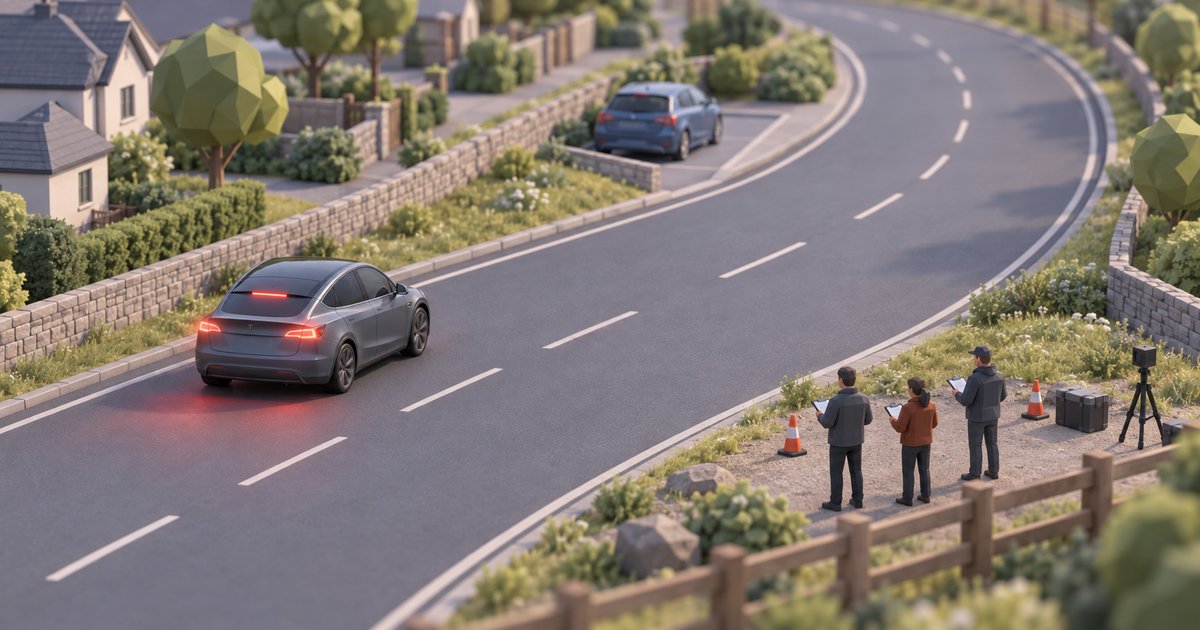
Three cars were driven more than 4,500 miles — roughly 7,200 km — over three weeks, predominantly on public roads with some closed-circuit measurement. The cars were a Tesla Model Y, a BMW i5 and an MG ZS, picked because their driver-assistance systems sit in just under 10% of UK new car sales. Every intervention the cars made was logged.
The braking count
| Car | Unnecessary braking events over the test |
|---|---|
| Tesla Model Y | 122 |
| BMW i5 | 8 |
| MG ZS | 6 |
The gap is not marginal — it is fifteen-fold against the next worst car. Thatcham's testers describe the Model Y slowing hard for a sharp corner it did not need to slow for, and braking for a parked vehicle it was never going to hit.
Principal ADAS engineer Yousif Al-Ani's explanation is that this is a choice rather than a fault: Tesla's collision-avoidance system is calibrated more sensitively than the regulations require. A car that brakes early will avoid some crashes a less twitchy car would not. The cost is that it also brakes when nothing is there.
Two qualifications belong next to the headline. The Model Y braked sooner than the others across a range of scenarios, but the i5 was not far behind it — the two cars are on the same side of the design argument, at different settings. And the number of times a test driver had to physically intervene was roughly equal between the Tesla and the BMW. What separates them is nuisance, not safety.
The speed-limit numbers are worse for everyone
Thatcham's earlier findings from the same programme, published on 24 June 2026, covered intelligent speed assist — the system that reads signs and warns you when you are over the limit.
| Car | Accuracy by distance | Accuracy by speed-change event |
|---|---|---|
| BMW i5 | 98.39% | 90.3% |
| Tesla Model Y | 98% | 82.6% |
| MG ZS | 91.3% | 74.3% |
The second column is the one that matters, because it counts the moments where the limit actually changes. Even the best system gets roughly one in ten of those wrong. The cars variously displayed 5, 10, 15 and 100 mph — none of them legal British limits. The Model Y's errors were usually 10 mph out; the BMW's were fewer but larger when they came.
Why a nuisance number is a safety number in Europe
Al-Ani's concern is not that the cars brake, but that owners stop letting them. "This is exactly why people are turning the speed-limit assist off, it's just not good enough," he told Auto Express. A system switched off protects nobody, so a false-positive count is a safety metric with a delay on it.
For European owners this lands as the testing regime tightens around exactly this behaviour: Euro NCAP's 2026 overhaul of its safe-driving assessment pushes in the same direction, and insurers — Thatcham's constituency — set premiums partly on what these systems do in traffic rather than on a proving ground.
It is also a useful counterweight to the fleet statistics. Tesla's own data, and Flanders' independently reported FSD crash figures, measure collisions that did not happen. Thatcham is measuring the interventions that did, and needn't have.