
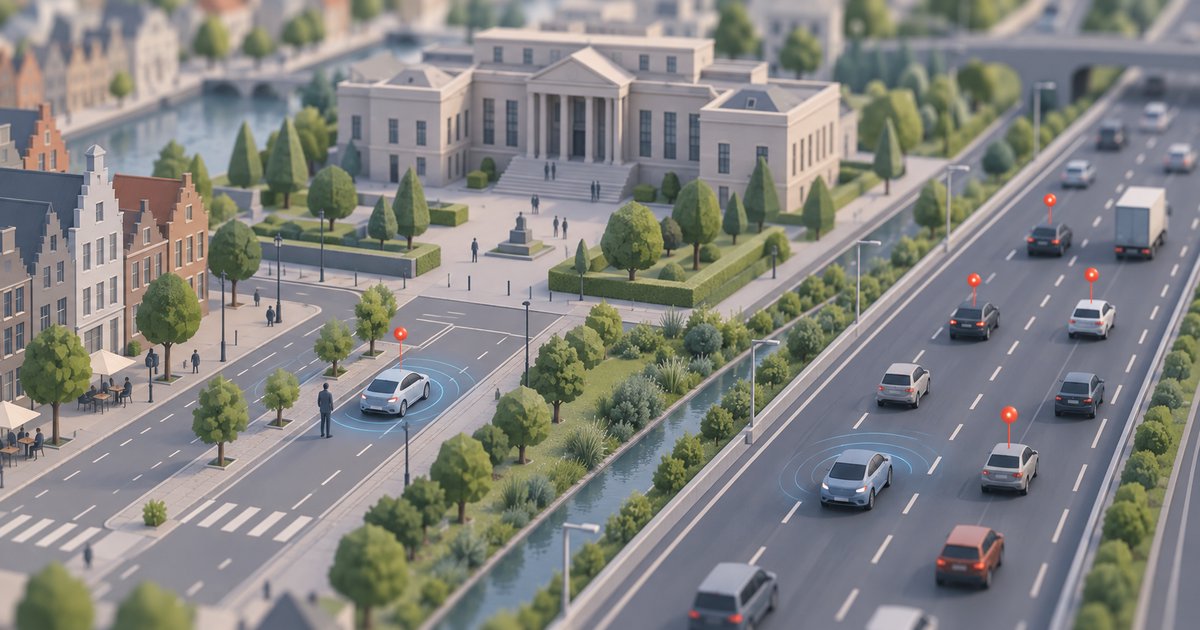
A European government has now put its own Full Self-Driving numbers on the record, rather than repeating Tesla's. On 18 September 2026 Flemish Mobility Minister Annick De Ridder presented safety figures for FSD (Supervised) to the Flemish Parliament, covering 11 June to 31 August 2026 — the first full period since Flanders authorised the system. Cars taking part drove 24.6 million kilometres with FSD engaged.
The headline that travelled was "nearly ten times fewer crashes". That is true of one half of the data and not the other.
Two roads, two very different results
| Road type | With FSD engaged | Manually driven Teslas |
|---|---|---|
| Away from motorways | 1 collision in 9.5 million km | 150 collisions in 146.9 million km |
| Motorways | 4 collisions in 15.1 million km | 32 collisions in 95.1 million km |
Off the motorway the contrast is stark: roughly one collision every 9.5 million kilometres with FSD, against one about every million kilometres without it. That is the 9.6-fold gap the minister quoted.
On the motorway it shrinks to something ordinary. FSD managed about one collision per 3.8 million kilometres; human drivers about one per 3.0 million. That is a reduction of roughly a quarter — real, but not an order of magnitude, and it is the number that gets dropped from the headline.
Two further measures went the same way as the first: about 93% fewer automatic emergency braking activations with FSD active, and between 82% and 90% fewer abrupt manoeuvres.
What the five collisions were
Five collisions involved cars in the scheme. FSD was not engaged in one of them. Investigators found no link between the system and the other four, which were all minor, low-speed and caused no injuries.
Read the figures with their limits attached
Three cautions belong next to these numbers, and none of them are hidden — they follow from how the data was gathered.
The counts are tiny. One collision off the motorway and four on it are not enough to pin down a rate with any precision; a single additional crash in either column would move the ratio a long way.
The comparison is not like-for-like. Drivers choose when to switch FSD on, and they tend to choose the conditions that suit it. The manual baseline includes every kind of driving, including the messy conditions a driver would never hand over.
And the system is supervised. A human remains legally responsible and intervenes when it goes wrong, so what is being measured is a person and the software together — not the software alone. An intervention that prevents a crash shows up in these figures as FSD not crashing.
Why it lands now
The European Commission's Technical Committee on Motor Vehicles votes on 6 October on extending FSD approval, and the evidence base for that vote has so far been supplied largely by Tesla — including its own Article 39 safety case, published on 1 September. Flanders is a different kind of document: a member-state authority reporting its own monitoring to its own parliament, three weeks before the vote.
Belgium approved FSD (Supervised) on 10 June 2026 after about 5,000 km of testing in Flanders, becoming the fifth EU state to do so; Slovenia followed as the sixth, and France said in September it would support homologation after refusing in July. Belgium is the first of them to show its working.