
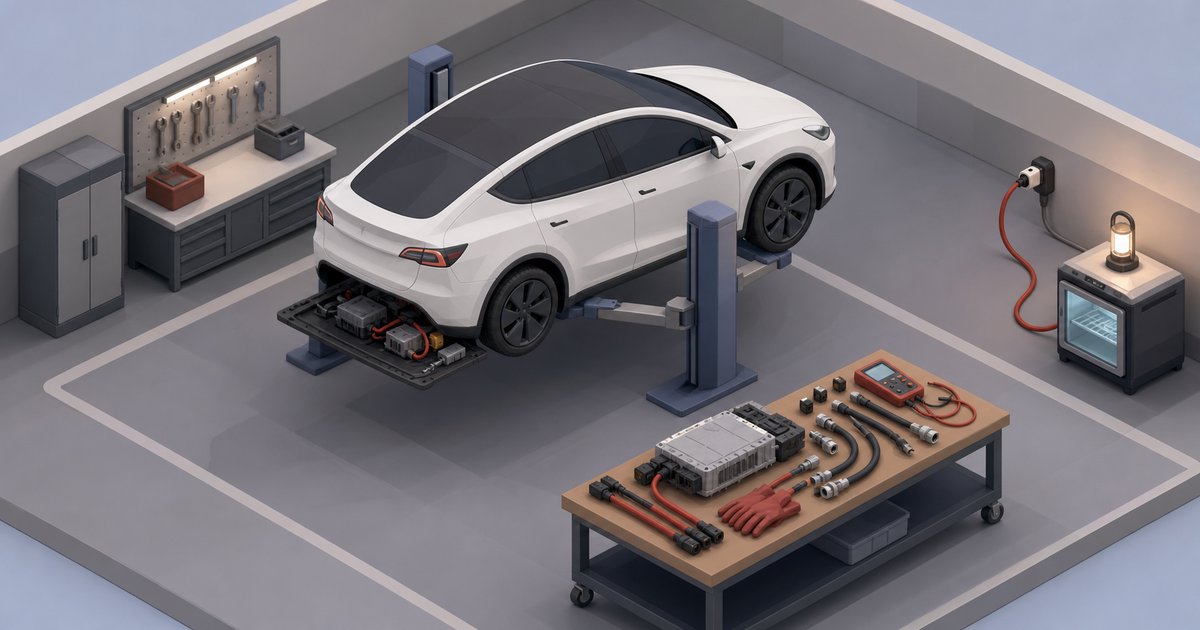
Tesla has published the procedure for retrofitting vehicle-to-load into a Model Y that shipped without it, and reading it is the fastest way to understand why almost nobody should.
The document is a draft PCS1-to-PCS2-Lite retrofit running to 344 steps. It applies to Model Y Premium cars built before June 2026 — and the eligibility line is not a clean date, because some cars built as recently as May 2026 left the factory without the PCS2 hardware the feature needs. Owners cannot tell from the outside.
What the job involves
| Procedure | PCS1 → PCS2 Lite retrofit, 344 steps, draft |
| Main part | PCS2 unit, part 2100145-N0-E, about $1,750 |
| Also required | 12 V DC harness, AC filter harness, revised inlet and outlet coolant hoses |
| Shop work | Vehicle on a lift, high-voltage battery isolation, coolant drain and refill, battery ancillary bay opened, wiring modifications |
| Equipment | High-voltage protective gear, resistance testing tools |
| Labour estimate | None published |
| Result | 20 amps at 120 volts (2.4 kW) via Tesla's $80 Outlet Adapter and a Gen 3 Mobile Connector |
This is not a plug-and-play module swap. Isolating a high-voltage battery, draining and refilling coolant and opening the battery ancillary bay is powertrain work, and Tesla has not published a labour-hour figure — which in practice means the invoice is the part price plus an unknown.
What you get for it
Less than the name suggests. The Model Y's implementation is not the Cybertruck's Powershare: there are no dedicated 120 V or 240 V outlets built into the car, and power comes out through the charge port via an adapter. At 2.4 kW it will run tools, a fridge, lights and laptops. It will not back up a house.
The comparison that ends the argument is the aftermarket. Third-party charge-port adapters cover the same use case for somewhere between $50 and $800, against $1,750 of parts plus unquantified labour for the official route.
The European reading
None of the figures above are European figures. Twenty amps at 120 volts is a North American spec, and the feature it retrofits is the one Tesla added to Model Y Premium in the United States only earlier this month. There is no European equivalent to retrofit into: European Teslas have no factory V2L at all, which is why the interesting hardware on this continent is an aftermarket CCS2 adapter rather than a service procedure.
What does travel is the pattern. Tesla is prepared to publish a retrofit path for a capability it shipped late — the same instinct behind extending the Cybertruck's PCS warranty to eight years and reimbursing owners who had already paid — but it prices that path at what the work costs rather than at what the feature is worth. A 344-step procedure is Tesla telling you the answer without saying no.
For anyone in Europe waiting on bidirectional power from their car, the useful conclusion is that the hardware boundary is real and it is the power-conversion system. Retrofitting across that boundary is expensive even where Tesla has written the manual, so when V2L or V2G does arrive here it will arrive on new cars first, and the fleet already on the road will be looking at adapters.