
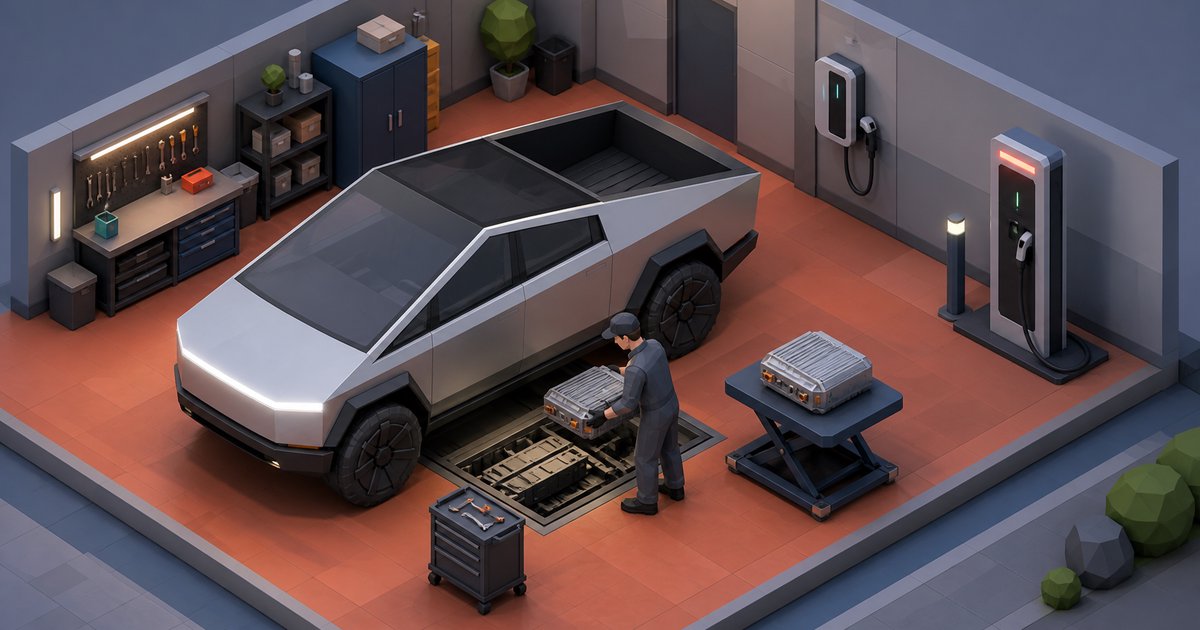
Tesla has done something it rarely does in public: conceded that a component on a shipping vehicle is not good enough, and put money behind the admission. The company has acknowledged that the Power Conversion System in pre-2026 Cybertrucks does not meet its reliability standards, extended the warranty covering the part, and committed to reimbursing owners who have already paid to replace one.
What the PCS does, and how it fails
The Power Conversion System bundles several power-electronics jobs into a single unit. Its main task is converting AC electricity from a Wall Connector or any Level 2 charger into DC for the high-voltage battery, and it also underpins the Cybertruck's 48-volt low-voltage architecture.
When it dies, the failure is specific rather than total:
- Home and Level 2 AC charging stop working.
- The truck's power outlets stop delivering power.
- Supercharging keeps working, because DC fast charging bypasses the PCS entirely.
That last point is why the fault has been survivable for most affected owners, and it is what makes Tesla's software mitigation possible at all.
The new warranty terms
| Model year | PCS coverage |
|---|---|
| 2024-2025 Cybertruck | 8 years / 150,000 miles |
| 2026 Cybertruck | 7 years / 70,000 miles (standard) |
| Basic Vehicle Limited Warranty (all years) | 4 years / 50,000 miles |
Lifting the 2024-2025 trucks to eight years and 150,000 miles puts the PCS on the same footing as the high-voltage battery, which is the informative part: Tesla is treating this as a powertrain-grade defect rather than a wear item. Newer trucks ship with a redesigned unit — Tesla has pointed to "Revision G", with earlier vehicles carrying revisions up to F that need replacing.
Three other measures came with the warranty change. Owners who paid out of pocket for a PCS replacement will be reimbursed, with Tesla saying the payments start in the coming weeks. A software update lets a truck with a dead PCS carry on Supercharging. And Tesla is covering Supercharging costs until the repair is completed. Official communication to owners went out between 29 and 31 July 2026.
The backdrop Tesla is responding to
The announcement did not arrive in a vacuum. Owners have been reporting repeat failures, several describing second and third PCS replacements after an initial repair, and Tesla service centres have told customers they are handling a high volume of high-voltage battery work, with some trucks waiting weeks for a pack. Before the policy change, some owners saw repair invoices cut to around $1,000 as one-off goodwill rather than as a warranty claim.
Why European readers should care anyway
The Cybertruck is not sold in Europe and there is no confirmed plan to homologate it here, so no European owner is filing one of these claims. The relevance is precedent. Tesla has been criticised for handling defects case by case through discretionary discounts, and this is the opposite: a published warranty extension, a reimbursement programme, and a written admission that a part fell below standard.
It matters technically, too. The 48-volt architecture the PCS supports is the one Tesla has been moving toward across its range, and a reliability problem in the first vehicle built around it is worth watching for anyone whose next Tesla inherits the design. European buyers keep a separate backstop either way — EU rules require a seller to remedy goods that do not conform for at least two years — but a manufacturer warranty extension of this length reaches considerably further than that floor.