
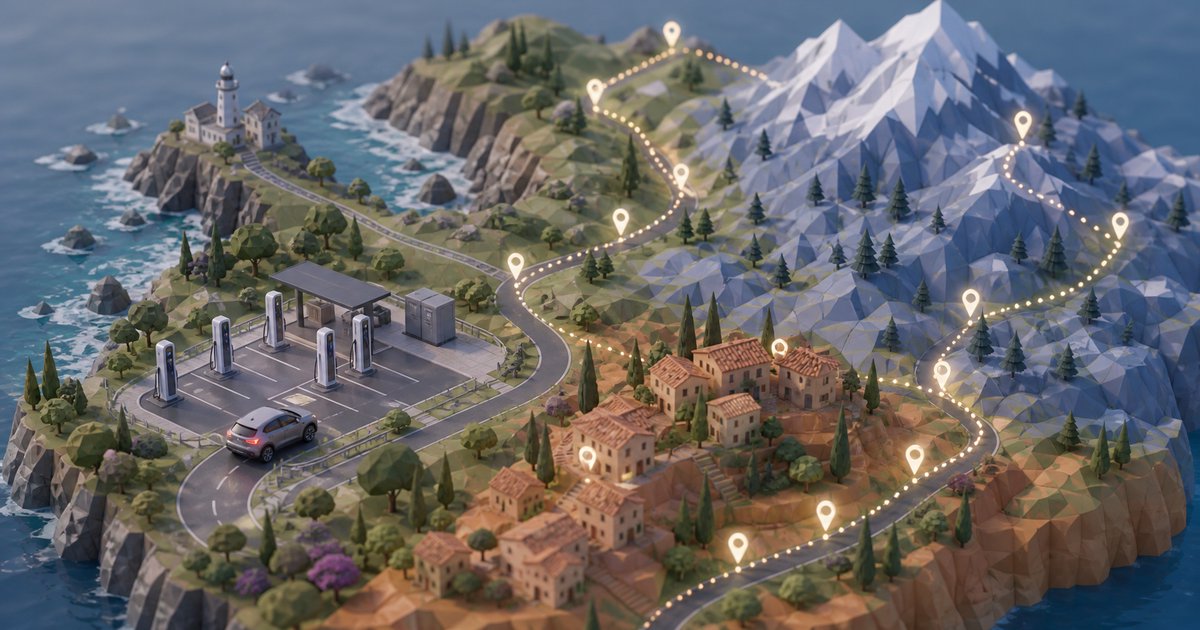
Tesla has named the winners of its latest Supercharger Voting round: 36 locations that owners themselves nominated and then chose. Sixteen are in the United States and three in Canada. The remaining seventeen are spread across fifteen other countries and regions, and nine of those sit in Europe.
Where Europe's nine are
| Country | Location |
|---|---|
| Croatia | Šibenik |
| Hungary | Hatvan |
| Italy | Lamezia Terme |
| Poland | Jordanowo |
| Portugal | Loures |
| Serbia | Paši Poljana |
| Switzerland | Obstalden |
| United Kingdom | Cotswolds |
| United Kingdom | Ullapool |
Outside Europe the round also picked sites in Türkiye, Israel, Australia, Japan, Malaysia, South Korea, Taiwan and Colombia.
Read as a list of place names it looks arbitrary. Read as a map it is not. Ullapool is on the north-west Scottish coast, near the start of the North Coast 500. Šibenik is on the Dalmatian coast, Lamezia Terme is in Calabria, Loures is on the northern edge of Lisbon, Obstalden sits above Walensee in the Swiss Alps. These are holiday corridors and rural gaps — the places where the network thins out precisely when the most people are driving through it. Jordanowo, in western Poland, sits near the A2 corridor that carries German traffic east, a route that has been filling in as Poland's Superchargers open to other brands.
How the voting works
Owners get five votes per three-month cycle, with a maximum of one vote per proposed location, and can also submit sites for future rounds. Voting has already reopened for the next batch; Drive Tesla puts the new round at 84 candidate locations. The previous round returned 37 winners, so the programme is running at roughly three dozen sites a quarter.
The one-vote-per-location cap is what keeps the result from being a popularity contest between two big cities. Spreading five votes across five different proposals rewards breadth, which is part of why a village in Wester Ross can beat a metro area.
What a win actually buys
Not a date. Tesla says construction timelines will vary and that exact addresses have not been announced, which means a winning location is a commitment to the general area and nothing more precise than that. Permitting, grid connections and land deals still decide when — and in Europe those are the slow parts. A site can be voted in this quarter and open two years later, or be quietly reshaped into a different town nearby.
That is worth stating plainly, because the programme's value is easy to overstate. Owners are not allocating capital here. They are giving Tesla a demand signal for places its own site-selection data would rank low: a coastal town of 30,000 with heavy summer traffic looks poor on annual throughput and excellent on the weekend in August when your car is at 12%.
Why this matters more in Europe than in North America
European Tesla drivers cross borders on ordinary journeys, so gaps are felt as route problems rather than local ones. The network here has been getting denser and faster — Norway has Europe's first 500 kW V4 site — but density has followed motorway spines, not coastlines. Six of Europe's nine winners are away from a main corridor.
If you want a say in the next round, the ballot is open now, and five votes spent on five thin spots count for more than five spent on one.