
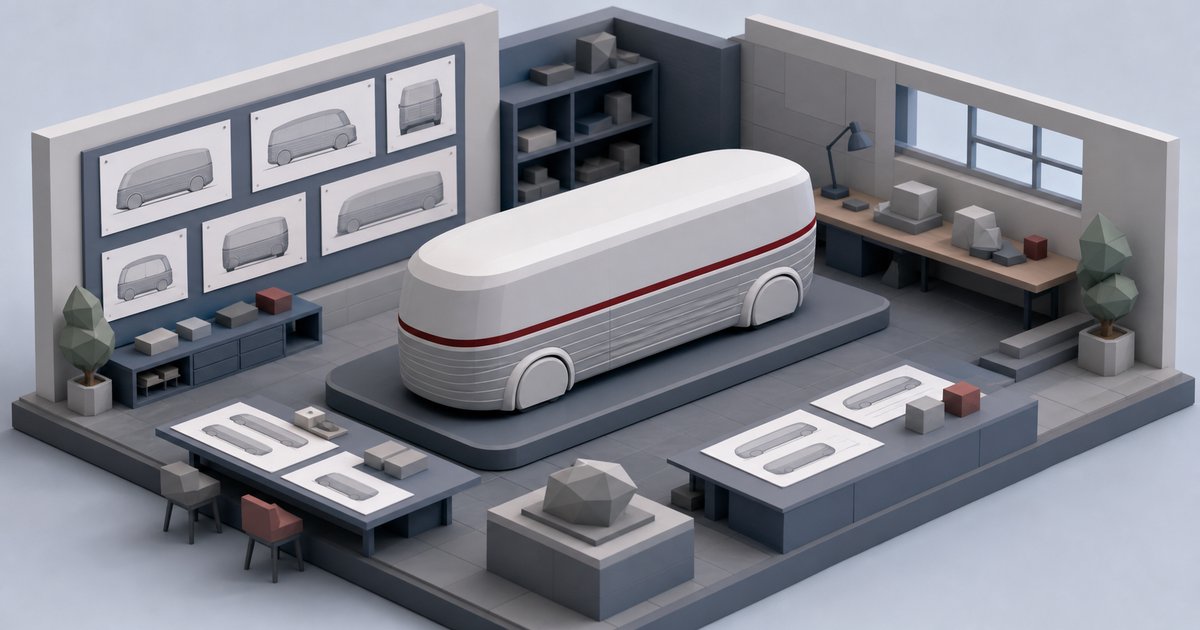
The US Patent and Trademark Office granted Tesla design patent D1138869 S on 4 August 2026, covering the exterior body of the Robovan. The application was filed in October 2024, around the time Tesla first showed the vehicle publicly, and credits chief designer Franz von Holzhausen along with Julien Bilodeau, Ian Kettle and Joseph Robinson.
Twenty-two months from filing to grant is unremarkable. What the grant means is where people tend to go wrong.
What a design patent actually covers
A design patent protects appearance. Not the drivetrain, not the autonomy stack, not the seat count — the shape. Tesla now has enforceable rights over the Robovan's silhouette: rounded corners, sweeping horizontal accent lines, fully enclosed wheel wells, and a "faceless" front with no grille, no hood and no mirrors.
It is worth being blunt about the limits. A granted design patent is not a production commitment, not a homologation filing, and not a timeline. Companies patent designs they never build, and they do it precisely because the design is cheap to protect and expensive to lose. Anyone reading this grant as evidence that a Robovan is close to a factory is reading more into it than the document contains.
What it does establish is intent. You do not spend two years prosecuting a design application for a concept you have written off.
What the vehicle is meant to be
As shown, the Robovan carries up to 20 passengers or converts to commercial cargo duty. It has no windshield and no conventional driver controls, which makes it less a van than a small tram — a rolling lounge with no notion of a driver's seat.
Tesla's leadership has floated other configurations, including autonomous recreational vehicles and school buses. Those remain remarks rather than programmes.
Development has clearly slowed. By most accounts the Robovan has taken a back seat while Tesla concentrates on getting the Cybercab to market, and the Cybercab is where the visible engineering effort has gone — including its Starlink V5 integration. One two-seat driverless vehicle at a time is a defensible order of operations.
The European problem nobody has solved
Here is where a European reader should be sceptical, and it has nothing to do with Tesla.
A vehicle with no windshield, no mirrors and no steering wheel has no straightforward route to EU type approval. The regulatory framework for vehicles built without driver controls is unsettled, and the current evidence is not encouraging: Tesla cannot yet get supervised FSD approved across the bloc, with France declining to back an EU-wide approval and Germany's KBA still reviewing. Those are cars with steering wheels and a human legally in charge.
A 20-seat passenger vehicle with neither would be a substantially harder case, and it would likely arrive through public-transport rules rather than passenger-car type approval. That is a different regulator, a different process and a different timescale.
So: Tesla owns the look of the Robovan. That is a real, checkable fact with a patent number attached. Everything past it — production, market, date, Europe — remains exactly as unspecified as it was on 3 August.
Update: 2026-08-08
On 6 August 2026, Elon Musk shared a Terafab promotional video on X that gave the Robovan its first visual outing since the October 2024 unveiling. It is a concept render credited to SpaceX rather than factory footage: the vehicle travels along an elevated roadway cutting through the facility, sharing the frame with a Tesla Semi and a Cybercab. Musk wrote that “Terafab Texas will be the largest and most valuable building on Earth by far.” Nothing about the programme's status has changed — there is still no production timeline, and the Robovan has yet to appear in any factory footage. Optimus, by contrast, has moved further, with production conversion under way at Fremont and a larger facility being built at Giga Texas. Source: Tesla's mysterious Robovan makes a sneak peek with Optimus in Terafab video.