
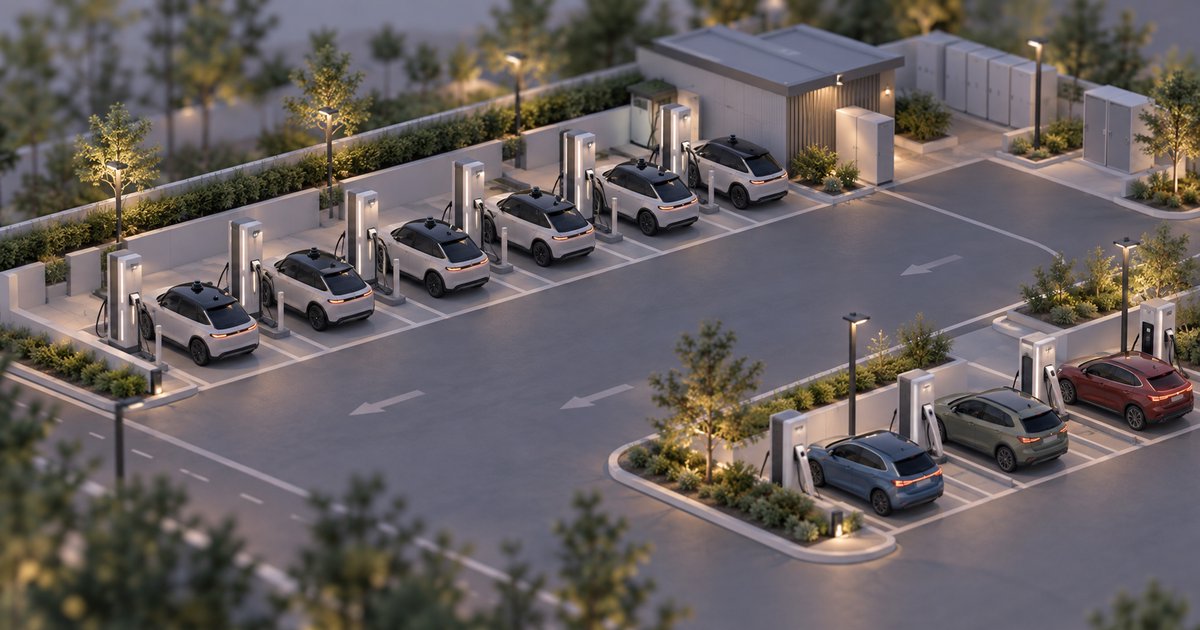
Tesla's head of North American charging has confirmed on the record what permit filings have been hinting at since January: the company is building Supercharger sites that only its robotaxis will be allowed to use.
Max de Zegher set out the logic in a post on 3 September 2026, the day the Cybercab entered paying service in Austin. Dedicated robotaxi sites, he wrote, are chosen for "back-to-back sessions, low-cost real estate close to demand, low capex" — and the reason is arithmetic rather than engineering: "every penny matters for Robotaxi scale, including charging."
The detail that matters to an owner
The more useful disclosure is about the present, not the plan. De Zegher said the driverless fleet is "still plugged in manually for now", and that it uses existing public Supercharger stations — "especially at night when utilization is low."
So Tesla's robotaxi fleet is currently charging on the same network its customers pay to use, staffed by human operators who walk over and insert the connector. Tesla is routing that fleet with what de Zegher called "the same Trip Planner fundamentals Tesla has refined for more than a decade" — the routing engine in every Tesla, pointed at a fleet instead of a driver.
That is why the dedicated sites are being built. A fleet doing back-to-back sessions on public stalls is both a cost problem for Tesla and a queueing problem for everyone else at the site.
What has actually been filed
None of these sites is announced. What exists is a paper trail, found in municipal permit records:
| Site | Stalls | Public access | Filed |
|---|---|---|---|
| Chandler, Arizona | 56 V4 | No — private | 17 April 2026 |
| Mesa, Arizona | Not disclosed | Not disclosed | April 2026 |
| San Francisco, Sansome St garage | 48 V4 | 18 public, 30 fleet-only | 20 January 2026 |
| Austin, 405 E. St. Elmo Rd | 48 V4 (phase 1) | Depot | August 2026 |
The Austin site is the one TeslAnt has already covered in detail, and it is the outlier: its second phase asks for equipment to support 80 wireless charging bays, which is the only version of this that removes the human with the cable. De Zegher did not mention wireless charging, phases or timelines in his post — that detail belongs to the filing, not to him, and the filing itself carries a possible drafting error about cabinet types.
Why a European reader should care
There are no European sites, no European filings, and no European timeline, so nothing changes at your local Supercharger this month. Two things are still worth registering.
The first is what it says about the operating model. If robotaxi economics need private depots on cheap industrial land rather than the public network, then Tesla's eventual European robotaxi build-out is a property and grid-connection exercise, not a software rollout — and property takes far longer than the FSD approval Tesla is still waiting on.
The second is the interim arrangement. Tesla's answer to fleet charging, before the dedicated sites exist, is to send driverless cars to public stalls overnight. Off-peak is genuinely the right time to do it. But it is the first time Tesla's own commercial fleet has been documented competing for capacity that owners pay for, and "especially at night when utilization is low" is a claim about today's utilisation, not a commitment about tomorrow's.