
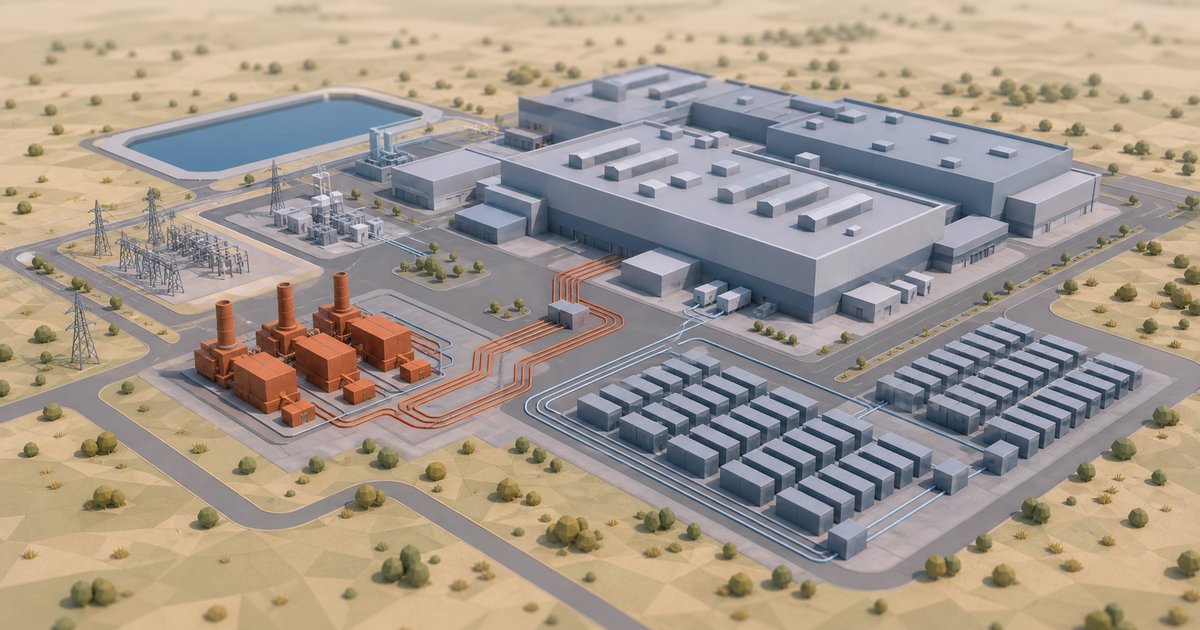
Terafab, the chip megafactory Tesla co-owns with SpaceX, will be powered by newly built natural gas plants and what SpaceX calls very large battery arrays. It will not be powered by Tesla solar. That is notable because Tesla is a partner in the project and sells solar panels, Powerwalls and grid-scale Megapacks built for exactly this kind of load.
The project
Terafab is a $16.8 billion first phase — down from the $25 billion figure floated in March — on a site in Grimes County, Texas, about an hour north-west of Houston. The site is a former coal-fired power plant, which means grid interconnection and cooling water are already there.
Its purpose is compute: more than a terawatt of compute per year for SpaceX and xAI data centres, plus future chips for Tesla's Optimus humanoid robot and the Cybercab. TeslAnt covered the site confirmation in Tesla and SpaceX confirming Grimes County.
Why not Tesla solar
Neither company has given an official reason, so what follows is inference rather than confirmed motive.
The practical case for gas is speed and firmness. A fab of this size needs continuous multi-hundred-megawatt power with no tolerance for interruption; solar plus storage at that scale and that reliability is a larger and slower build than turbines, especially on a schedule set by AI compute demand.
Electrek points to a second factor: the ownership asymmetry. Musk holds roughly 20% of Tesla, but he owns APR Energy outright — the gas turbine company he acquired in May for more than $1 billion, revealed through Federal Trade Commission filings rather than announced. APR operates a fleet of trailer-mounted gas and diesel turbines totalling more than a gigawatt of capacity, which is precisely the equipment a fast fab build needs. SpaceX has separately said it intends to buy $2.8 billion of gas turbines over the next three years.
So a decision that routes power spending away from a company Musk part-owns and toward one he owns entirely is at minimum worth noting. It is not evidence of intent, and the engineering argument for turbines stands on its own.
The part that carries risk
Turbines at this scale need air permits. xAI has already been sued over its use of unpermitted natural gas turbines in one of the most polluted areas in the United States, and that litigation is the template for what Terafab's power plan could attract. No permit or emissions detail for Terafab itself has been published, and no construction or production timeline has been given.
Why it matters beyond Texas, and in Europe
Tesla Energy's pitch to industrial and data centre customers is that solar plus Megapack can carry serious load. The most visible new industrial project Tesla is attached to has chosen otherwise. Whether or not that is the right engineering call, it is a reference case that Tesla's energy sales team now has to work around, and competitors will cite it.
For European readers there is a narrower interest too. Terafab is where chips for Optimus and the Cybercab are meant to come from, and both products' timelines depend on it being built. The power plan is one of the first hard commitments that suggests the schedule is being optimised for speed over anything else.