
Tesla is recalling 19 Model Ys in the United States because a fastener holding the front suspension to the subframe may never have been tightened properly — and the reason is that the check meant to confirm the work was inadvertently switched off.
What happened
The front suspension lateral link attaches to the subframe with two fasteners. On cars built between 26 July and 4 August 2026, at least one of those fasteners may not have been torqued to specification. An under-torqued fastener can loosen over time and eventually allow the link to separate from the subframe, which shifts wheel alignment and, in Tesla's own filing, increases the risk of a collision.
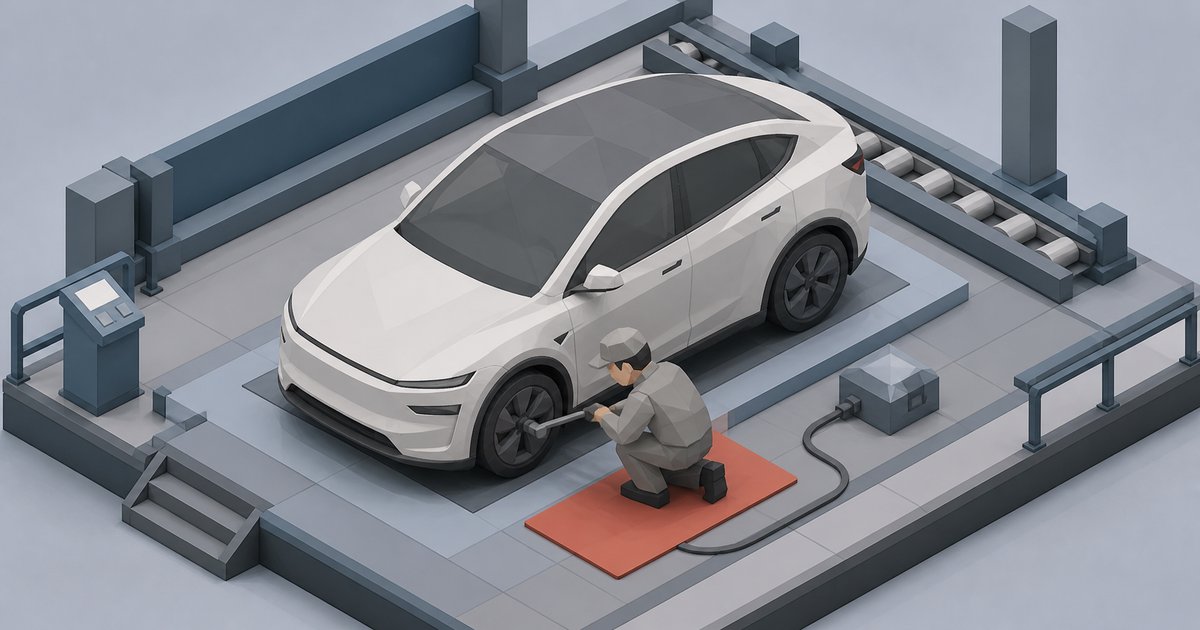
The root cause is unusually specific. A programmable logic controller responsible for position control of the recovery torque tool was inadvertently deactivated on 26 July 2026. That controller is the process control that confirms the correct fastener was torqued to the correct value. With it off, nothing was verifying the joint.
The escape was caught by a person, not the process. On 7 August, Tesla staff flagged a car at Fremont over a handling and noise concern, and an end-of-line inspection found a fastener missing at the link-to-subframe attachment.
Scope and remedy
| Vehicles recalled | 19 (2026 Model Y) |
| Build window | 26 July – 4 August 2026 |
| Estimated actually defective | about 75% |
| Crashes or injuries | none reported |
| Owner letters | by 30 October 2026 |
Service centres will inspect the fasteners, torque them to specification where they are loose, check wheel alignment and replace any damaged components, at no cost to owners.
This is not the investigation you may be thinking of
Tesla front suspension is already the subject of a far larger federal matter, and the two should not be run together.
NHTSA has an open investigation covering roughly 1.2 million Model 3 and Model Y vehicles, opened after more than 150 complaints of front suspension components failing or separating in service. That is about parts breaking on cars across several model years. This recall is a manufacturing escape on 19 cars over one build window in late July and early August, traced to a single deactivated controller. Same corner of the car, different failure mode, different scale by five orders of magnitude.
It is also distinct from the rear suspension sagging Model Y L owners in China have reported — a different axle, a different variant and a different market.
Does this reach Europe?
No. The affected cars were built at Fremont, which supplies North America. European Model Ys are built at Giga Berlin, and the recall is filed with NHTSA against US production only.
The mechanism is worth remembering, though. A fault like this travels only if the same tooling condition occurred on the same line, and Berlin runs its own. Where a Tesla recall does need to reach Europe, it runs through the Dutch RDW as type-approval authority, which set out publicly last month what would actually trigger one.
Nineteen cars is a rounding error against Tesla's output, and no one was hurt. The uncomfortable part is not the number. It is that the only thing between an untorqued suspension bolt and a customer was a single controller — and it took a noise complaint, twelve days later, to notice it had stopped.