
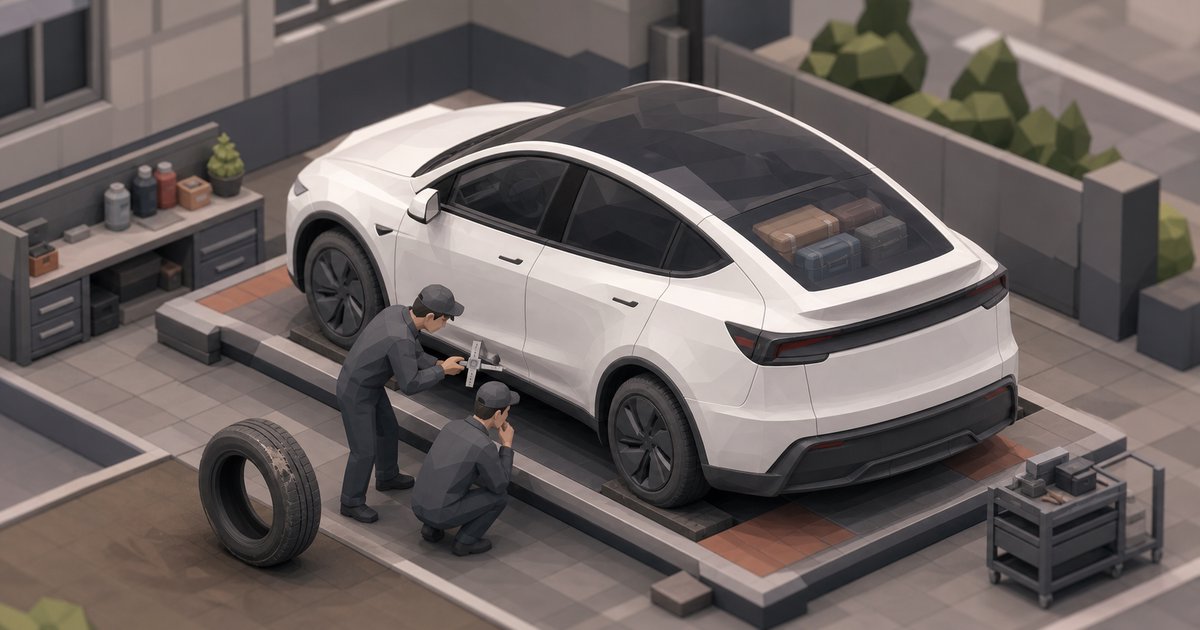
Owners of the Model Y L in China are reporting that the car's rear suspension sags — in some cases badly enough to ruin a set of tyres — and they are comparing notes on Sina in numbers large enough that Chinese outlets are calling it a wave. Tesla China has not commented publicly.
The Model Y L is the six-seat, long-wheelbase Model Y launched in China in August 2025. It is not sold in Europe, so nothing here directly affects a European owner's car. It matters because of what the reports describe: a load-related failure of the rear springs on Tesla's newest high-volume China variant, roughly a year into deliveries.
What owners describe
The symptom is a rear wheel arch that drops noticeably, typically after long-distance driving or when the car is loaded to its six-seat capacity. Because the drop changes rear wheel alignment, the reported consequence is abnormal wear on the inner shoulder of the rear tyres — several owners say theirs reached the wear limit.
Two cases circulating give a sense of the range: one car showed the fault at about 9,000 km after a trip to Tibet, another at roughly 30,000 km in Shanghai. Owners argue that spread points to a batch problem rather than isolated abuse. That is their characterisation, not a finding.
The 764 mm number
The specific figure making the rounds is Tesla's own service threshold. After-sales guidance reportedly puts a normal rear wheel arch height at 784 ± 20 mm, and authorises a spring replacement only when the measurement falls below 764 mm.
That has produced a folk diagnostic. Owners measure the gap above the rear tyre in fingers: four fingers is normal, three is a warning, two and a half or fewer means the spring has gone. It is crude, but it exists because the official threshold is a hard cut-off — a car that sags visibly but measures 765 mm gets nothing.
Who pays
This is the part owners object to most. Tesla replaces the springs free under warranty. The tyres the sagging destroyed are the owner's problem.
One owner reported the suspension collapsing again ten days after a replacement, and the service centre declining to fit a second set. Tesla China's customer service has told affected owners to book a service-centre inspection; there has been no acknowledgement of a systemic fault and no recall.
How much of this is established
Enough caution is warranted here to be explicit about it. The complaint count has not been quantified by anyone — "surge" and "wave" are the descriptions, not a number. Tesla has made no statement. No regulator has opened a file. The arch-height specification is reported from service documentation rather than published by Tesla. What is established is that multiple owners are describing the same failure mode with the same measurements, and that Tesla is replacing springs under warranty, which is not something a manufacturer does for a non-issue.
Separately, and not to be conflated with this: US regulators opened a probe in July into front suspension failures on about 1.2 million Model 3 and Model Y cars. Different axle, different models, different market — but it is the second suspension matter Tesla is fielding this summer.
For anyone tracking Tesla build quality on newer variants, the Model Y L is the one to watch. For European owners, there is nothing to do — the car is not sold here, and no European model has been implicated.
Update: 2026-09-16
Tesla's own documents do not agree on how tall this car is. Reporting on 15 September 2026 compared the North American owner's manual, at software version 2026.26, with Tesla China's dimensions page: overall height 1,664 mm against 1,668 mm, laden ground clearance 118 mm against 122 mm, unladen 166 mm against 169 mm, overall length 4,969 mm against 4,976 mm and front overhang 889 mm against 896 mm. The North American figures are the lower and shorter set throughout. What that means is unresolved — it may be a genuine market-specific difference rather than a revision, and no source has established that any single figure was changed after publication. Tesla has not commented on the discrepancy, has issued no recall and has not written to owners. The same reporting adds that most affected cars came from the first batch delivered in September and October 2025 and have been repaired under warranty, with the fault recurring on some. Sources: Tesla quietly changes Model Y L dimensions following rear suspension complaints and Tesla Model Y L Manuals Differ on Height After China Owners Report Rear Sag.