
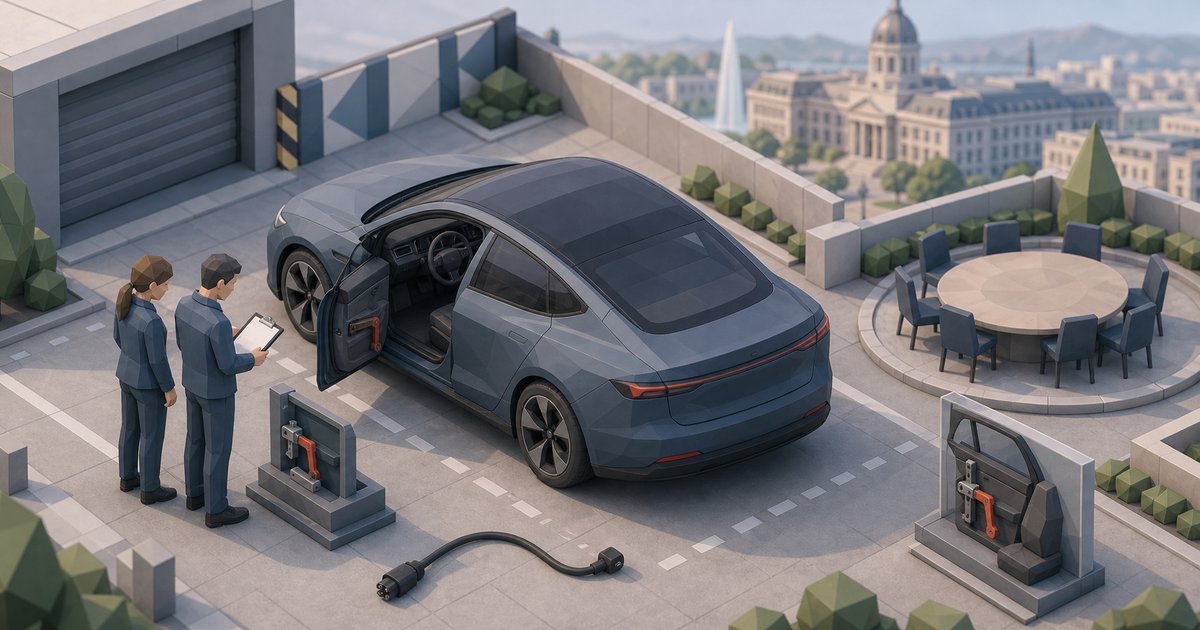
China's market regulator ordered the largest recall in the country's history last week, and Tesla's share of it was 2,975,910 cars — the biggest single block in a roughly 4.3-million-vehicle door-release campaign spread across eleven carmakers. The remedy is warning labels marking the interior emergency release, plus an over-the-air update that lowers the windows after a crash.
European owners drive the same cars with the same handles. The obvious question is whether the same recall follows here. As of this week it has not, and the Dutch regulator has now explained the terms on which it might.
"No recall in Europe" — for now
On Wednesday 26 August 2026, the RDW told Reuters in written answers that "there is currently no recall in Europe for the affected electric vehicles". It declined to say whether it is considering or investigating one, only that none exists today. It has not ruled one out either.
The RDW matters more than the size of the Dutch market suggests. It is one of the national type-approval authorities that can grant EU-wide vehicle approval, so its reading of the rules travels well beyond the Netherlands.
The standard it set out is the consequential part
Rather than assess Tesla directly, the RDW restated the requirement it believes any car must satisfy. Vehicles, it said, "must be capable of being opened under all circumstances — including when electrical systems fail — in an intuitive way, without the use of tools, from both inside and outside."
Two words in that sentence carry the weight.
Intuitive is the same objection China's SAMR made: the mechanical release exists, but a person under pressure cannot find it. Outside goes further than China's action did. China's recall addressed occupants trying to get out; the Dutch formulation also covers rescuers trying to get in through a flush handle with no 12-volt power behind it.
The RDW gave its reason plainly: "in recent years, there have been incidents in which occupants or emergency responders had difficulty opening vehicles following an accident or fire."
Germany is examining something
Germany's federal transport ministry says the KBA's examination is "still ongoing" — though as electrive notes, this is not obviously the KBA's remit, which leaves it unclear what exactly is ongoing. That is a familiar shape: the KBA is already the body weighing Tesla's FSD approval, and it says very little while it works.
Where this actually gets decided
The more consequential venue is not a national regulator at all. Door-opening requirements are currently under discussion in the UN vehicle-regulation talks in Geneva and at Euro NCAP. Geneva writes the type-approval rules Europe adopts; Euro NCAP sets the star ratings manufacturers chase commercially. A change at either reaches every car sold here, not one brand.
That echoes the American path, where NHTSA denied a Tesla-specific door-release defect petition and opened industry-wide rulemaking instead. Three jurisdictions have now examined the same problem, and two of them reached for a general standard rather than a single-brand recall.
What it means for European owners
Nothing changes on your car this week. There is no European recall, no labels being posted, and no announced equivalent of China's window-lowering update.
The gap China's regulator identified is one you can close yourself in five minutes. Sit in a parked Model 3 or Model Y, find the mechanical release in each door, and show every passenger who rides with you regularly where it is. Whatever Geneva decides, that is the part that has to work at three in the morning with the electrics gone.