
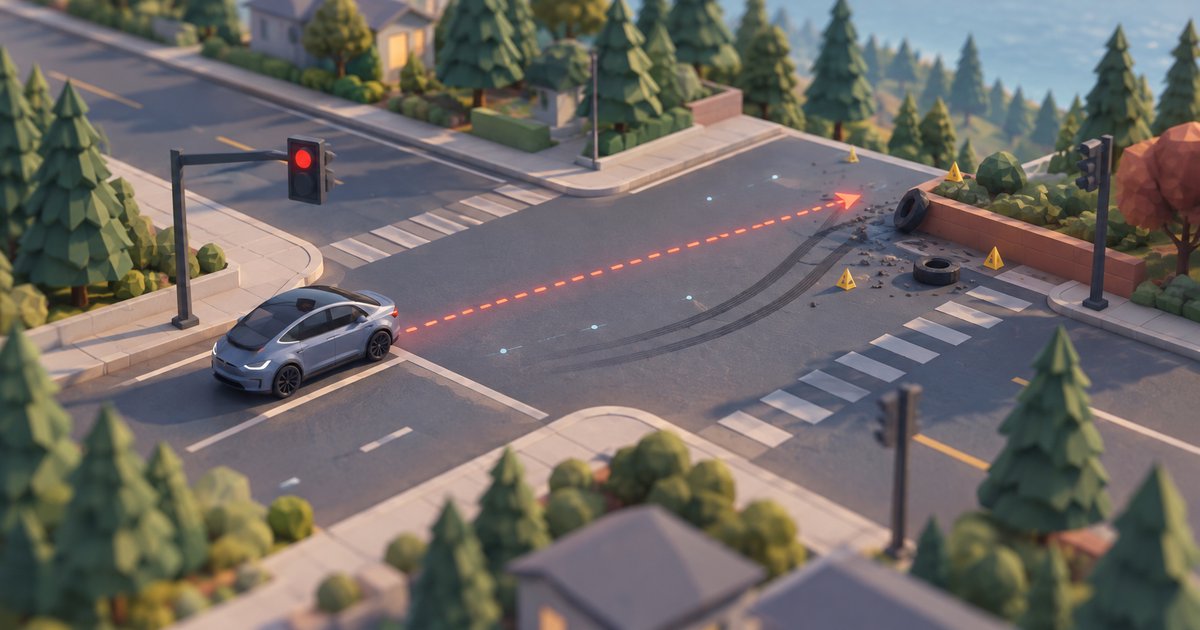
A family from Kirkland, Washington is suing Tesla over an incident that they say began with the car doing nothing at all. According to the complaint, Linh Nguyen was stopped at a red light on 29 June 2023 with his then-14-year-old daughter beside him when his 2023 Model X accelerated into the intersection without him touching the pedal.
The case was filed in King County Superior Court. Tesla removed it to federal court on 23 September 2026, which is what brought a three-year-old crash into the news this week.
What the complaint alleges
The junction is 144th Street Northeast and 124th Avenue Northeast, east of Seattle. The filing says the stationary car accelerated without warning, crossed the intersection at speed and hit a curb hard enough to burst its own tyres, with Nguyen unable to brake or steer out of it.
| Element | What the filing says |
|---|---|
| Vehicle | 2023 Tesla Model X |
| Date and place | 29 June 2023, Kirkland, Washington |
| Alleged behaviour | Accelerated from a standstill through a red light, no driver input |
| Driver injuries | Neck, back, shoulder, knees, left side; dizziness and confusion |
| Passenger | Daughter, then 14, injured and severely distressed |
| System blamed | Autopilot |
The theory names Autopilot specifically: that it failed to keep the vehicle stopped, accelerated without input, and prevented Nguyen from regaining control. The complaint also alleges Tesla knew of safety risks and overstated the technology's capabilities — Nguyen says he paid roughly 15,000 dollars extra for it. The family seeks damages for injuries, emotional distress, medical treatment, loss of family companionship, diminished vehicle value and higher insurance premiums. Tesla has not commented.
The claim sits between two categories
Most Autopilot litigation concerns a car that failed to stop for something. This concerns a car that allegedly failed to stay stopped, and that is a different engineering claim.
Sudden acceleration from a standstill is the classic pedal-misapplication complaint, made about every make of car for forty years. Blaming Autopilot is a separate assertion — that a driver-assistance system was active at a red light and commanded torque. The filing does not resolve which it means, and nothing published establishes that Autopilot was engaged. That decides what evidence the case turns on: Tesla logs pedal position, torque commands and braking inputs continuously, and that telemetry has settled previous disputes of this kind.
A regulator looked at this in March
On 30 March 2026 the Federal Register carried NHTSA's denial of defect petition DP23-001. Filed by investigator Costas Lakafossis in March 2023, it sought a recall of roughly 2.26 million Teslas built since 2013, arguing that one-pedal driving makes drivers likelier to hit the accelerator when reaching for the brake.
NHTSA found no safety-related defect, no design factor increasing the likelihood of pedal misapplication, and vehicle data showing the cars functioning as designed. A denial does not bind a civil court, but it means this case arrives six months after the agency with subpoena power over Tesla's data examined the same class of allegation across 2.26 million vehicles and declined to act. Distinguishing the case from that finding is presumably what the Autopilot framing is for.
What Europe should take from it
Directly, little: a Washington incident, a US federal court, and a pre-refresh example of a model Tesla stopped building in March 2026. The reason to watch is December. The revised EU Product Liability Directive brings software and driver assistance inside the product-liability regime and, as TeslAnt covered when that deadline came into view, shifts part of the evidential burden to the manufacturer where a claimant cannot reasonably obtain the technical data. In the United States these cases are fought over access to Tesla's own telemetry, and Tesla has settled at least one rather than let a jury weigh it — the fire-truck death that ended before Musk's Autopilot claims were tested in open court. A European claimant making this allegation after December would not have to reverse-engineer what the car did; they could ask the court to make Tesla produce it.
No court has tested the allegation, Tesla has not answered it, and the federal regulator has already looked at the underlying phenomenon fleet-wide and found nothing to recall.