
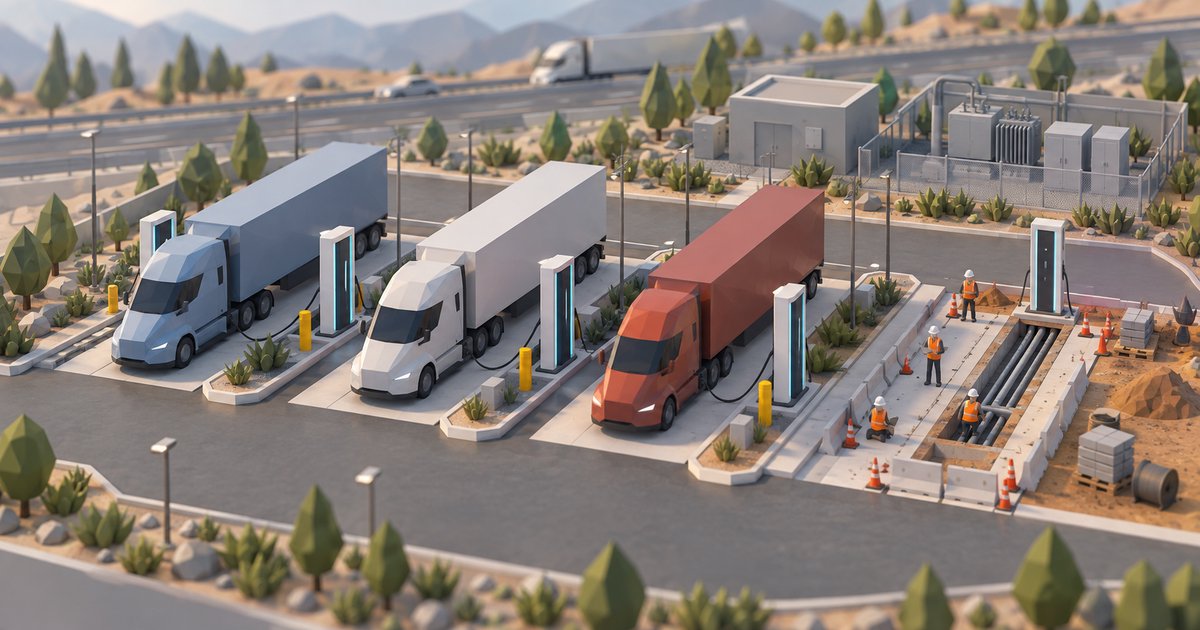
Tesla's truck-charging network is being built by somebody else, on somebody else's land. Forum Mobility announced on 17 September 2026 that it is breaking ground on four new heavy-duty charging depots in California, adding about 30 MW — and that Tesla will operate public Megacharging sites at three of them.
Where they go
| Depot | Location | Tesla public Megacharging |
|---|---|---|
| FM Francis | Ontario, CA | yes |
| FM Adeline | Oakland, CA | yes |
| FM Coliseum | Oakland, CA | yes |
| FM Santa Fe | Rancho Dominguez, CA | contracted fleet offtake, public access retained |
The four take Forum Mobility past 40 MW online or under construction. Each site pairs Megawatt Charging System ports with CCS, and uses pull-through lanes so a driver does not have to unhitch a trailer to charge. Forum's existing FM Harbor depot at the Port of Long Beach has been running since December 2024 with 44 CCS ports and 9 MW, and has had two Tesla MCS Megachargers added to it.
Across the network, Forum says it has contracted fleet commitments from 25 carrier customers covering more than 330 Tesla Semis. Forum Mobility's chief executive put the reason plainly: "The highly favorable total cost of ownership for battery-electric class 8 trucks has driven rapid motor carrier adoption."
Why a partner site is the interesting part
Tesla built the Supercharger network by owning it — the land deals, the hardware, the pricing, the queue. This is a different shape. Forum Mobility develops and owns the depot; Tesla operates the Megacharging that sits on it and opens it to any Semi driver, not only to the fleet that signed the offtake contract.
That solves the problem that has held Semi charging back. A drayage operator will not buy electric trucks without charging, and nobody builds charging for trucks that have not been bought. Letting a specialist infrastructure developer carry the site while Tesla carries the charger splits that risk in two, and it scales faster than waiting for Tesla to buy industrial land near every port.
What this says about Europe
Tesla is now running three different models at once, and the Californian one is the newest. In Europe it opened Semi Charging for Business on 14 September, selling Megachargers and 125 kW Basechargers to fleets for their own depots, and two days later its Semi programme lead put a number on a network of Tesla's own: 21 public European sites carrying more than 100 charging points, on MCS 3.2, open to other manufacturers' trucks, with the rollout placed in 2027.
The Forum Mobility depots are neither of those. Tesla is not selling the hardware to the site owner, and it is not building the site itself — it operates public Megacharging on ground a specialist infrastructure developer owns and runs. That is a third arrangement, and it is the one that scales fastest, because it spends Tesla's capital only on chargers while somebody else carries the land, the grid connection and the permitting.
For a European haulier weighing a 2027 order, the useful signal is not the Californian geography but the willingness: Tesla will put public Megachargers on land it does not own. Europe's announced 21 sites do not exist yet, and the European Semi tops out at 800 kW against a 1.2 MW charger. California is where the model gets tested first, with real trucks, against more than 330 Semis already contracted.