
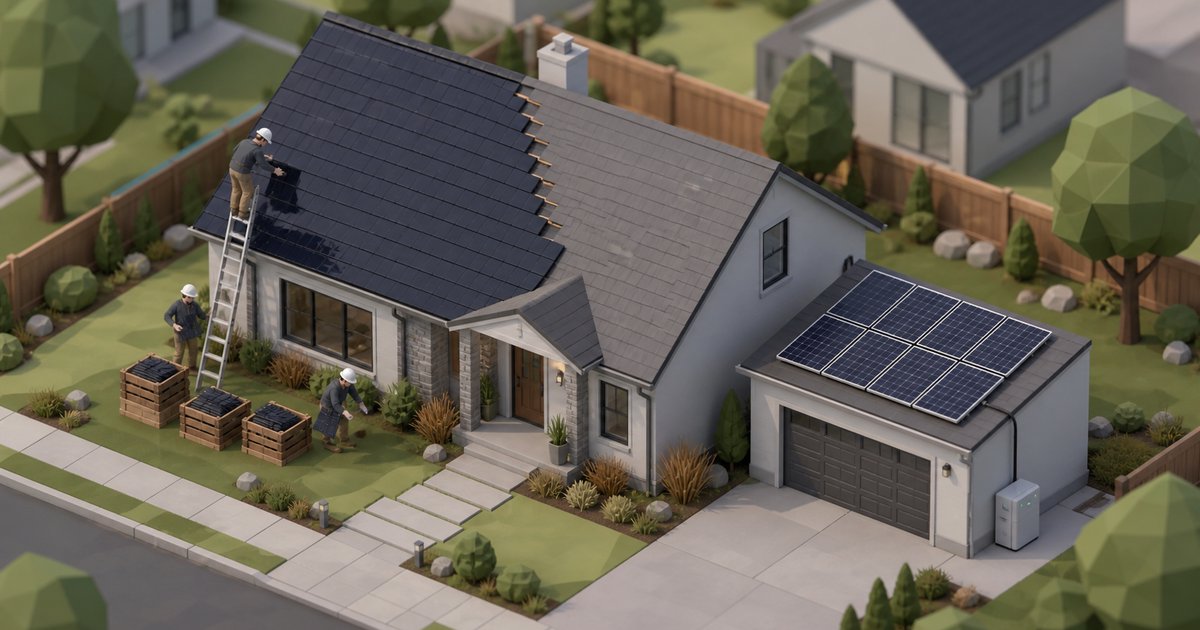
Tesla has stopped selling the Solar Roof. The company has told its certified third-party installers that solar roof tiles are no longer available to order and that it will supply only conventional solar panels going forward, according to two sources close to the programme cited by Electrek. Tesla's own website made the change visible on 20 August 2026, when the Solar Roof pages began redirecting to the solar panel pages.
There has been no press release and no product announcement. The product simply stopped being orderable.
The gap between the promise and the count
The Solar Roof was unveiled in October 2016, weeks before Tesla completed its $2.6 billion acquisition of SolarCity, and it was the centrepiece of the argument for that deal: a roof that generated power and looked better than the alternative. Elon Musk repeatedly said Tesla would build 1,000 Solar Roofs a week by late 2019 or early 2020.
| Metric | Figure |
|---|---|
| Unveiled | October 2016 |
| Promised production rate | 1,000 roofs per week |
| Peak actual installation rate | roughly 21–32 roofs per week |
| Total US installations, about seven years | roughly 3,000 |
| Shortfall against the stated goal | more than 95% |
Roughly 3,000 systems over seven years is what a product looks like when it never reaches manufacturing scale. The company claimed it hit the 1,000-a-week threshold in 2020, but installations never came close to matching that claim.
Why it never worked economically
The original pitch was about $22 per square foot, a number that put the tile within reach of a premium conventional roof. It did not hold. Tesla raised Solar Roof prices sharply in 2021, in some cases after contracts had already been signed — one customer's quote went from roughly $72,000 to about $146,000. Tesla settled a resulting class-action lawsuit for $6 million in 2023.
The underlying problem was that every Solar Roof was a roofing job as well as a solar job. Tiles have to be installed by trained crews across an entire roof surface, at labour costs that scale with area rather than with generating capacity. A panel array bolts onto a roof someone else already built. That difference is why the tile stayed a bespoke product while panels became a commodity.
What Tesla Energy keeps
Solar panels, Powerwall and Megapack all continue. Read against the rest of Tesla's energy activity, the decision looks less like a retreat than a narrowing: the company is still putting capital into cells and storage, including a $10.1 billion solar cell factory filing in Texas and a solar power purchase agreement worth around 1 TWh a year. What it is dropping is the hand-installed consumer roofing product at the front of that chain.
What it means for European owners
Practically, very little changes here. Solar Roof was a North American product and was never offered at scale in Europe, where Tesla Energy's presence rests on Powerwall and on grid-scale Megapack projects. Both are unaffected.
The signal is worth noting, though. Tesla Energy is now a storage-and-panels business without a flagship generation product of its own design, and Powerwall is the part of it a European household actually buys. For anyone who had been holding out for the tile to arrive in an EU market, that wait is now definitively over.
Update: 2026-09-01
On 1 September 2026, Electrek reported what the withdrawal cost the certified contractors who sold and fitted the tiles. Installers including Elevated Roofing & Siding in Ohio, PGT Home Energy Solutions in Arizona, Westfall Roofing in Florida and Saguaro Solar in Tucson said they had sunk hundreds of thousands of dollars into the programme — certification required a multi-week course on the US West Coast and three supervised installations, plus crews able to do roofing and electrical work on the same job, for installs that took two weeks against about two days for rack-mounted panels. Tesla says it will honour existing warranties and supply replacement parts, but contractors question whether parts and trained labour will still exist across a 25-year warranty on a discontinued product. Sources: Tesla killing Solar Roof is leaving installers with six-figure losses, Tesla Solar Roof Exit Leaves Contractors Facing Costs, Service Questions.