
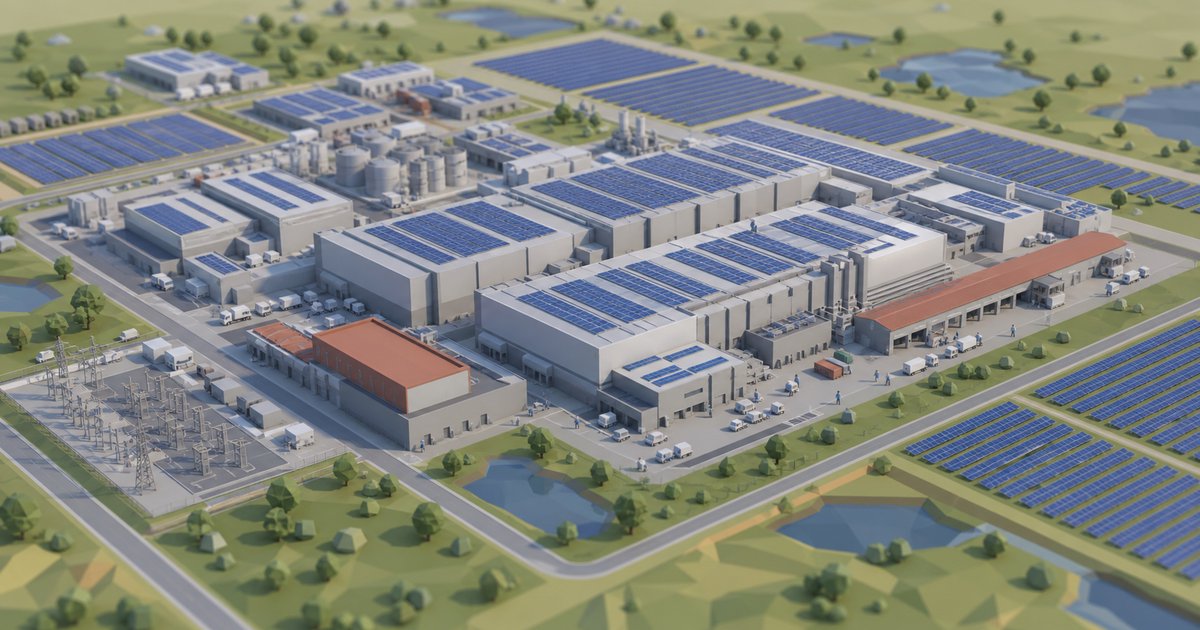
Tesla has filed for Texas tax incentives on a solar factory large enough to change what Tesla Energy is. The filing, made under the state's Jobs, Energy, Technology & Innovation Act, describes a $10.1 billion vertically integrated solar cell manufacturing facility in Fort Bend County, about 40 minutes from Houston, inside the Lamar Consolidated Independent School District's jurisdiction. The project name is "Project Crystal Sun".
What the filing describes
The plant is specified to produce "photovoltaic solar cells and/or assembled solar modules" for utility-scale, commercial and distributed solar installations. The equipment list is the part that establishes the ambition: wafer and ingot manufacturing lines, coating systems, metallization equipment and testing hardware.
That list matters because it describes vertical integration rather than assembly. Buying cells and laminating them into modules is a comparatively light industrial step. Growing ingots and slicing wafers means starting from polysilicon — the capital-heavy end of the supply chain, and the end that is almost entirely concentrated in China today.
| Item | Detail |
|---|---|
| Investment | $10.1 billion |
| Location | Fort Bend County, Texas |
| Construction start | Later in 2026 |
| Construction complete | 2028 |
| Commercial operation | Q1 2029 |
| Permanent jobs claimed | 9,712 |
| Peak construction jobs | 1,147 |
The filing also projects $6.4 billion in direct and indirect state and local taxes and a $107 billion boost to Texas GDP. Those are applicant-supplied figures in a document whose purpose is to win a tax abatement, and the 9,712 permanent-job claim is high for a solar plant of any size — worth treating as a filing claim rather than a forecast.
One number is conspicuously missing: the filing states no gigawatt capacity. Without it there is no way to judge whether $10.1 billion is aggressive or ordinary for the output involved.
Where this fits
Tesla's energy business has been the part of the company growing without argument, and it has been expanding its manufacturing base accordingly — Megapack 3 production started this month at the new 50 GWh Texas Megafactory. Solar cells are the missing upstream piece: Tesla sells solar and storage together, but has never made its own cells at scale.
There is a second reading that has nothing to do with rooftops. Tesla and SpaceX have just confirmed Grimes County, Texas as the site of their Terafab chip plant, and semiconductor fabs consume electricity at industrial scale continuously. A company building both an AI chip fab and a solar cell plant in the same state, in the same window, is plausibly building the generation to feed the fab.
What it means for European buyers
None of this changes what is on sale in Europe. Tesla's European energy business sells Powerwall and Megapack, not panels, and a Texas plant serving American utility-scale demand does not alter that. What it may eventually change is the cost base underneath Tesla Energy — and that is the number Europe would feel.
Update: 2026-10-19
On 22 September 2026, Linton Crystal Technologies sued China's Zhejiang Jingsheng (JSG) for patent infringement in the Eastern District of Texas. The complaint cites market reports that JSG won an order for crystal pullers, the furnaces that grow silicon ingots, and related equipment for a 10 GW solar production line in Texas, with deliveries in 2026. pv magazine links that order to Project Crystal Sun, which would make 10 GW the first capacity figure for the plant. The complaint does not name Tesla, Tesla has not commented, and equipment delivered in 2026 would arrive two years before the plant's scheduled completion, so the link is unconfirmed. Separately, the Lamar CISD board approved the project's tax-value limitation 7–0 in September, covering 2029 to 2038. Of the $10.1 billion, $8.6 billion is earmarked for manufacturing equipment and other personal property.
Update: 2026-10-23
On 22 October 2026, Fort Bend County commissioners approved four incentive agreements for Project Crystal Sun, each by 4–0. Interim County Judge Daniel Wong abstained because his firm has worked with Tesla, Community Impact reports. The package covers a property-tax abatement in the reinvestment zone the county created on 24 August near Needville, a Chapter 381 grant that returns part of the taxes Tesla pays, participation in the foreign-trade-zone programme paired with payments in lieu of taxes, and a "true-up" payment agreement, according to Teslarati. The site is still not chosen. The county's package is meant to beat an undisclosed rival, which a site-selection adviser on the project told Lamar CISD trustees in September is out of state. Tesla hopes to decide before the end of 2026, and the state JETI agreement still awaits Governor Greg Abbott's approval. If Fort Bend is picked, commercial operation would start in the first quarter of 2029.