
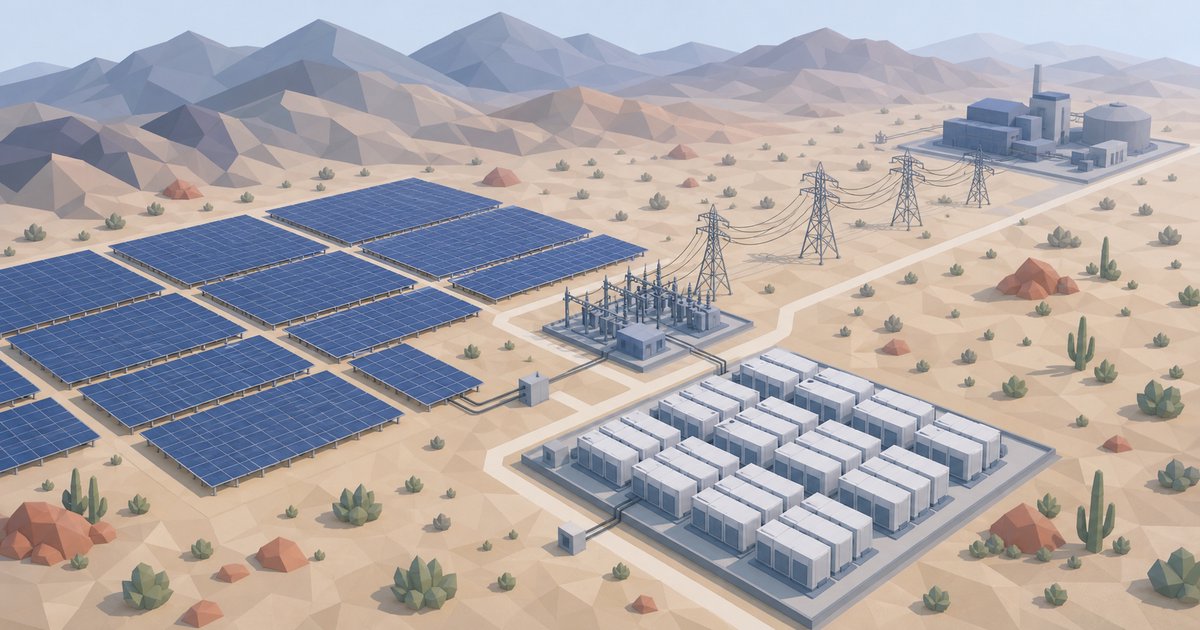
Tesla has signed a long-term power purchase agreement with ContourGlobal covering roughly one terawatt-hour of renewable electricity a year. The deal, signed on 28 July 2026, gives Tesla about 90% of the annual output of Project Sterling, a solar-plus-storage plant in Arizona, bundled with the associated renewable energy certificates.
ContourGlobal describes it as one of the largest corporate solar-plus-storage power purchase agreements ever signed in the United States from a single project. For once that kind of claim is easy to check against the specification.
What Project Sterling is
| Component | Rating |
|---|---|
| Solar PV | 509 MWp / 450 MWac |
| Battery storage | 360 MW / 1.4 GWh |
| Tesla's share of output | ~90%, about 1 TWh a year |
| Construction start | Later in 2026 |
| Commercial operation | Targeted 2028 |
The plant sits on the Western Area Power Administration grid and will hold firm transmission rights into the California Independent System Operator market — which is to say the electricity can actually get somewhere useful, a detail that sinks more renewable projects than panel prices do.
The pairing matters more than the headline megawatts. A 509 MWp solar farm on its own produces a fat midday peak and nothing in the evening. Bolting on 1.4 GWh of storage turns intermittent generation into something closer to a schedulable supply, which is what a manufacturer running three shifts actually needs.
Why Tesla is buying power rather than selling it
There is a neat irony in Tesla — a company that sells grid batteries for a living — signing up as a customer for someone else's solar farm. It is not a contradiction. Tesla's own Megapack 3 production ramp is about supplying hardware to grid operators; this agreement is about procuring electricity for Tesla's own consumption.
And that consumption is climbing on two fronts at once. Manufacturing is the obvious one. The less obvious one is compute: AI training capacity is electricity-hungry in a way that vehicle assembly is not, and it runs continuously rather than on a shift pattern. Locking in a fixed-price terawatt-hour a year against that kind of load is a hedge, not a gesture.
A 2028 start date is worth registering too. Tesla is contracting for power it will not receive for roughly two years, which tells you something about how far ahead the company is projecting its own demand.
The European read
Nothing here changes anything for a Tesla owner in Europe. Project Sterling is an Arizona asset serving American operations, and Tesla does not currently run an equivalent European procurement deal on this scale that it has disclosed.
What it does illustrate is the shape of the constraint. Europe's problem is not usually generation capacity; it is grid connection, transmission and timing — the same three things this deal was engineered around. Romania and Hungary spent this week rationing industrial electricity because a river ran low, and Germany is rewriting its grid rules for charging hubs precisely because connection capacity has become the scarce resource.
Tesla's answer in Arizona was to buy generation and storage together, with transmission rights attached. That is a template European industrial buyers will recognise, whether or not Tesla ever repeats it here.