
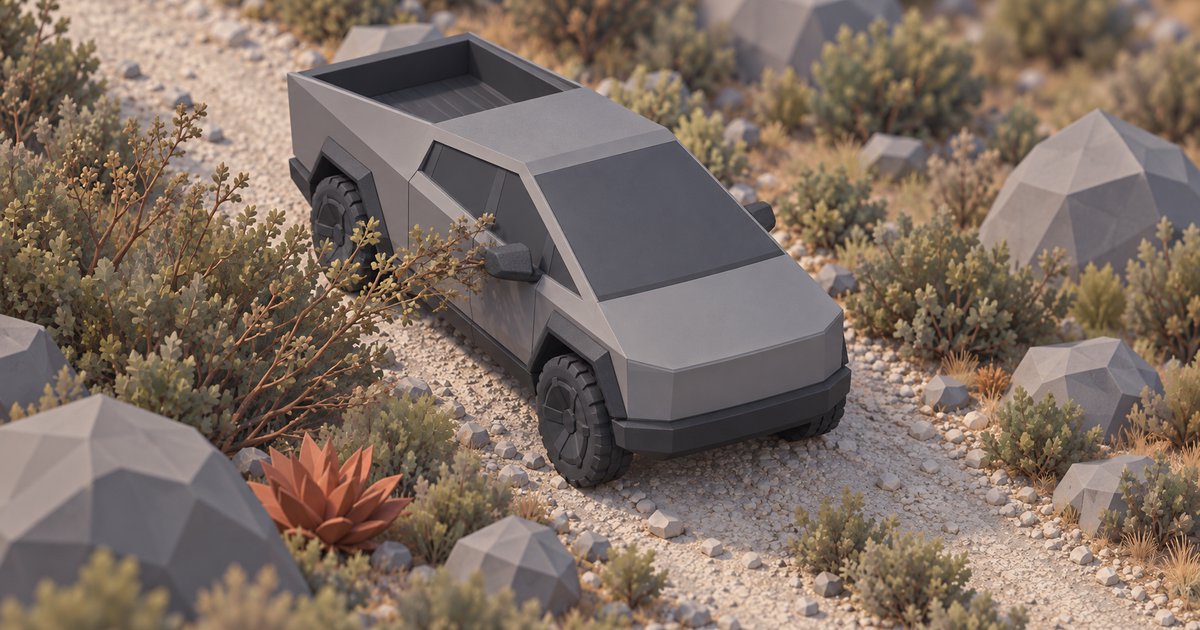
Tesla has changed the Cybertruck's mirror caps from a painted finish to textured plastic that matches the fender trim. Wes Morrill, the Cybertruck's lead engineer, disclosed the change publicly, and Drive Tesla Canada reports it has been reaching vehicles over the past few weeks.
The painted cap was the wrong part for the job
The complaint the change answers is specific. A painted cap sits on the widest point of a vehicle whose owners drive it into places with vegetation, and paint marks where brush touches it. The rest of the exterior is stainless steel that shrugs that off, so the mirror caps were the component least able to take the use the truck invites — a mismatch between a finish and the job it was doing.
Textured plastic does not show the same contact. It also matches the fender trim, so the cap now reads as part of the same family of surfaces rather than a painted exception to them.
Cheaper and better is the unusual part
"Sometimes you can take out cost AND make the product better," Morrill said of the change. That framing is worth taking seriously rather than as marketing. Most running changes on a vehicle trade one against the other: a cheaper part is usually a worse part, and a more durable part usually costs more. Paint is a process — a booth, a cure, rework when it fails inspection — and removing it takes out both the spend and the failure mode at once.
Tesla has not published part numbers, a VIN break, or a figure for the saving, and there is no retrofit programme for trucks already built with the painted caps.
| Old | Painted mirror caps |
| New | Textured plastic, matching fender trim |
| Reason | Scratch resistance against brush; lower cost |
| Source | Wes Morrill, Cybertruck lead engineer |
| Rollout | Reaching vehicles over the past few weeks |
| Retrofit | None announced |
A pattern, not an incident
This is the fourth Cybertruck component revision to surface this month. Tesla has redesigned the side repeater camera, switched the aero shield to polypropylene, and reworked the tailgate track and bed gear box. Each is small on its own. Together they describe a vehicle still being engineered well after launch, with the parts that fail in the field getting replaced by parts that do not.
What this means in Europe
Nothing directly, and that is worth stating plainly. The Cybertruck is not homologated for sale in the European Union, and no European buyer will receive either version of this part from Tesla.
The relevance is indirect but real: the Cybertruck is where Tesla now does its visible running-change engineering, and the habits it forms there — deleting paint processes, standardising on textured trim, replacing parts that mark in service — are the ones that reach the Model Y and Model 3 lines that do sell here. Watch which of these revisions shows up on a European car in a year's time.