
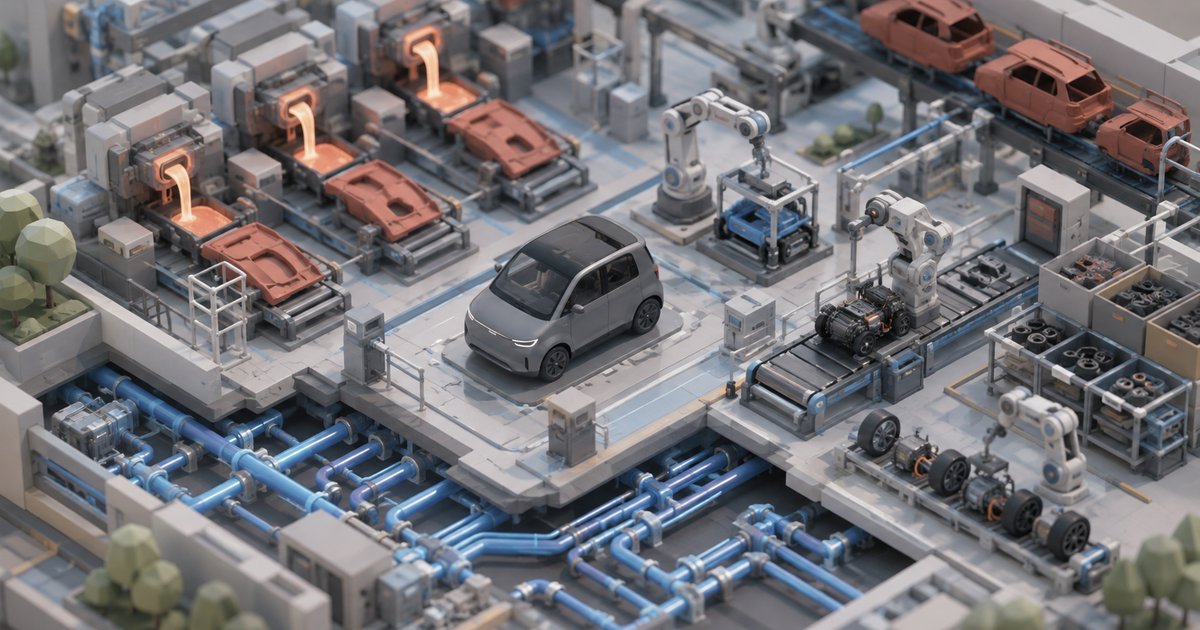
Tesla spent most of its Cybercab launch on Thursday talking about the ride. The engineering detail released alongside it is the more revealing half, because almost none of it is about how the car drives. It is about how cheaply the car can be built.
A third-generation thermal system
The Cybercab is the first Tesla to carry what the company calls the Supermanifold V3. In Tesla's own description, it "removed unnecessary refrigerant valves and lines and consolidated the high- and low-voltage controllers", producing a module whose "production [is] 80% automated and its operation 38% more efficient than other automotive thermal systems".
Both figures are manufacturing claims as much as engineering ones. The Supermanifold is the aluminium block that routes refrigerant around the car — the part doing the work when a cold battery preconditions on a winter motorway run, and again when a pack sheds heat during a fast charge. TeslAnt covered the revised manifold that appeared unannounced in Grünheide-built Model Ys a day earlier, identifiable only by a part number. This is the generation after that one, and Tesla is describing it out loud.
The drive unit follows the same logic
Tesla says the Cybercab's single front motor is 18% smaller and 25% lighter than what it calls the top competing EV drive unit — it does not name the competitor — and that it is designed to be assembled automatically in under ten seconds. It uses a bar-wound stator, which packs more copper into a given volume, cutting resistance and improving heat rejection.
| Claim | Figure |
|---|---|
| Thermal system production automated | 80% |
| Thermal system efficiency vs. others | +38% |
| Drive unit size vs. best competitor | −18% |
| Drive unit weight vs. best competitor | −25% |
| Drive unit assembly time | under 10 seconds |
| Assembly footprint vs. a conventional line | about −50% |
| Drag coefficient | under 0.2 |
Built without a paint shop
The body comes together on Tesla's "unboxed" process — modules built in parallel and joined late, rather than one body travelling down a single line — which Tesla says roughly halves the floor area a line needs. The exterior panels are reaction-injection moulded from recycled material and coloured in the mould, so the car skips the paint shop entirely. A paint shop is normally the most expensive and most energy-hungry building on a car plant.
The aerodynamics belong to the same argument rather than to performance: a drag coefficient under 0.2 is how a 47.6 kWh pack returns a preliminary EPA figure near 293 miles from 219 hp.
How firm is any of it
These are Tesla's numbers, presented by Tesla, with no independent verification and no named benchmark — "top competing EV drive" is unfalsifiable as written. Nothing here has been measured by a third party, and Tesla still has not announced a Cybercab price. The sub-$30,000 figure Musk has repeated for two years did not become official on Thursday either.
What the disclosures do establish is intent. Every claim released concerns parts count, cycle time, floor space or process steps. None concerns speed, handling or range.
Why a European reader should care
Not because the Cybercab is arriving — it is not, and the obstacle is where Tesla sits in the approval queue. It matters because Tesla's manufacturing changes migrate. The Supermanifold went from a Model 3 part, to a quietly revised Model Y part at Grünheide, to a third generation in Austin, and the cars Europe does buy are built with whichever version is current when they leave the line. Cost engineering aimed at a robotaxi is the mechanism by which the next Model Y gets cheaper to build.
Update: 2026-09-23
On 22 September 2026 Tesla Recruiting posted that "Cybercab is the most efficient EV ever certified & built, and we're producing a drive unit every 10 seconds". The sub-ten-second drive unit assembly described above as a design intent is now stated as an actual rate. Two qualifications belong with it. The ten seconds applies to the drive unit line, not to finished cars — a separate figure from the sub-10-second vehicle cycle time Tesla has quoted for the unboxed assembly line. And the efficiency claim is not new: the 165 Wh/mi certification dates from May 2026, when Tesla compared it with a Model 3. Tesla's September wording names no baseline at all, though several outlets rendered it as 40% more efficient than a Model Y.