
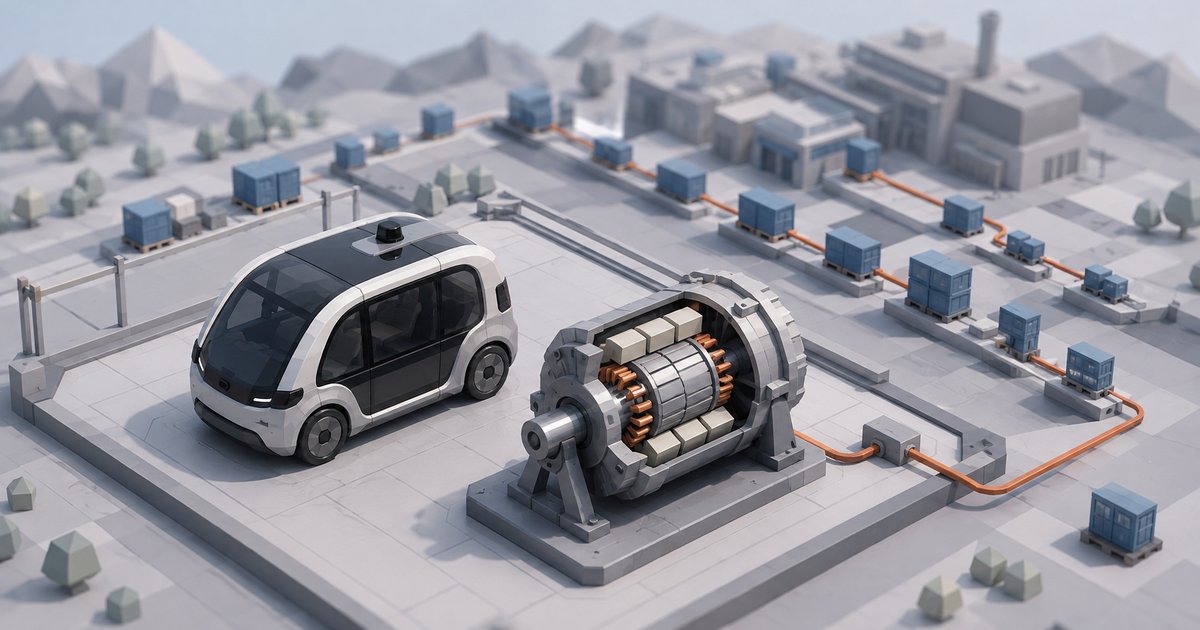
Hours after the Cybercab began carrying paying passengers in Austin, Elon Musk posted that "the Cybercab motor uses no rare earth metals, but maintains the same range! This was extremely hard to achieve." It is the first Tesla in production with a traction motor built without them, and it closes a commitment the company made three and a half years ago.
The promise, and what it was judged to be worth
At Tesla's Investor Day on 1 March 2023, VP of powertrain engineering Colin Campbell said the next generation of Tesla's permanent-magnet motors would use no rare earths, citing rising demand and the "environmental and health risks" of mining them.
The rare-earth analysts at Adamas Intelligence ran the numbers two days later, and their arithmetic is the necessary counterweight to Musk's framing. In 2022, passenger-EV traction motors accounted for about 12% of world consumption of neodymium-iron-boron magnets, the type almost every EV motor uses, and Tesla was 15% to 20% of that segment. Tesla's entire traction-motor magnet appetite was therefore 2% to 3% of global demand. Adamas projected that a complete switch would cut world demand for those magnets by 3% to 4% by 2035, a dent it expected to pass "virtually unnoticed".
So this does not loosen the rare-earth market. What it changes is Tesla's own exposure to it.
Why exposure is the point
| Date | What changed |
|---|---|
| 4 April 2025 | China placed export controls on seven heavy rare earths - samarium, gadolinium, terbium, dysprosium, lutetium, scandium and yttrium - plus their metals, alloys and finished magnets |
| Spring 2025 | Shipments fell sharply; the IEA recorded carmakers in the United States and Europe cutting utilisation or briefly halting lines for want of magnets |
| 1 December 2025 | Controls extended to goods made outside China that contain Chinese material or were made using Chinese process technology |
China refines more than 98% of the world's heavy rare earths. Dysprosium and terbium are what stop a neodymium magnet demagnetising when a motor runs hot, which is exactly why traction motors need them, and why the April 2025 list hit carmakers rather than consumer electronics.
What it costs in engineering
Tesla has not said what the magnets are made of. Ferrite is the standing candidate - it has powered rare-earth-free designs before - and Adamas's 2023 review of them found the trade-off unforgiving. One Proterial ferrite motor matched a rare-earth unit's output and rotational speed while weighing 30% more; another recovered its performance by spinning 50% faster, at a material cost in torque.
Against that, Tesla says the Cybercab drive unit is 18% smaller and 25% lighter than the best competing unit - a figure that arrived with the rest of the Cybercab's manufacturing disclosures, and with no competitor named. Electrek reports the car consuming 165 Wh/mi, which if it survives final certification would make it the most efficient EV sold. Beating the ferrite penalty while getting smaller and lighter is the part that would be genuinely hard, and it is the part nobody outside Tesla has measured.
What has actually shipped
Roughly 45 Cybercabs are registered in Texas. That is the entire installed base of this motor. There has been no teardown, no named magnet chemistry and no third-party verification - the claim rests on one sentence from Tesla's CEO.
What would make it matter in Europe
European carmakers were among those squeezed in 2025, so a European-built motor that needs no export licence is worth more here than the Texas fleet suggests. Tesla's cost engineering does migrate: the Supermanifold went from a Model 3 part, to a quietly revised Grunheide Model Y part, to the Cybercab's third generation. If the motor follows that route into cars built at Grunheide, a European Tesla stops depending on a decision made in Beijing. Until then it is one drive unit in about 45 cars, 8,000 km from the nearest European buyer.
Update: 2026-09-05
Two qualifiers belong on the account above. Tesla has built traction motors without rare earths before: the original Model S and Model X used AC induction motors, which carry no permanent magnets at all, and Tesla took on rare-earth magnets only with the Model 3's permanent-magnet design. What is new is a permanent-magnet-class motor without them, not a Tesla without them, which is why Electrek framed the 2023 commitment as Tesla going “back” to rare-earth-free motors. The efficiency claim is also smaller than it sounds: electric motors already convert 90% or more of input energy into rotational torque, so the headroom is thin, and Tesla put no number on the improvement it claims. Source: Electrek.