
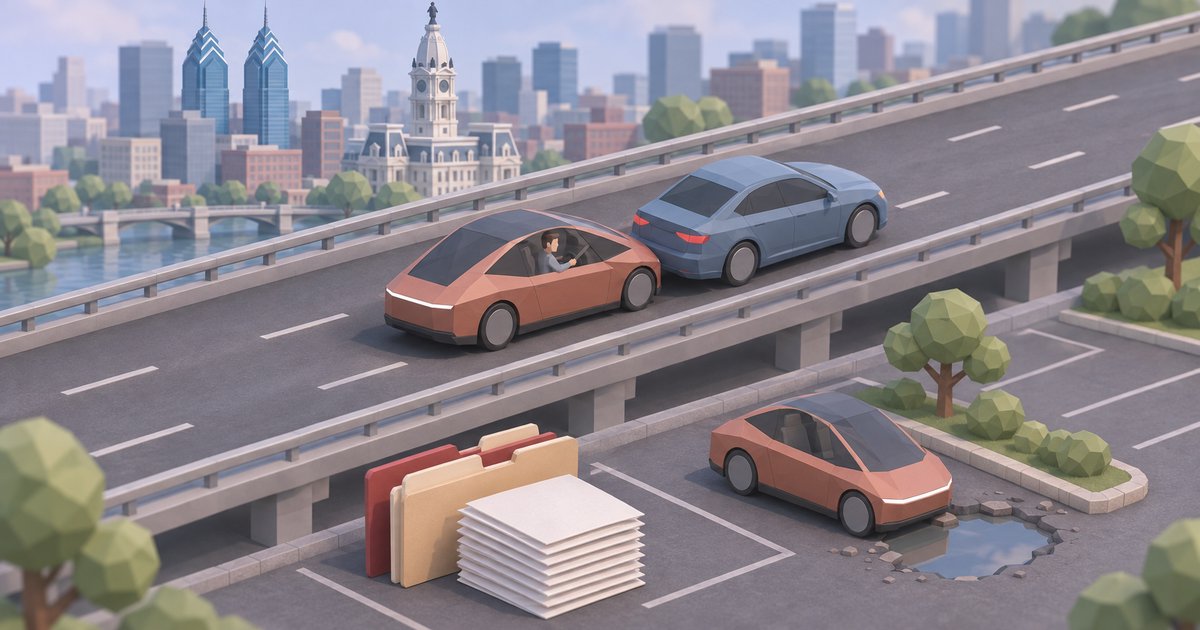
The US National Highway Traffic Safety Administration (NHTSA) now holds eight crash reports for Tesla's Cybercab, five of them added in the release published this month. Electrek counted them first; TeslAnt recomputed the figures from the Standing General Order crash files and compared them with archived copies of the October files.
Four of the crashes happened in driverless operation in Austin, none above 5 mph (8 km/h). The other four happened in September with a Tesla test driver on board and driver assistance engaged, in four different states. One of them was at 53 mph (85 km/h) on a highway in Philadelphia.
Driverless: four low-speed crashes in Austin
These reports sit in NHTSA's file for automated driving systems, where Tesla's crash summaries are public:
- August: drove into a large, water-filled pothole in a parking lot at 5 mph, with a safety monitor aboard and no passengers. This one was already in the October file.
- September: slowing to a stop at a parking-lot exit when a car reversing out of a space hit its right side. No passengers.
- September: stopped in traffic behind another car and rear-ended by a pickup truck.
- September: drove over a raised concrete edge of a parking lot, across the pavement and down a kerb at up to 3 mph (5 km/h), with one rider aboard.
Nobody was hurt in any of them. In two, the Cybercab was stationary and was hit by another vehicle.
With a test driver: four crashes, two injuries
| Place | Road | Speed | Other vehicle | Injury | Investigated by |
|---|---|---|---|---|---|
| Lehi, Utah | Intersection, turning right | 11 mph (18 km/h) | SUV | Minor, no hospital | Lehi Police Department |
| Tampa, Florida | Highway, stopped | 0 | Car | None | Florida Highway Patrol |
| Philadelphia, Pennsylvania | Highway | 53 mph (85 km/h) | Car | Unknown | Pennsylvania State Police |
| Austin, Texas | Highway | 5 mph (8 km/h) | SUV | Minor, hospital treatment | Austin Police Department |
These four sit in the driver-assistance file, which also holds the Autopilot and FSD (Supervised) crashes of ordinary Model 3s and Model Ys. Each is coded with a commercial or test driver and the system "verified engaged". Tesla has redacted every narrative as confidential business information, so the reports do not say who caused the crashes or what the system was doing. The Utah and Florida reports were already in the October file; Philadelphia and Austin are new.
Tesla tests Cybercabs fitted with steering wheels and human drivers, as its fleet around Detroit shows. Neither Pennsylvania nor Utah is a Robotaxi market. The Philadelphia report is not the October collision in which a Cybercab lost its door skin, which happened on a city street. Tesla's timestamp puts this one on a highway at about 22:20 local time, and NHTSA dates it to September.
What the speeds show
Across all 43 Tesla reports in the driverless file, the highest speed before a crash was 29 mph (47 km/h): a Model Y driving over a pothole in a Dallas work zone, a crash that also appears in Tesla's own list. The median is 1 mph. None of the 43 happened on a highway: 21 were on streets, 15 in parking lots and seven at intersections. Electrek reads that as a result of where Tesla lets the service drive, inside small geofenced zones, rather than proof that the software is safe. A report does not establish fault either: it is required whenever the system was engaged within 30 seconds of a crash.
Why it matters in Europe
Tesla has started selling the Cybercab to private buyers in the US and plans to build it in a new €3 billion hall at Grünheide from 2029. Europe has no public crash register of this kind, so NHTSA's files are the only public record of how the car behaves on real roads. So far, the one Cybercab crash at real road speed happened with a test driver on board, not in driverless service.