
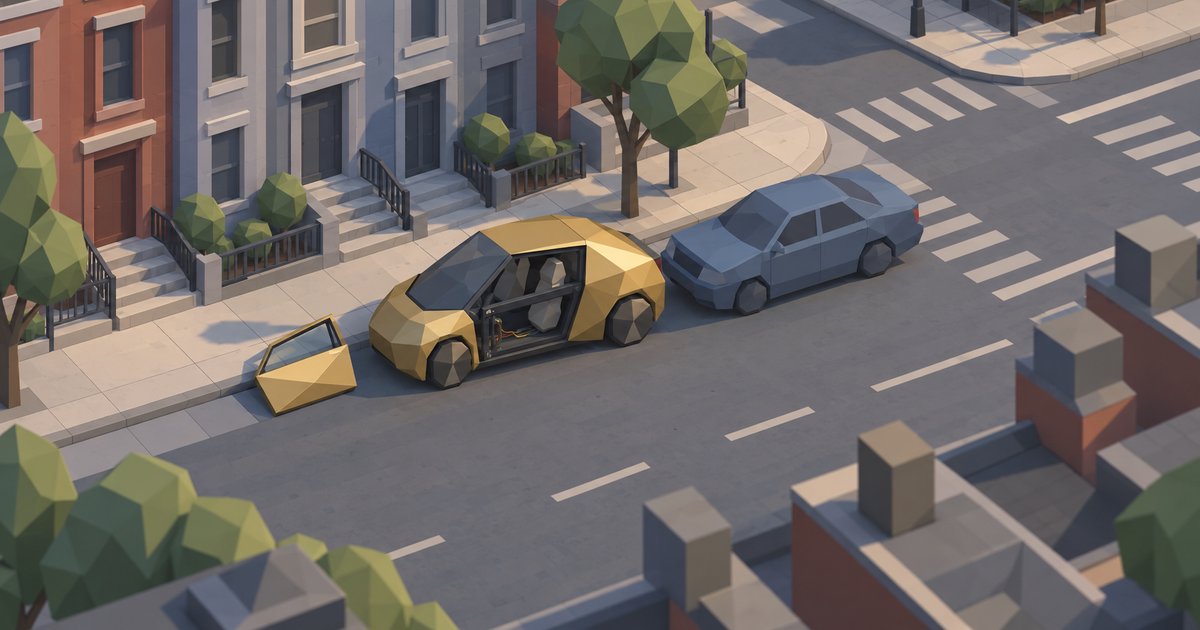
A Tesla Cybercab lost the entire outer panel of its left-side door in a low-speed collision on South Broad Street in Philadelphia this week, a little over a mile south of City Hall, Electrek reported on 7 October. The photos were posted on Reddit by user ryephila and spread on X. Philadelphia is not one of Tesla's Robotaxi markets; Cybercabs carry paying passengers in Austin, where the car entered service on 3 September.
Who was at fault, and what the other vehicle was, has not been confirmed. Nothing published shows whether Tesla's software was driving, and Tesla has not commented. It is not the first Cybercab collision: in May one was rear-ended in a multi-car incident in Austin.
What the door shows
With the skin gone, the photos show what Not a Tesla App describes as a black inner frame, the window regulator, latch hardware, wiring and a crossbar running the length of the door for side-impact protection. The glass survived. The side skirt is crumpled and the rear quarter panel scuffed.
The panel itself is the instructive part. Electrek describes the Cybercab's body panels as moulded plastic with the colour mixed into the material rather than painted on. The coloured skin is joined to a plastic backing piece, and the whole panel is held on by fasteners reached from inside the door. A skin built that way is swapped rather than straightened and repainted, which suits a car meant to earn its keep by the kilometre. Tesla has published nothing on what a Cybercab costs to repair.
Why a Cybercab was in Philadelphia
The cars have been there for weeks. On 18 September The Philadelphia Inquirer reported gold Cybercabs with Texas plates parked at a Tesla location in Devon and seen on City Avenue. "We're not at liberty to discuss that," a person in Tesla's sales department told the paper; Tesla's media team did not respond. Electrek counted at least 30 at the Devon site. Not a Tesla App says the crashed car was likely on validation testing.
The permit question
Pennsylvania requires a PennDOT certificate of compliance to operate a highly automated vehicle. The state's list of current certificate holders has seven names:
| Holder | Where |
|---|---|
| Waymo | Philadelphia, Tinicum Township, Pittsburgh |
| Perrone Robotics | Philadelphia |
| Aurora | Pittsburgh area |
| Motional | Pittsburgh, Allegheny County |
| Mapless AI | Pittsburgh, Pittsburgh International Airport |
| Stack AV | 32 municipalities in western Pennsylvania |
| Carnegie Mellon University | 20 counties, several interstates and the Pennsylvania Turnpike |
Every one is listed as operating with an "HAV driver on board". Tesla is not on the list, nor on PennDOT's separate list of testers authorised under the guidance that applied before Act 130, the 2022 law that created the certificate.
Without a certificate, a Tesla test car in Pennsylvania has to be driven by a person — notable for a car built with no steering wheel and no pedals. Electrek reports that Tesla has been bolting Cybertruck steering wheels into test Cybercabs for this kind of work, and riders in Austin have glimpsed the on-screen joystick Tesla uses to move one by hand, which appears to be limited to about 13 km/h. Which of the two was in use on Broad Street is not public.