
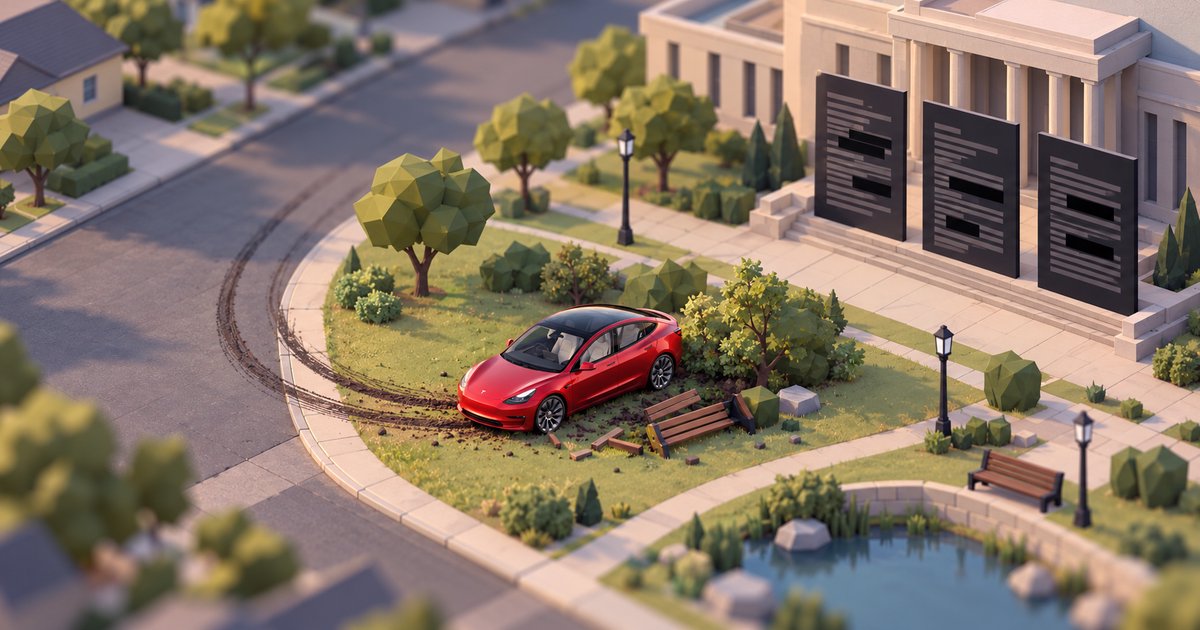
A wrongful death lawsuit filed in Travis County, Texas adds a fourth account of a crash this site covered in August — and it does not match the three before it.
Leolina Medrano, representing the estate of Steven Alvarez, alleges the Model 3 "suddenly and unexpectedly accelerated without any input", that it was "unreasonably dangerous", and that Tesla failed to warn owners. The suit seeks more than one million dollars, the final figure left to a jury. The Austin American-Statesman, reporting the filing on 1 October 2026, says neither Tesla nor its lawyers responded to a request for comment.
The same crash, told three ways
Alvarez, 23, an IT technician at a local school, died on 20 May 2026 when his 2025 Model 3 left Brazoswood Drive in Clute and came to rest in Clute Municipal Park.
| Source | What it says happened |
|---|---|
| Clute police, May 2026 | Preliminary theory: the driver suffered a medical episode |
| Tesla's NHTSA filing | Automation engagement status marked Verified Engaged; speed 104 mph |
| The lawsuit, October 2026 | The car accelerated by itself, with no driver input |
None is a finding of fact, and no two sit comfortably together. The second is the one almost nobody saw: it surfaced only because Electrek searched the federal crash database, and Tesla's filing was the only place the speed and the engaged system appeared at all.
The allegation itself is the weakest part
Sudden unintended acceleration is the most-investigated and least-substantiated claim in the modern car industry, and that is worth stating plainly.
In March 2026 the US National Highway Traffic Safety Administration closed a defect petition seeking a recall of roughly 2.26 million Teslas going back to 2013. It found no evidence of a safety defect and concluded the incidents were consistent with drivers pressing the accelerator when they meant to press the brake. Around half the crashes it reviewed happened within six months of the owner taking the car. That defence has already been run in a Texas courtroom this year: in the Katy case, where a Model 3 killed a woman in her own home, Tesla's answer was that the driver had pressed the accelerator to 100%.
So a court filing asserting phantom acceleration starts a long way behind the evidence. What makes this case different is not the allegation. It is the discovery.
Why a lawsuit reaches what a database cannot
Tesla redacted the crash narrative, the software version and the operating-area field from its federal report as confidential business information — a treatment it applies to the overwhelming majority of its crash filings. Nobody outside the company can say what the car was doing before impact, or which build was running.
Civil discovery is not bound by that. A Texas court can compel vehicle logs that a redaction policy keeps out of the public database, and the defence of a pedal-misapplication case runs directly through the telemetry Tesla has withheld. Whatever the merits of the complaint, the proceeding is a route to the data — the same dynamic now playing out in a separate Autopilot suit over a Model X in Kirkland, Washington.
What a European owner should take from this
Not the allegation, which may well fail. The structural point: Europe has no equivalent of the American crash-reporting order, so there is no filing to redact and no database to search. European regulators weighing FSD approval read the same redacted US record everyone else does.
That makes an American courtroom, for now, one of the few places where the data behind a Tesla driver-assist crash can actually be made to appear.