
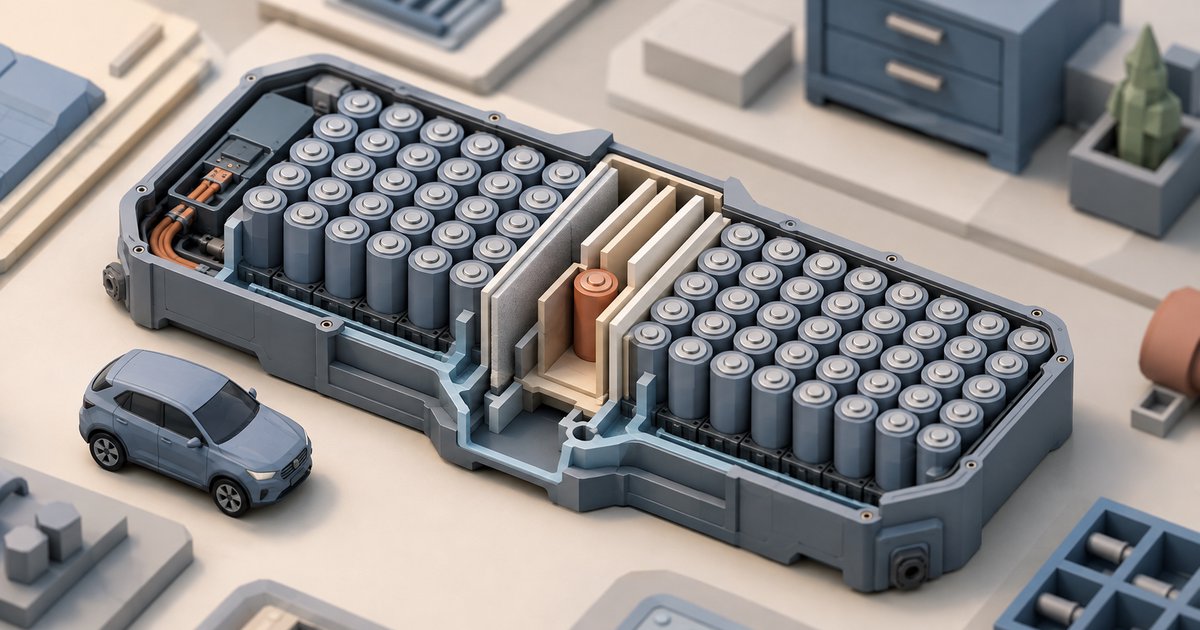
A pack with thousands of cells in it will eventually have a bad one. Tesla's new engineering page starts from that premise rather than denying it, which makes it more useful than most manufacturer safety material.
The page, published on 2 September 2026, walks through how Tesla says it designs vehicle battery packs for safety, durability and longevity — from cell chemistry and manufacturing, through pack architecture, to the software that watches the battery once the car is on the road.
Containing one cell instead of preventing every cell
The organising idea is what Tesla calls passive propagation resistance (PPR). With thousands of cells in a pack, a single-cell thermal runaway is treated as something to expect somewhere in the fleet, not something to design out entirely. The engineering goal is therefore containment: cells are thermally isolated and structurally separated, and surrounded by cooling designed to absorb the energy a failing cell releases so that its neighbours never reach runaway themselves.
"Passive" is the load-bearing word. The protection is meant to work through materials and geometry rather than through a system that has to detect a fault and respond correctly — so it does not depend on power, software or a sensor being right at the moment it matters.
Testing past the certification floor
Tesla says it tests the complete battery system against failure scenarios that go beyond what regulations require, naming three conditions specifically:
- high ambient temperature
- a full state of charge
- loss of coolant flow
Those are the combinations that make a bad cell worse, and they are deliberately harder than the certification cases. Thermal management runs the other way in normal use: liquid cooling and heating channels hold cell temperatures in range while driving, charging and parked. That matters for longevity as much as safety, because even temperatures across a pack stop individual cells from ageing faster than the rest and becoming the weak link that limits the whole battery.
The headline number, and what it actually covers
Tesla's claim is that across more than 265 billion miles driven through the end of 2025, it has found no evidence of a spontaneous battery failure causing a vehicle fire in Model 3, Model Y, Cybertruck or Semi.
Read the qualifiers, because they are doing real work:
| The claim says | The claim does not say |
|---|---|
| spontaneous failure | anything about fires following a crash or road debris strike |
| Model 3, Model Y, Cybertruck, Semi | anything about Model S or Model X, whose packs are the oldest designs Tesla still supports |
| no evidence found | that no such failure occurred |
This is Tesla measuring and reporting on Tesla, with no independent audit, and the two models left off the list are the two a reader would most want on it. None of that makes the figure wrong — a fleet that size with no spontaneous pack fire in four model lines is a substantial engineering result, and it is consistent with what teardown analysts have described of Tesla's pack architecture for years.
Why read it
Tesla rarely publishes engineering rationale, and this page arrives while battery safety is unusually live in Europe: the Euro 7 rules bring an Environmental Vehicle Passport with in-car battery state-of-health reporting from 29 November, and independent testing houses are now publishing degradation data at scale, as Aviloo did last week across 500,000 tests. A manufacturer explaining its own design choices is a useful thing to hold next to numbers gathered by people who do not work there.