
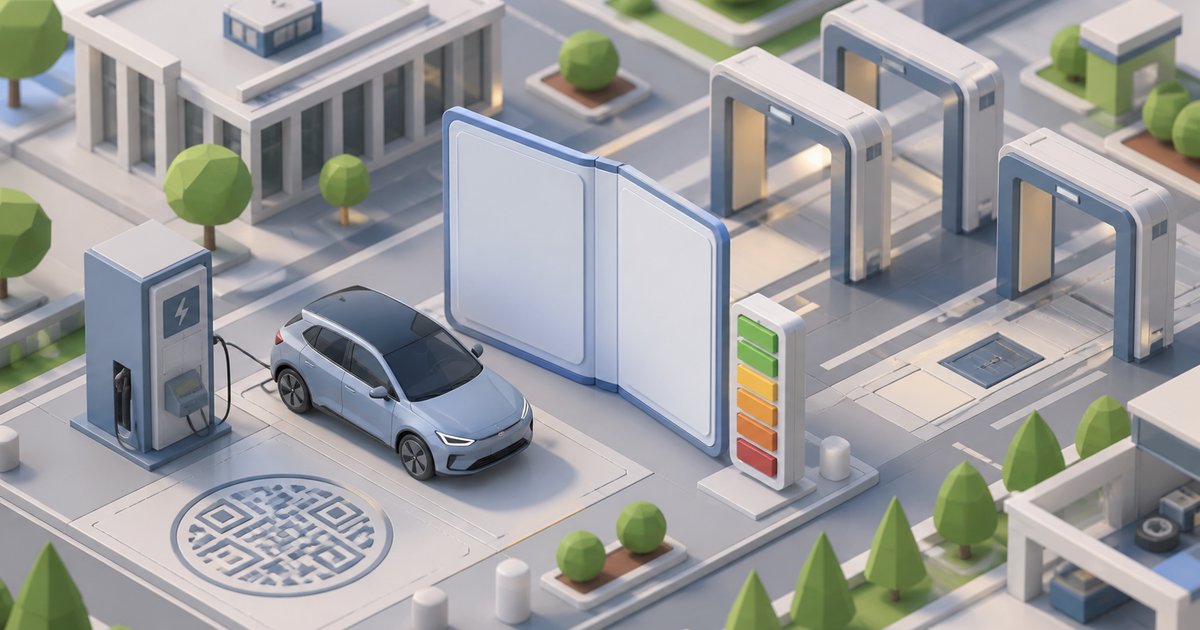
From 29 November 2026, no new car type can be approved for sale in the European Union without an Environmental Vehicle Passport. The requirement comes from Euro 7 — Regulation (EU) 2024/1257, adopted in April 2024 — and it is the first time EU emissions law has reached past the exhaust pipe to cover what an electric car's battery does over its life.
The date applies to newly approved types. Models already type-approved carry on unchanged until 29 November 2027, when the requirement extends to every new car and van sold.
What the passport actually is
The Environmental Vehicle Passport is a per-vehicle record of environmental performance at registration. It has to carry the car's pollutant emission limits, CO2 figures, fuel and electric energy consumption, electric range and battery durability.
It is not a document filed with an authority and forgotten. The static parameters must be reachable through a QR code inside the car, and the in-vehicle display has to show live data from the on-board monitoring systems — lifetime consumption values and, for anything with a traction battery, its state of health.
That last item is what changes for owners. Battery state of health is currently a number you infer from range, pay a third party to measure, or take a seller's word for. Euro 7 turns it into a readout the car must publish.
Not the same as the battery passport
Two EU passports land within fifteen months of each other, and they are different instruments. The battery passport that starts on 18 February 2027 comes from the battery regulation, attaches to the pack itself, and carries chemistry, raw-material origin, carbon footprint and recycled content. The Environmental Vehicle Passport comes from Euro 7, attaches to the vehicle's type approval, and describes how the car performs. A new EV sold in 2027 will carry both.
The durability floors
Euro 7 also sets minimum performance levels that a traction battery must hold:
| Vehicle | After 5 years / 100,000 km | After 8 years / 160,000 km |
|---|---|---|
| Cars (M1) | 80% | 72% |
| Vans (N1) | 75% | 67% |
These are legal floors for type approval, not warranty terms, and they bind the type rather than the individual car. Until now a manufacturer's battery warranty was the only number of its kind in the market.
For context on where current hardware sits against those figures, Aviloo's report on more than 500,000 battery tests puts the Tesla Model Y's median state of health at 90.3% after 150,000 km — comfortably clear of the eight-year floor, at a mileage beyond it.
What it means for Tesla and European owners
Tesla sells into the EU on European type approvals, so every new Tesla type approved from late November has to produce an EVP and surface battery state of health in the car. Tesla already exposes more diagnostic data than most manufacturers, and its packs have tested well, so the compliance burden looks lighter for Tesla than for makers who have preferred to keep degradation data out of view.
The competitive effect may matter more than the compliance one. Once every new car publishes a comparable state-of-health figure, battery longevity becomes a specification buyers can check — and the used market, where uncertainty about the pack does most of the damage to residual values, gets a standard reference.
Euro 7 is broader than this — it also brings the first EU limits on brake particle emissions and tyre abrasion, which bear on heavy electric cars in particular. But the passport and the in-car battery readout are the parts visible from the driver's seat.