
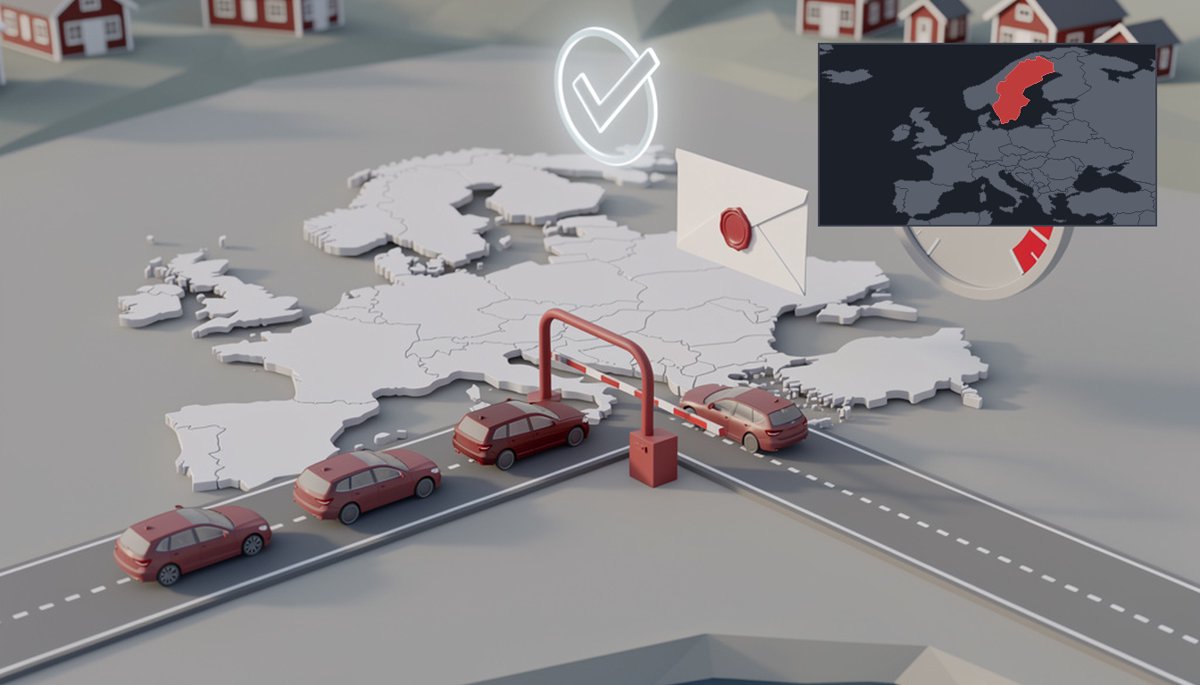
What Sweden is asking for
Sweden's Transport Administration (Trafikverket) has formally recommended that the European Union vote against approving Tesla's Full Self-Driving (Supervised) for use across the bloc unless Tesla removes the system's ability to drive faster than the posted speed limit. The recommendation came in a previously unreported letter dated 30 April 2026, sent to the EU's Technical Committee on Motor Vehicles (TCMV) — the body that decides whether new vehicle technologies can be type-approved for the whole single market.
The objection is narrow but pointed. FSD includes a "Speed Offset" setting that lets a driver choose how far above the legal limit the car will travel. Swedish officials argue that letting an automated system systematically exceed legal speed limits "risks undermining both the legal framework and the expected safety benefits of vehicle automation." In other words, their concern is not the self-driving stack itself but a configurable feature that, by design, breaks traffic law.
Why the timing matters
The letter lands at a sensitive moment. The TCMV is due to take up the matter at the end of June, ahead of any vote on a bloc-wide rollout. Until now, Tesla has been collecting approvals country by country — the Netherlands cleared FSD (Supervised) first, followed by Estonia, Lithuania, Denmark and most recently Belgium. A single EU-wide type approval would replace that patchwork with one decision valid everywhere, which is the outcome Tesla wants.
A formal objection from a member state's transport authority does not automatically block approval, but it raises the political temperature inside the committee and gives other cautious countries cover to ask the same questions. Sweden is not demanding that FSD be banned; it is demanding that the speed-limit override be stripped out as a condition of approval.
What it means for European owners
For drivers in countries that have already approved FSD nationally, nothing changes today — those approvals stand. The fight is over the EU-wide green light that would let Tesla switch the feature on uniformly across all member states without negotiating each market separately.
If the committee sides with Sweden, the most likely result is not a rejection but a compromise: Tesla could be asked to cap or remove the Speed Offset in European builds. That would make EU FSD behave more conservatively than the US version, where exceeding the limit by a set margin is a long-standing driver-selectable option. Tesla has not publicly responded to the Swedish recommendation.
The episode underlines a recurring tension in Europe's approach to driver-assistance systems: regulators here treat strict adherence to traffic law as non-negotiable, even when a feature is popular with drivers. How the TCMV resolves it will shape how — and how fast — FSD spreads across the continent.
Update: 2026-06-19
On 12 June 2026, the European Transport Safety Council (ETSC) escalated the fight, sending letters to the transport ministers of nearly every EU member state and urging them to demand independent safety evidence before accepting FSD (Supervised)'s provisional approval. Not every regulator agrees: the Netherlands' RDW, which approved FSD first, pushed back on the suggestion that it had relied on Tesla's assurances, pointing to its own testing programme of more than 1.8 million kilometres and around 1,000 experiments. The TCMV is still due to take up the question on 30 June, leaving the bloc-wide decision finely balanced.