
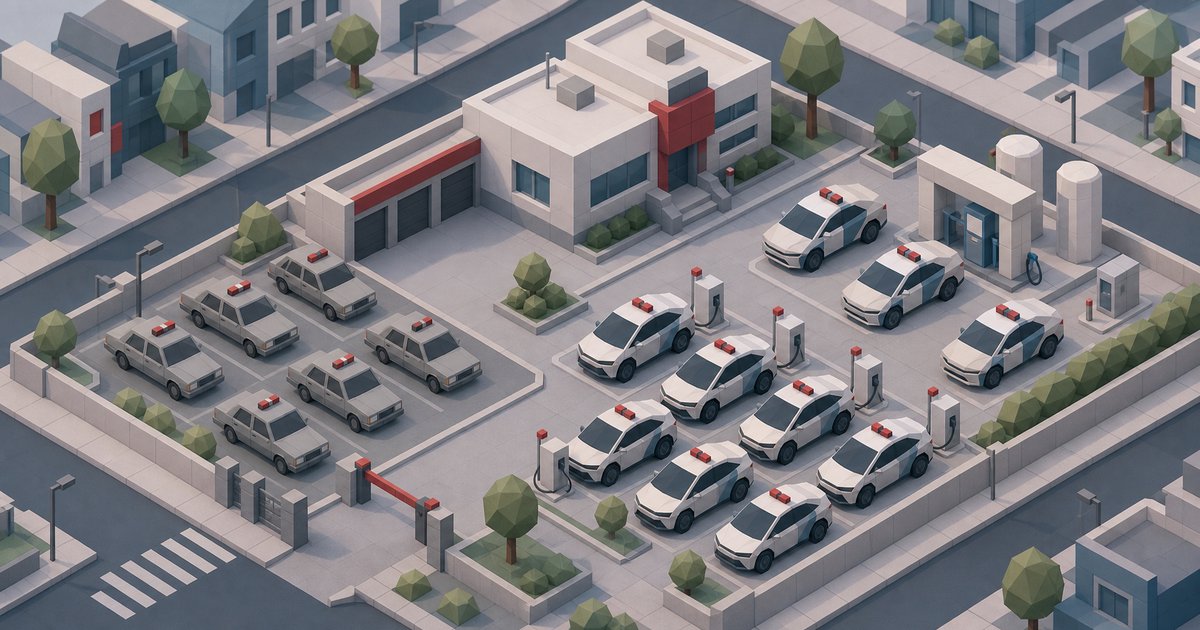
South Korea has committed to buying only battery-electric or hydrogen vehicles for its police fleet from 2035. The Ministry of the Interior and Safety, the Korean National Police Agency and the Ministry of Climate, Energy and Environment signed a memorandum to that effect on 30 July 2026 at Gangnam Police Station in Seoul, which also hosts the pilot.
The size of the job
The commitment is more demanding than the headline suggests, because the starting position is low and the replacement rate is slow.
| Metric | Figure |
|---|---|
| Total police fleet | ~17,600 vehicles |
| Electric or hydrogen (end-June 2026) | 2,185 (12.4%) |
| New vehicles bought or leased per year | ~1,908 |
At roughly 1,900 vehicles a year against a 17,600-vehicle fleet, the natural replacement cycle is a little over nine years. That arithmetic is what makes 2035 the meaningful date: a purchase mandate starting then only reaches a fully zero-emission fleet in the mid-2040s. Certain specialised vehicles are expected to stay exempt, which pushes the endpoint out further.
So this is not a 2035 fleet target. It is a 2035 procurement rule, and the distinction matters when comparing it with European commitments that are frequently written the same way and read as though they mean something stronger.
Why police fleets are a genuine test
Patrol duty is one of the harder public-fleet use cases to electrify, and it is a better proving ground than the office-runabout fleets that usually get converted first:
- Duty cycles are long and unpredictable. A patrol car cannot plan its day around a charging window.
- Idle load is high. Lights, radios, computers and cameras draw power continuously, which in a combustion car means idling and in an EV means battery that is not going to the wheels — the one metric where electrification straightforwardly wins.
- Shift handovers help. Vehicles used across multiple shifts return to a station between them, which is exactly the depot-charging pattern that works.
The hydrogen half of the commitment reflects a domestic industrial position rather than a technology assessment. South Korea has a national hydrogen strategy and a manufacturer, Hyundai, with fuel-cell products to sell into it. European buyers should read the "and hydrogen" as procurement policy, not as a judgement about which technology wins.
The European comparison
Public fleets in Europe are moving the same way, but through a patchwork of national and municipal rules rather than a single national commitment. Where the direction is clearest is in the postal and logistics fleets that run predictable routes from fixed depots — Royal Mail took delivery of its 9,000th electric van this month.
Corporate fleets are less settled. Germany's Schwarz Group dropped electric company cars from its policy, a reminder that fleet electrification is reversible when the total-cost case is marginal and the charging infrastructure is not in place.
That is the useful lesson from Seoul. A procurement mandate signed nine years ahead of its start date is cheap to announce and easy to soften later. What will determine whether it holds is whether the charging goes in at the stations in the meantime — the same thing that determines it everywhere else.