
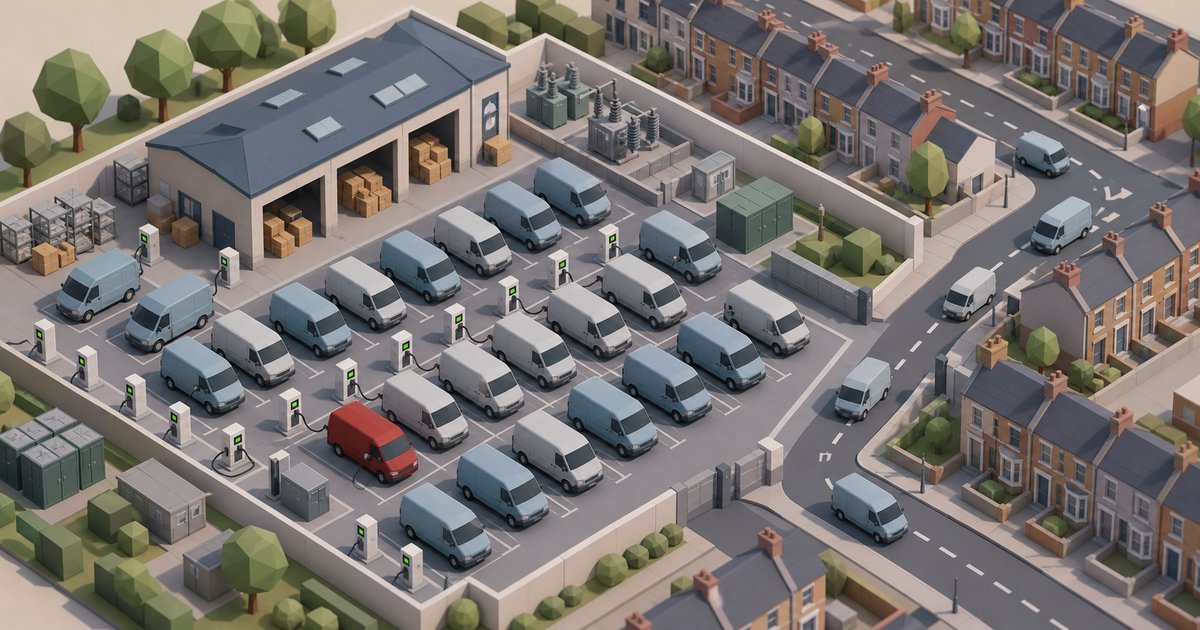
Royal Mail has put its 9,000th electric van into service, and the pace of the milestones is now the story. The vehicle entered service at the Colchester Delivery Office, where it joins more than 120 electric vans already working out of that single site — and it arrived less than eight months after the operator marked its 8,000th.
The curve is steepening
Royal Mail began electrifying deliveries in 2017 with an order of 100 vans. Getting from that pilot to four figures took years; the most recent thousand took under eight months. That acceleration is what separates a procurement announcement from a genuine fleet transition.
| Milestone | Timing |
|---|---|
| First order | 100 vans, 2017 |
| 8,000th van | Under 8 months before the 9,000th |
| 9,000th van | August 2026 |
| Net-zero target | 2040 |
The scale now makes Royal Mail the operator of the UK's largest electric delivery fleet. Nearly a third of its delivery routes are served by zero-emission vehicles, and 44 delivery offices are fully electric — meaning every round from those buildings runs without burning anything.
Why postal fleets electrify first
Last-mile delivery is the easiest case in road transport to electrify, and Royal Mail's numbers show why. Delivery rounds are short, highly predictable and start and finish at the same depot every day. That combination removes the two hard problems in commercial EV adoption at once: range anxiety becomes irrelevant when the route is known in advance, and public charging becomes optional when vans return to a single site to charge overnight on cheap off-peak power.
The depot is the real asset here. Getting 44 delivery offices to full-electric status means Royal Mail has installed enough grid capacity and enough chargers at those sites to turn over an entire fleet every night — the part of fleet electrification that takes longest and rarely makes headlines.
Beyond the van
The programme is not limited to vans. More than 100 micro electric vehicles are being rolled out in locations including London, Bristol, Newcastle-under-Lyme, Solihull, Brighton and the Isles of Scilly, and the operator has launched a fleet of 20 e-cargo cycles for urban deliveries. Both are attempts to match vehicle size to the job rather than sending a full-size van down a pedestrianised high street.
What it means for European operators
Royal Mail is a useful benchmark because it is a single operator running one of Europe's largest and most uniform delivery fleets under real commercial pressure, not a subsidised trial. Its trajectory suggests the constraint on postal and parcel electrification across Europe is no longer vehicle availability or driver acceptance — it is depot power and charger installation, and those are planning problems rather than technology problems.
The wider UK context is favourable: EV uptake there hit a record share in July, though the SMMT continues to warn that manufacturing investment needs ZEV Mandate reform. Fleet operators are converting faster than the factories building the vehicles are expanding — a mismatch worth watching over the next two years.