
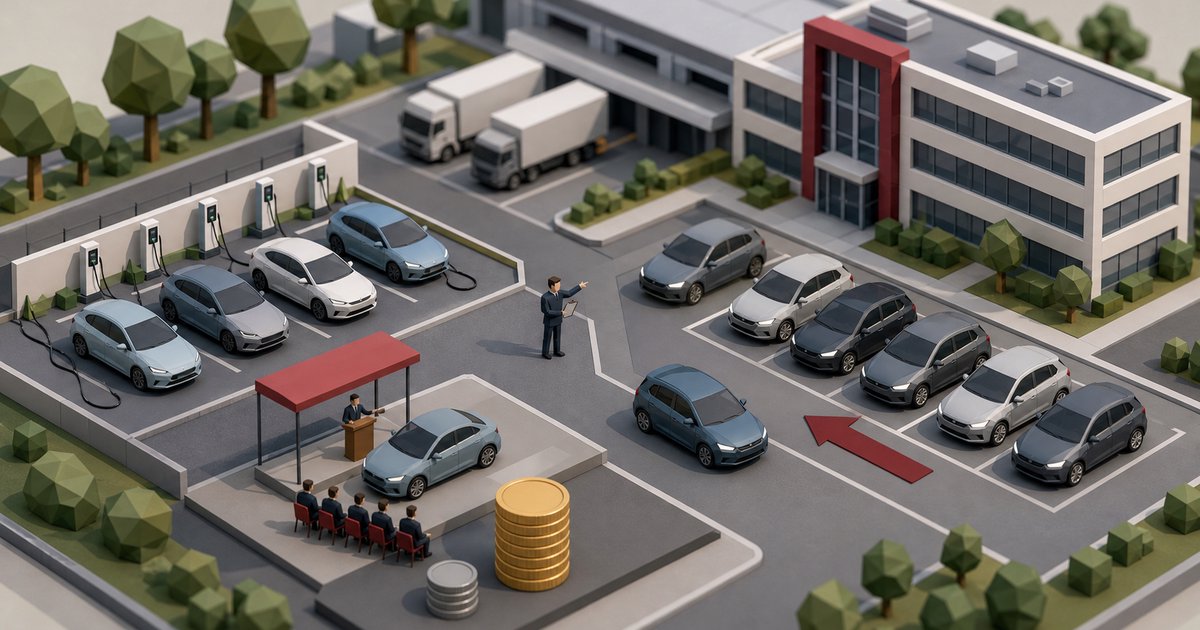
One of Europe's largest retailers has stopped letting its German staff order an electric company car. The Schwarz Group — the parent of Lidl and Kaufland — has temporarily removed fully electric vehicles from its German company car list, meaning employees placing new orders can no longer choose a battery-electric model.
The company points to a volatile market environment and shifting regulatory frameworks. Underneath that, the decisive number is residual value.
The residual value problem
Three years after registration, electric cars in Germany are currently retaining between 47% and 51% of their original list price at an annual mileage of 20,000 km, depending on vehicle class. Resale is hardest in the upper mid-range and premium segments, where there are comparatively few used buyers willing to pay the prices those cars need to command.
That is precisely the segment German company car fleets occupy, and it is why the decision lands where it does. Company cars are leased, not kept, so the monthly cost a fleet operator pays is driven almost entirely by the difference between purchase price and forecast resale value. When that forecast falls, the lease rate rises even if the sticker price has not moved.
Why this cuts against the European trend
The timing is awkward, because the direction of travel elsewhere is the opposite. Germany just recorded its highest monthly EV registrations since 2023, and across the continent battery-electric cars took a record 25.6% share of new sales in June. Tesla in particular has led German EV subsidy applications and pushed a EUR 2,000 discount on the base Model Y.
Nor is the Schwarz Group's position consistent across its own markets: Lidl committed in 2025 to electrifying its entire company fleet in Belgium and Luxembourg by 2030. The German reversal is a national-market judgement about used values, not a corporate retreat from electrification.
What fleet buyers should read into it
Company and fleet registrations account for roughly two-thirds of new car sales in Germany, so fleet policy is not a sideshow — it is the largest single lever on the country's EV mix. A decision like this does not show up in monthly registration data immediately, because it only affects new orders, but it feeds through over the following quarters.
There is also a self-correcting mechanism at work. Weak residuals mean cheap used electric cars, which is exactly what a thin second-hand EV market needs to build the buyer base that would lift residuals again. The uncomfortable part is that somebody has to absorb the depreciation in the meantime, and fleets are currently declining to volunteer.
For the moment, the practical signal for European EV watchers is that the constraint on corporate EV adoption has moved. It is no longer purchase price, charging access or model availability — all of which have improved markedly. It is the resale value three years out, and that is a harder problem for manufacturers to discount their way out of.