
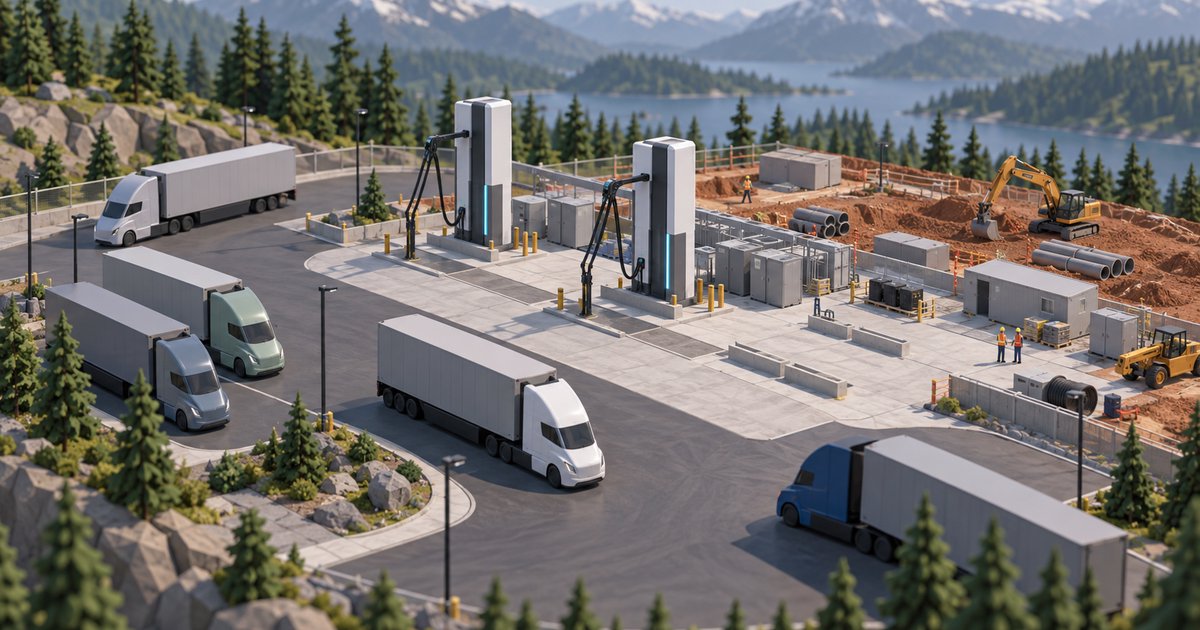
R.R. Plett Trucking will start building Canada's first Tesla Megachargers next month, at its headquarters in Langley, British Columbia and at a second yard in Kamloops. Electric Autonomy Canada reported the plan on 18 September 2026. The 12 Tesla Semis the chargers are meant to feed do not arrive until June 2027.
That ordering is the whole story. A Class 8 electric truck is useless without the power to turn it round, and the power takes longer to install than the truck takes to build.
Two sites, 1.2 megawatts each
| Site | Role | Charger |
|---|---|---|
| Langley, B.C. | Headquarters; Port of Vancouver drayage | 1.2 MW Tesla MCS |
| Kamloops, B.C. | Interior staging point | 1.2 MW Tesla MCS |
BC Hydro is supplying the electrical capacity, which is the part of a megawatt charging project that cannot be rushed. Construction is due to start in October 2026 and to finish before the trucks land.
Note the rating. 1.2 MW is the North American Megacharger figure, and it is not what Europe is being sold: Tesla put the European Semi at 800 kW on the MCS standard, against a single 550 km variant. A European haulier reading this should not expect these numbers.
Thirty minutes instead of three hours
The case for spending on 1.2 MW rather than ordinary DC fast charging is shift patterns, not convenience.
"You can cut charging time from three hours down to 30 minutes with the MCS," Trevor Plett told Electric Autonomy, "which will help us double shift those trucks."
A truck that charges in three hours does one shift a day. A truck that charges in thirty minutes can do two. That is the difference between an electric truck being a demonstration and being a unit of fleet capacity, and it is why the charger is worth more than its own cost.
Against the Volvos they already run
R.R. Plett is not starting from zero. The company, family-owned in Langley since Reg Plett founded it in 1978, has run eight Volvo VNR Electric tractors since 2024 on drayage between the Port of Vancouver and its own yard.
| Volvo VNR Electric | Tesla Semi | |
|---|---|---|
| In the fleet | 8, since 2024 | 12, ordered for June 2027 |
| Weight | About 23,000 lb | Under 19,000 lb |
| Range | 300–350 km | About 500 km |
Roughly four thousand pounds of tractor weight is four thousand pounds of payload a shipper can be charged for. Combined with the range, that is what moves the Semi out of short drayage and onto longer runs.
The rebate does not apply, and it still costs less
The Tesla Semi is not eligible for British Columbia's Go Electric commercial vehicle rebates. R.R. Plett says its upfront cost is nonetheless lower than the Volvos it already operates, which were eligible.
That is worth sitting with. A truck winning on price against a subsidised competitor is a different claim from a truck winning on subsidy, and it is the first Canadian data point on what Tesla is actually charging fleets.
A corridor, eventually
The two chargers are the first leg of a Vancouver-to-Calgary electric freight corridor. R.R. Plett is considering further MCS sites at Golden, B.C. and at Calgary over the next three to five years, which would close the gap across the Rockies.
It is a private depot network, built for one fleet. That is the opposite of the arrangement Tesla struck in California, where it will run public Megacharging at depots it does not own. Both models are being built at once, and it is not yet clear which one Tesla intends to lead with.