
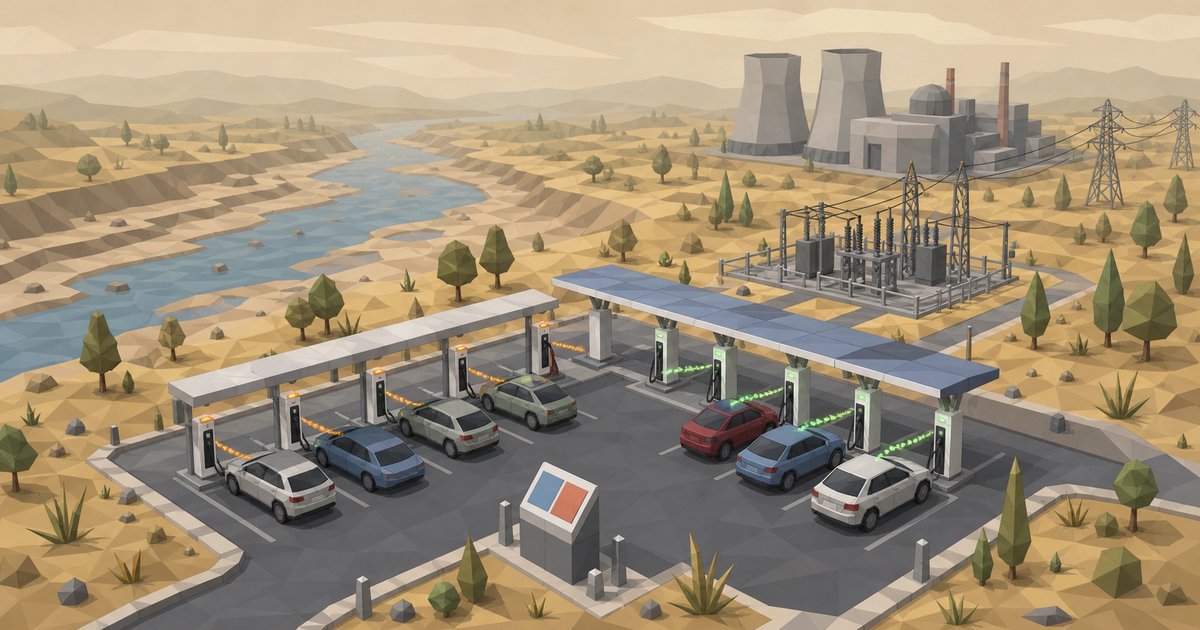
A heatwave and a drought have squeezed Hungary's electricity grid, and the country's charging operators have responded by turning their fast chargers down. Tesla went the other way and cut prices instead — for about a week.
Why the grid is tight
Paks, Hungary's only nuclear plant, is running at a fraction of its capacity because the Danube is too low and too warm to supply enough cooling water. That shortfall has arrived in the middle of a heatwave in which air conditioning is pushing evening demand towards record levels.
The important detail for drivers is that the problem is not all-day. It is a few hours each evening, which is why every measure below targets roughly the same window.
What the networks are doing
| Operator | Measure | Window | From |
|---|---|---|---|
| MOL Plugee | 150 kW+ chargers capped at 100 kW | 17:00–22:00 | 1 August |
| E.ON Drive Infrastructure | Site power cut 50% at HPC locations | 17:00–22:00 | 3 August |
| Shell Recharge | Capped at 150 kW per station | 16:00–22:00 | 5 August |
| Metro | Store chargers switched off by software | 16:00–22:00 | daily |
| EV.app | No power limit; 420 Ft/kWh (≈€1.16) at peak | peak hours | — |
E.ON says its 50% reduction frees up to 10 MW of grid capacity. Shell has also temporarily shut down charging at Tesco car parks.
The difference matters more than it looks. A throttled charger still works, it just costs you time — a 150 kW stop delivered at 100 kW adds real minutes. A switched-off charger costs you a re-route. Only EV.app priced the peak rather than rationing it.
Tesla's version, and its reversal
On 2 August Tesla moved Hungarian Superchargers to 80 Ft/kWh off-peak, covering 23:00 to 17:00, against 200 Ft/kWh during the 17:00–23:00 evening peak. Non-Tesla drivers were quoted 112 Ft/kWh off-peak and 280 Ft/kWh at peak. The company said plainly that it was helping balance Hungary's grid: move flexible charging out of the evening and the peak looks after itself.
At 2.5 times, that was the sharpest price signal any operator in the country put up. It did not survive the month. By 8 August the 80 Ft/kWh rate had gone and most Hungarian Superchargers had returned to a four-tier structure:
| Rate | |
|---|---|
| Off-peak (00:00–08:00, 22:00–00:00) | 94–111 Ft/kWh |
| Peak (08:00–22:00/23:00) | 142–159 Ft/kWh |
| Flat-rate sites | 142 Ft/kWh (Szombathely, Pécs), 158 (Sormás), 162 (Győr) |
Tatabánya carries the highest peak rate at 159 Ft/kWh. Tesla has given no public explanation for withdrawing the announced tariff.
What this means for Tesla owners in Hungary
The good news is that Superchargers are not among the networks cutting power, so a Supercharger stop in Hungary this month still delivers what the car asks for.
The rest is less comfortable. The advertised off-peak discount is gone, and the peak window now in force runs from 08:00 to 22:00 or 23:00 depending on the site — far wider than the 17:00–23:00 emergency window the other operators are targeting. In practice you are paying peak rates for most of the day at a moment when the grid only needs help for six hours of it.
Two practical conclusions. Check the price in the car before you plug in rather than trusting the early-August announcement, and if you are relying on a third-party network after 17:00, plan for a 150 kW post to behave like a 100 kW one.
Update: 2026-08-19
On 18 August 2026, Forocoches Eléctricos measured the same summer squeeze outside Hungary, and from a different cause: at Zunder's sixteen-bay site at El Raso in Villalpando, Spain, a Model 3 drew barely more than 50 kW from a post advertised at 400 kW, with one bay touching 230 kW for a few seconds before falling back. Only two cars were plugged in, so this was not the site splitting power between bays — the cables were already hot to the touch and the charger's own thermal protection cut the output. Hungary's caps are scheduled and can be avoided by charging outside 17:00–22:00. Heat derating cannot. On a hot day, treat an advertised peak figure as a ceiling you may not reach at any hour.