
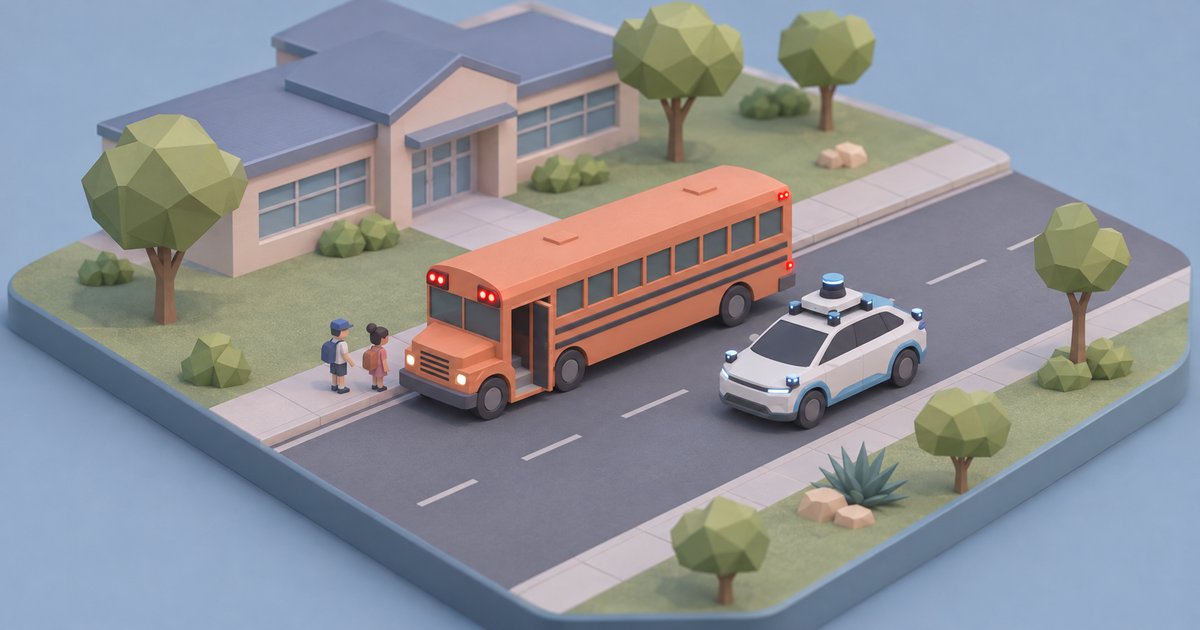
The US National Highway Traffic Safety Administration doubts that Waymo's school-bus recall worked. On 6 November 2026 its Office of Defects Investigation opened recall query RQ26006 into 2,895 vehicles running Waymo's fifth-generation automated driving system, the whole population covered by the original probe. Reuters reported the file on 9 November.
Most incidents came after the fix
The case began on 17 October 2025, when NHTSA opened preliminary evaluation PE25013. It was prompted by a media report of a Waymo passing a stopped school bus in Atlanta on 22 September 2025, and by traffic citations from the Austin Independent School District. In US law, traffic must stop while a school bus shows flashing red lights or extends its stop arm, because children are getting on or off.
Waymo filed recall 25E084 on 10 December 2025. Its recall report said the remedy, a software update, had reached every affected vehicle by 17 November 2025. The investigation then found what NHTSA calls "a large number" of incidents in which a Waymo passed a stopped school bus, and most of them happened after that date. In its closing résumé for PE25013, the agency writes that this "calls into question the effectiveness of the recall remedy".
| File | Opened | Vehicles | Status |
|---|---|---|---|
| PE25013, preliminary evaluation | 17 October 2025 | 2,895 | Closed 6 November 2026 |
| Recall 25E084, software update | Filed 10 December 2025 | All affected vehicles | Remedy reported complete 17 November 2025 |
| RQ26006, recall query | 6 November 2026 | 2,895 | Open |
The recall query has two aims: to judge whether the remedy was adequate, and to find what caused the incidents after it. Its opening résumé lists eight reports from outside sources, all of them traffic citations from the Austin school district. Waymo's own figures are marked confidential. A recall query can end with no action, or with NHTSA asking for a new or wider recall.
Why Tesla owners should care
Austin is also where Tesla's Robotaxi service started, and Tesla now runs it in five Texas cities. Tesla faces its own school-related file: since 9 October NHTSA has been weighing a petition alleging that Tesla's robotaxis speed through active school zones. That file counts four incidents and no crashes, and a decision is due around 21 January 2027.
RQ26006 shows how NHTSA handles a software recall on a driverless car. Shipping the update over the air does not close the matter. The agency compares incident dates with the remedy date, and if the problem continues, it reopens the case. The same approach would apply to Tesla, whose FSD (Supervised) is already the subject of an engineering analysis covering about 2.9 million cars over red lights, oncoming traffic and level crossings.
What it means in Europe
The rule at issue is North American. European school buses do not carry stop arms, so the specific failure has no direct counterpart on European roads. The underlying question does carry over. Waymo has picked Munich for its first EU robotaxi service, driverless by the end of 2027, and Madrid as its second EU region. The authorities that approve those services will also have to decide how to verify that an over-the-air fix works on the road. For Tesla drivers in Europe, nothing changes: FSD (Supervised) is still not approved in the EU, and none of these files concerns the cars Tesla sells there.