
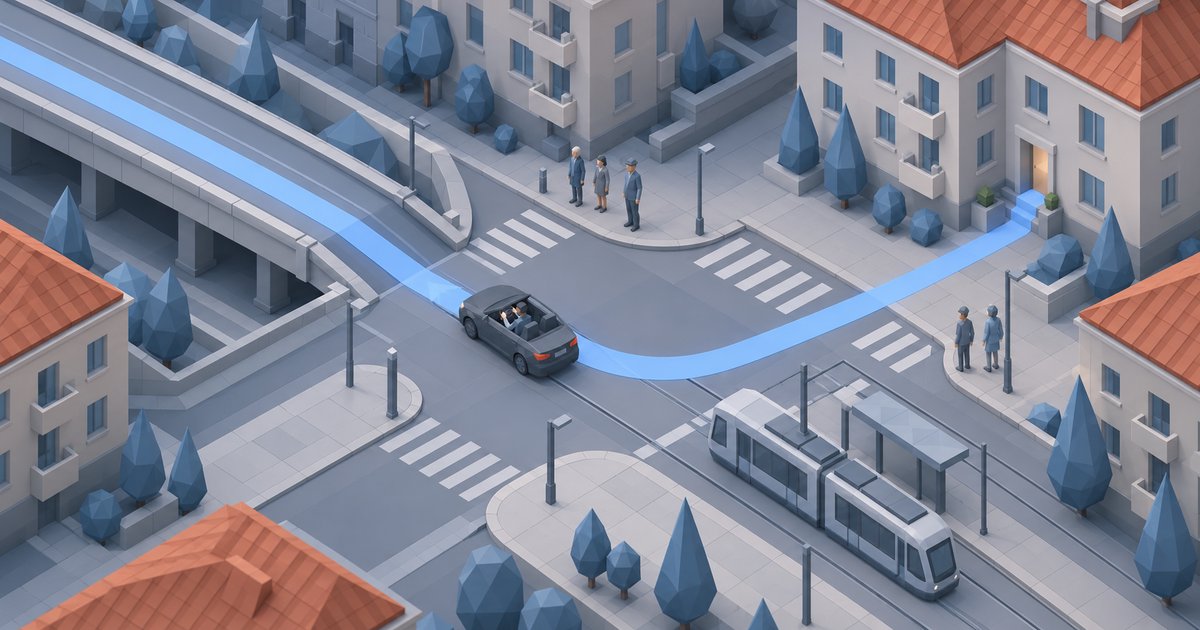
Mercedes-Benz will sell MB.DRIVE ASSIST PRO in Germany from the first half of 2027, the company said on 21 October 2026. The Level 2 system, developed with NVIDIA, follows the navigation route from start to destination, city streets included. From the end of 2026, selected owners in Stuttgart and Munich whose cars already carry the hardware will get it early by over-the-air update. Mercedes says it will be the first carmaker to offer such a system in Germany, after China and the United States.
That puts a point-to-point assistant on German roads while Tesla's FSD (Supervised) is still not approved there.
What Mercedes announced
The press release sets out the plan:
- Orders in Germany from the first half of 2027. Existing owners with suitably equipped cars can add it over the air. Availability depends on the model, and the system is to spread across Mercedes' car and van range.
- Early access from the end of 2026 in Stuttgart and Munich, for customers Mercedes contacts directly. Nobody can apply, netzwelt notes.
- A free trial month after market launch. There is no German price yet. In the US, Mercedes sells the system as a three-year subscription for $3,950, electrive reports.
- What it does: with Mercedes navigation running, one button on the steering wheel switches it on. It helps with leaving the motorway, lane changes, merging into the right lane, turning at junctions, and braking and pulling away at traffic lights.
- Hardware: 27 sensors (ten cameras, five radars and twelve ultrasonic sensors) feed a computer rated at up to 254 TOPS. It runs MB.OS with NVIDIA's Hyperion architecture, its Halos safety system and Alpamayo software.
- Hands on: Mercedes calls it a cooperative hands-on steering concept. The driver can steer at any moment, must pay attention throughout and remains responsible.
Mercedes first said in May that the system would reach selected German cities by the end of 2026, electrive reported then. The new release adds the order date, the early-access terms and the legal basis.
A different legal route from Tesla's
Mercedes says it developed the system under UN Regulation 171, the UNECE rule for driver control assistance systems (DCAS), and that this could let it launch in all EU markets "without a further regulatory approval". It does not say an approval has been granted. BMW used the same regulation to cover its hands-off motorway assistant in 18 European markets with one certificate, and BYD is seeking it for its city system.
Tesla took another road. FSD (Supervised) rests on a provisional approval from the Dutch RDW under Article 39 of the EU type-approval regulation, which other states adopt by letter. It is now legal in nine countries: the Netherlands and eight that recognised the approval, Slovakia most recently. The Dutch exemptions cover hands-off driving outside motorways and the requirement to obey speed limits, as Norway's transport minister set out on 16 October. Mercedes' system keeps the driver's hands on the wheel.
Germany has not recognised the Dutch approval. The ministry and the KBA are still reviewing the safety documentation, and the KBA wants to test a Tesla itself, as TeslAnt reported in the minister's call for an EU-wide decision. The EU committee cannot vote before December.
What it means for Tesla owners
For Tesla owners in Germany, nothing changes today: the supervised city-streets system is not offered. The comparison is what changes. In 2027 a German driver will be able to buy point-to-point assistance from Mercedes under a UN rule that needs no national exemption, with hands on the wheel. Tesla's system goes further where it is approved, with hands-off driving outside motorways, and that is why it needs each country's consent or an EU vote. In the Netherlands it costs €99 a month. Mercedes' US price works out at about $110 a month.