
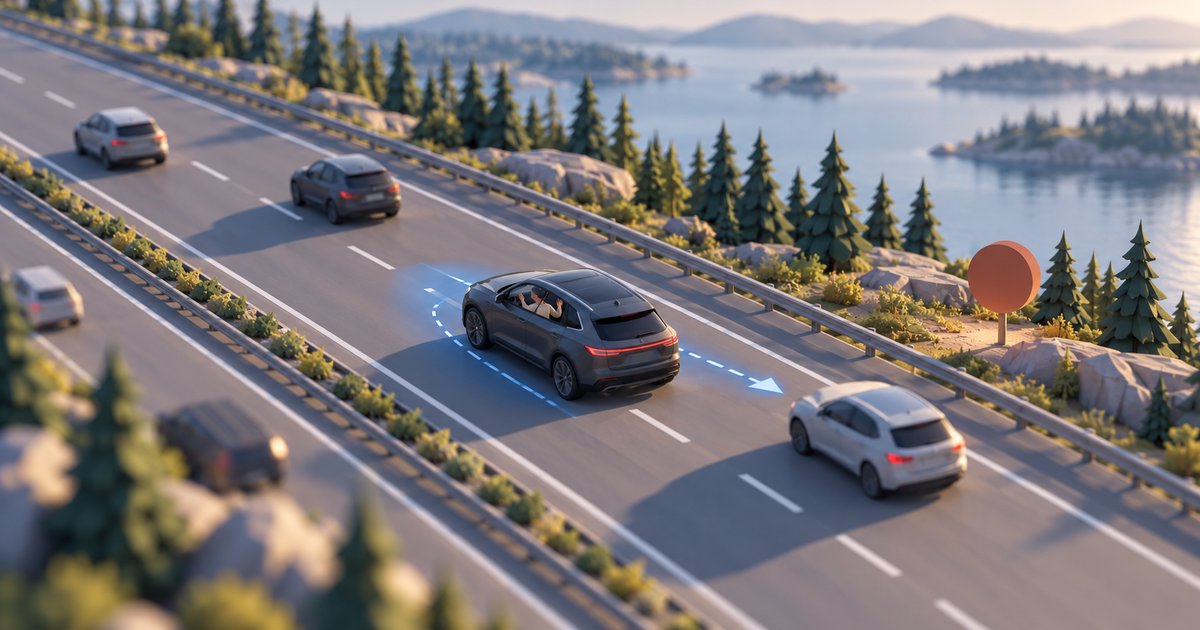
BMW is bringing hands-off motorway driving to Sweden. On compatible stretches of motorway, a driver can take both hands off the wheel at up to 130 km/h while the car steers, accelerates, brakes and holds its distance.
One correction to the local headlines, which have run as though this is available now: it is not. Swedish cars get the function with Remote Software Upgrade 11/26, which BMW expects to release in November. The announcement is the approval and the date, not the switch-on.
What the driver actually does
Highway Assistant is a Level 2 system and BMW is not pretending otherwise: the driver has to keep watching the road and be ready to take over immediately. What changes is where the hands go.
Lane changes are the distinctive part. Rather than touching the indicator stalk, the driver looks at the relevant door mirror. The car registers the gaze and performs the lane change itself.
The function covers the new iX3, the new 3 Series, the new X5, and 7 Series cars built from July 2026. Existing cars with the necessary camera and sensor hardware can be upgraded over the air. Swedish pricing has not been announced; Vi Bilägare puts the German price at roughly 16,000 kronor.
The approval is the whole story
The reason BMW can do this in Sweden, and the reason it can do it in 18 European markets, is a certificate.
In November 2025 BMW became the first carmaker approved under UN Regulation 171, the DCAS rule in force since September 2024 — the first globally harmonised framework for systems that steer and change lanes while a human supervises. R171 is a UNECE regulation, so an approval under it is recognised across the states that apply it, and adding a country becomes a software and mapping exercise rather than a fresh negotiation.
Lotus took the same route, certifying in March 2026 and switching on supervised overtaking on German autobahns in August — though hands-on, and only along one corridor. BMW's is the broader implementation of the same rulebook.
Two routes, and Tesla is on the slower one
| BMW Highway Assistant | Tesla FSD (Supervised) | |
|---|---|---|
| Legal basis | UN R171 (DCAS), harmonised | Article 39 exemption, national |
| Travels across borders | Yes, by recognition | No, re-approved per country |
| European markets | 18 | 8 |
| Hands on the wheel | Not required to 130 km/h | Required |
| Available in Sweden | From November 2026 | Not approved |
Tesla's European permission rests on the provisional type approval the Dutch RDW issued in April 2026 under Article 39 of Regulation (EU) 2018/858 — the clause for technology that does not fit the harmonised rulebook. Being outside the rulebook is why it does not travel: every member state decides separately, which is why the count has crawled to eight, most recently Croatia on 28 September. Sweden is not on that list.
What it means for a Swedish Tesla owner
Nothing changes in the car, and that is the point. Sweden is one of Tesla's strongest markets — the Model Y was the country's best-selling car in September, in a month when about half of all new Swedish cars were electric.
From November, the driver of a considerably rarer BMW on the E4 can legally let go of the wheel. The owner of Sweden's best-selling car cannot, and will not until either Sweden recognises the Dutch exemption or the bloc-wide decision now pencilled in for December goes Tesla's way. The gap is not about which system is better. It is about which one holds a certificate that crosses borders.