
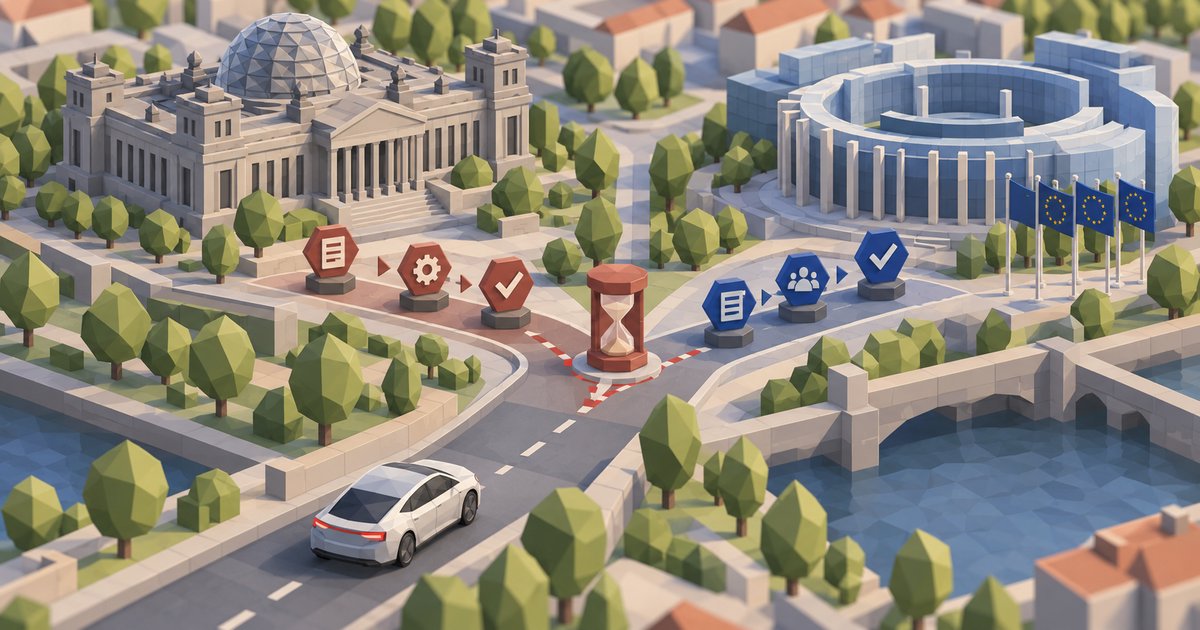
Germany's transport minister said on 6 October 2026 that he wants Tesla's Full Self-Driving (Supervised) usable across the European Union, and soon. He said it on the morning of the day the EU committee that could authorise it met in Brussels and, as expected, did not vote.
What Bilger said
Federal Transport Minister Steffen Bilger (CDU) was speaking at a Tagesspiegel Background conference in Berlin. He called an agreement at European level sensible and said he would push for FSD to be usable throughout the EU promptly. If that agreement cannot be reached, he added, one would have to discuss "what could be done in Germany".
He did not spell out what EU approval would look like in practice, and heise, which reported the remarks, said so.
Two things make this more than a soundbite. The first is who said it. Germany's position until now had surfaced as a citizen-service reply describing the ministry as "technology-open and safety-oriented" — official correspondence binding on nothing. A minister at a podium is a different order of commitment. The second is that Berlin is the vote that decides this file.
The arithmetic that makes Germany the file
Authorisation needs 15 of 27 member states representing 65% of the EU population. Eight states now recognise the Dutch RDW authorisation — Croatia became the eighth at the end of September — and together they are roughly 12% of the Union.
Germany, France, Italy and Spain are all outside that group, and France has refused outright. Those four are close to 58% of the EU population, so the 65% threshold cannot be reached while all four stay out. Germany is the only one of them whose yes brings the number within range on its own.
The fallback already has a legal route, and an expiry date
"What could be done in Germany" is not improvisation. Article 39(5) of Regulation 2018/858 lets a member state adopt the Dutch authorisation for its own territory by notifying the RDW in writing. That is the same mechanism the eight recognising countries used — a German national route would make Germany the ninth through the ordinary door, not a new one.
What it would not be is permanent. If the Commission later rejects the application in the formal EU procedure, a national authorisation granted this way is withdrawn six months afterwards, though cars registered before that point stay legal. A German solo approval would open the market while leaving a conditional clock running on it.
It is also the opposite of the call Ireland made, where the NSAI said it would wait for Brussels rather than act nationally.
The objection has not moved
Parliamentary State Secretary Christian Hirte said the ministry and the KBA are still working through the Dutch safety documentation with the RDW and Tesla, and that the KBA wants to test a Tesla itself before Germany settles its position. He gave no date for finishing.
The sticking point is the one it has been throughout: FSD can be configured to exceed the detected speed limit, and a Brussels road-safety test found it over the limit in 55% of the 30 km/h segments it drove.
What changes for owners
Nothing today. FSD (Supervised) stays available in eight countries and unavailable in the other nineteen, and the committee's decision is a December matter. What changed on 6 October is that the largest outstanding vote now has a minister publicly arguing for yes — and a named legal route for acting without Brussels if the answer is no.