
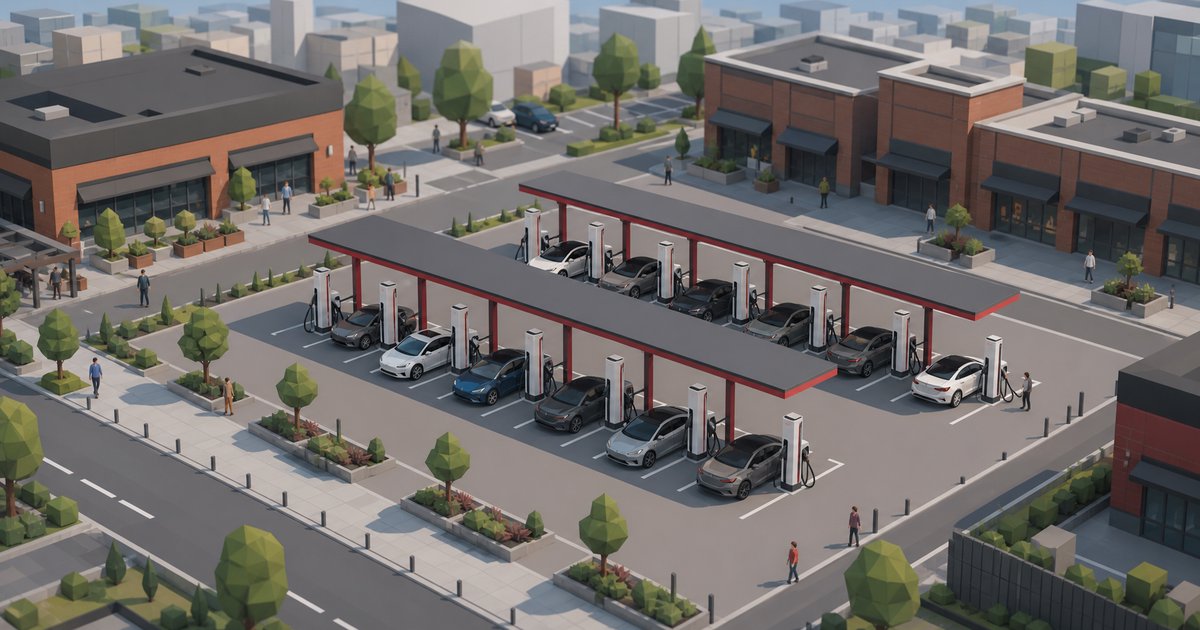
Ionity has opened its first fast-charging hub inside London. The site went live at Greenwich Shopping Park on 19 August 2026 with 12 bays rated at up to 400 kW, and the network calls it the first of several planned for the capital.
What has opened
| Detail | Greenwich Shopping Park |
|---|---|
| Charging bays | 12 |
| Peak power | Up to 400 kW |
| Opened | 19 August 2026 |
| Launch offer | Free charging for 24 hours from Friday 21 August, via the Ionity app |
The location matters as much as the hardware. Greenwich Shopping Park sits beside the A206, close to the O2 Arena and the Greenwich Peninsula — a retail park a driver reaches while already stopping, rather than a motorway-services detour. Ionity built its European reputation on trunk-road sites, and this is the network moving into urban destination charging.
Chief executive Jeroen van Tilburg framed the opening around supply: "Growing numbers of drivers are choosing to make the switch to electric and it is vital that the supply of ultra-fast chargers is rapidly scaled up." Ionity describes Greenwich as the first in a pipeline of ultra-rapid hubs for London, with more urban sites in development across major UK cities, but has not named them or given a number. The hub is also tied to Ionity's Uber partnership, which offers ride-hailing drivers preferential rates and, in return, gives Ionity utilisation data from cars that charge several times a day.
Ionity's largest UK site remains the 24-bay, 350 kW hub at the DoubleTree by Hilton Dartford Bridge, which opened in February 2025 outside the capital. Greenwich is smaller but carries the higher power rating.
What 400 kW actually means for a Tesla
A Tesla in the UK charges on CCS, so Ionity works with no adapter and no separate hardware. What it will not deliver is 400 kW. No Tesla on sale accepts anything close to that figure — the Model 3 and Model Y peak in the 250 kW region — so the number on the cabinet describes the cabinet, not the car.
Even the car's own ceiling is conditional. TeslAnt recently documented a Model 3 drawing 50 kW from a 400 kW charger in Spain, where ambient heat forced the site to derate. The practical value of a 12-bay urban hub is not peak power. It is the odds of finding a free stall on a Saturday afternoon in south-east London.
Cost is the open question
Ionity did not publish a per-kWh price with the opening, and the free-charging window closes after 24 hours. That is the detail worth watching, because it decides whether the site becomes a genuine alternative or a fallback. Ionity's ad-hoc pricing in Europe has historically sat above Tesla's Supercharger rates, and the network's subscription products exist precisely to close that gap for frequent users.
What it changes for Tesla owners in London
London Tesla owners gain redundancy rather than capability. On a network where a single congested Supercharger can reshape an afternoon, 12 more ultra-rapid bays in a dense part of the city is a real addition — and it arrives as Tesla itself keeps opening Superchargers to other brands across Europe. Competition in urban fast charging is what puts pressure on both prices and queue lengths.