
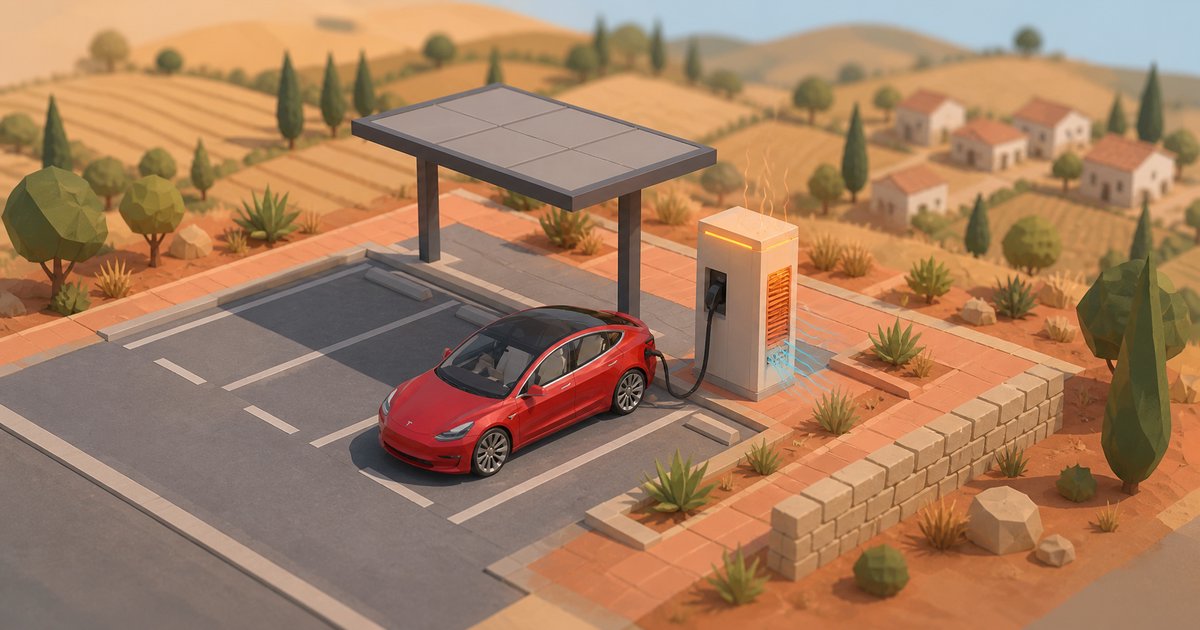
A Spanish reporter pulled into a fast-charging site advertised at up to 400 kW last week, plugged in a Tesla Model 3, and watched the session settle at barely 50 kW. For a few seconds the car saw 230 kW. Then it dropped back to 50 and stayed there.
The site was Zunder's location at El Raso in Villalpando, and the day was a hot one. Carlos Noya, who logged the session for Forococheselectricos, arrived to find the cables already warm to the touch — the tell that the hardware had been working hard before he got there.
Advertised power is a ceiling, not a promise
| Figure | |
|---|---|
| Site rating | up to 400 kW |
| Brief peak seen | 230 kW, a few seconds |
| Sustained rate | ~50 kW |
| Share of rated power | ~13% |
A DC charger's rated output assumes its power electronics and its cables can shed the heat they generate. Both are liquid- or air-cooled, and both have protection thresholds. When cabinet or cable temperatures climb, the controller reduces current rather than risk the hardware — the same logic a car applies to its own pack, just on the other side of the connector. On a 40 °C afternoon, after a queue of cars has already heated the cable, there is very little thermal headroom left to spend on your session.
This is not a fault, and no error appears on the screen. The charger simply delivers less, and the number on the pillar goes on advertising what it can do on a mild morning.
Superchargers are not exempt from physics
Tesla's network handles heat better than most, but it is the same equipment problem. Owners on Tesla Motors Club have logged sessions in the American southwest collapsing to roughly 46 kW at ambient temperatures near 46 °C, and at least one Arizona site has shut down outright with a thermal warning on the display. Tesla's own summer driving guidance exists because of this, and older V2 cables are the most heat-sensitive part of the fleet.
European Superchargers are also already capped at 250 kW for Teslas, as TeslAnt covered when a Zeekr was recorded drawing 257 kW from one. Losing four-fifths of 250 kW hurts the same as losing four-fifths of 400.
The grid is a second, separate squeeze
Heat is also reaching charging from the supply side. Hungary's Paks nuclear station cut output across four reactors this summer because Danube water temperatures rose too high for cooling, and Hungarian operators including MOL and Shell Recharge responded by capping the power their chargers deliver. That is a policy decision made upstream of any thermal sensor. A driver cannot tell the two causes apart from the driver's seat — both look like a slow charge.
What actually helps on a European summer trip
Precondition the battery by navigating to the charger rather than typing the address in your phone; a cold or hot pack is the one variable you control. Pick a shaded or canopied stall where the site offers one. Charge in the early morning or late evening on the hottest days, when both the cabinet and the queue have cooled. And on a summer road trip through southern Europe, plan legs on a realistic rate rather than the number printed on the pillar — a 400 kW site that gives you 50 turns a 15-minute stop into an hour.