
Germany is about to decide whether bidirectional charging is a product or a hobby. The Bundesnetzagentur publishes the final version of its MiSpeL determination — the rules on market integration of storage and charge points — on 1 October, with a closing workshop the day after. An alliance of carmakers and energy suppliers has spent the closing days of the process telling the regulator it has got the mechanics wrong.
What MiSpeL actually decides
MiSpeL governs how electricity is counted at a charge point: which kilowatt-hours qualify for renewable support, and which qualify for a refund of grid fees and levies. The Bundesnetzagentur published a revised working draft on 5 August 2026, changed substantially from the version it consulted on in September 2025.
For the first time, both of its metering options cover bidirectional charge points. A car that can export as well as import is finally treated in law like a stationary battery. That part the industry asked for. The mechanics underneath it are the problem.
Two routes, and the objection to each
| Route | How it works | The objection |
|---|---|---|
| Separate meter | A second meter records flows into and out of the car exactly | Transparent, but expensive — it needs work inside the consumer unit |
| Flat rate | Settles through the existing household meter | Open only to households that already have solar |
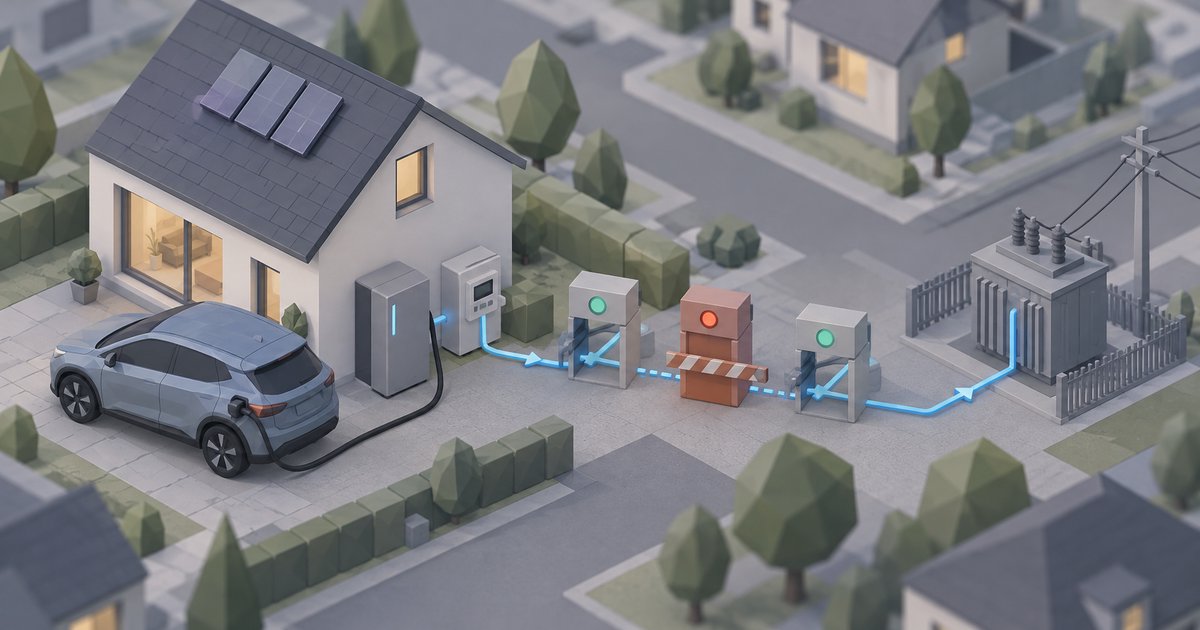
The flat rate is where the argument sits. Under the draft, the first 500 kWh a household exports is settled at the normal EEG feed-in rate. Above that sits a buffer zone that earns neither the EEG payment nor a refund of fees and levies. Only above the buffer is the electricity treated as battery discharge and eligible for the refund.
A driver without a solar array gets neither route on reasonable terms.
Who is objecting, and what they want instead
BMW, Ford, Volkswagen's Elli, E.ON, Octopus Energy, The Mobility House and Enpal signed a joint letter saying the draft contains substantial technical, economic and operational barriers that endanger the market ramp-up of bidirectional charging. One unnamed manufacturer in the group called it an industrial policy defeat. The VDA's Loic Geipel was blunter: "What is currently planned by the Bundesnetzagentur makes bidirectional charging economically unattractive. This makes the mass market impossible."
The utilities object for their own reasons. The BDEW and the VKU say the metering concepts and billing logic are simply too complex to operate in practice.
Their counter-proposal is narrow. Delete the buffer zone, and require direct marketing of the exported electricity instead — that removes the EEG payment, and with it the incentive the buffer was built to guard against. They also want the flat rate opened to households without solar.
Where this leaves a Tesla owner
Tesla is not on the letter, which is worth noticing given how much rides on the answer. It sells Powerwall 3 in Germany, its largest European market, and Cybertruck Powershare finally reached Powerwall this month after missing its summer deadline. None of that reaches German households on sensible economics if the export side is settled the way this draft sets out.
This is also the third German rule this quarter to land on the same question. The planned 2027 solar throttle would cap what a home battery can give back at all, and Audi's vehicle-to-grid tariff with Octopus already ships with a ten-hours-a-day plug-in requirement to make its numbers work.
1 October is the date to watch. A rulebook that leaves the 500 kWh threshold and the buffer zone in place would put a third constraint on a product that has not yet sold in volume to anyone.