
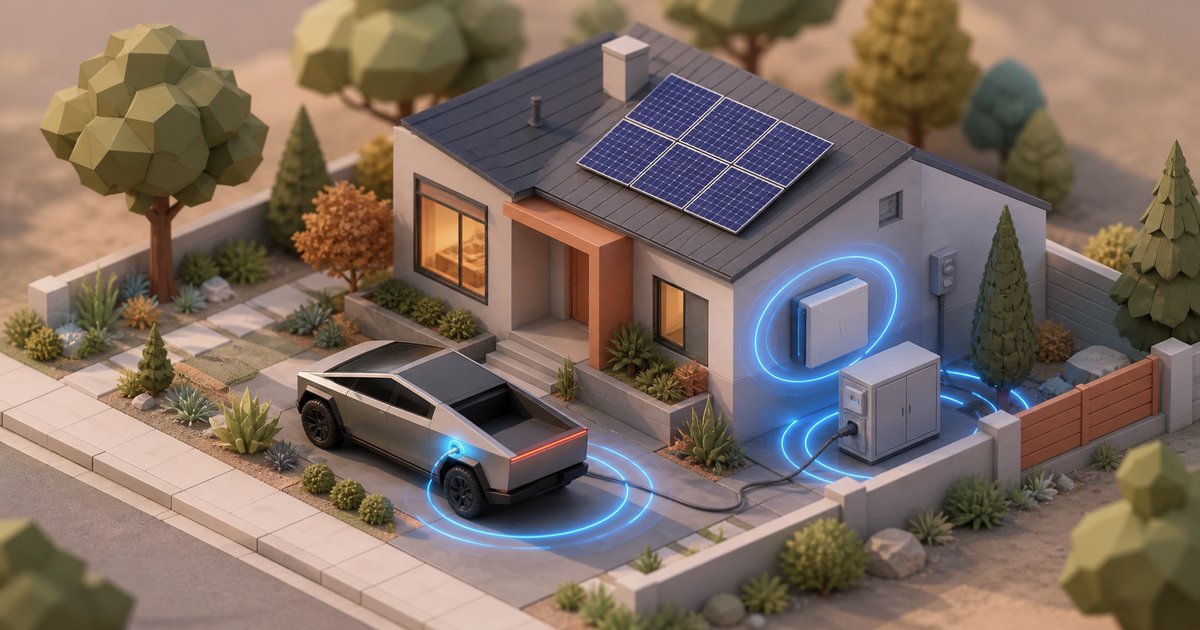
Tesla told Cybertruck owners in December 2025 that Powershare would work with Powerwall by mid-2026. Lead engineer Wes Morrill later put it at summer 2026. Summer ends in weeks, the feature has not shipped, and the most recent word from Tesla is that there is no updated timeline to give.
What works today, and what does not
Powershare itself is not vapour. A Cybertruck can already back up a house through a grid outage, provided the owner has the Powershare Gateway and a compatible Wall Connector installed. That path works and has worked.
What does not work is the combination that most Tesla energy customers actually own.
| Configuration | Status |
|---|---|
| Cybertruck + Powershare Gateway + Wall Connector | Available |
| Cybertruck + existing Powerwall | Not released |
| Original target | 2025 |
| Revised target (Dec 2025) | mid-2026 |
| Restated target | summer 2026 |
| Current guidance | none given |
Why it is hard, in Tesla's own words
Morrill has been unusually specific about the obstacle, and it is worth quoting rather than paraphrasing: "Two grid-forming devices need to negotiate who will form and who will follow depending on state of charge of each."
A grid-forming device is one that creates the voltage and frequency reference the rest of the house follows. During an outage, a Powerwall does that. So does a Cybertruck running Powershare. Put both on the same panel and they have to decide, continuously and correctly, which one leads and which one follows — as each one's state of charge changes, and as sun and load move through the day.
Morrill added the constraints that make it worse: this negotiation has to happen without a network connection, across multiple hardware generations of Powerwall in the field, while satisfying safety certification. Tesla has said the extra time is to cover the many configurations and generations of Powerwall already installed, and that it "turned out to be much harder than anticipated" to make it work through existing wall connectors.
That is a credible engineering explanation rather than an excuse. Two independent sources of grid-forming power on one premises is exactly the case that islanding standards treat most carefully, because getting it wrong energises circuits that are supposed to be dead.
Why Europe should care about a truck it cannot buy
Cybertruck is not sold in Europe and there is no sign that changes. The problem underneath it is not Cybertruck-specific.
Every vehicle-to-home proposition — Tesla's or anyone else's — runs into the same arbitration question the moment a house already has storage. Europe has been building the rules for this: the standard that makes AC vehicle-to-grid work landed in July while the EU regulation still points at the older version, and Tesla owners here have been reaching for third-party V2L adapters in the meantime.
There is one reading that favours Tesla: recent iOS app builds reportedly contain Powerwall-related Powershare strings, which usually means a release is near. Owners have heard that kind of signal before on this feature.
The honest summary is that Tesla has now missed this date twice, has explained clearly why, and has stopped giving new dates — which is arguably more useful than a third one it might also miss.