
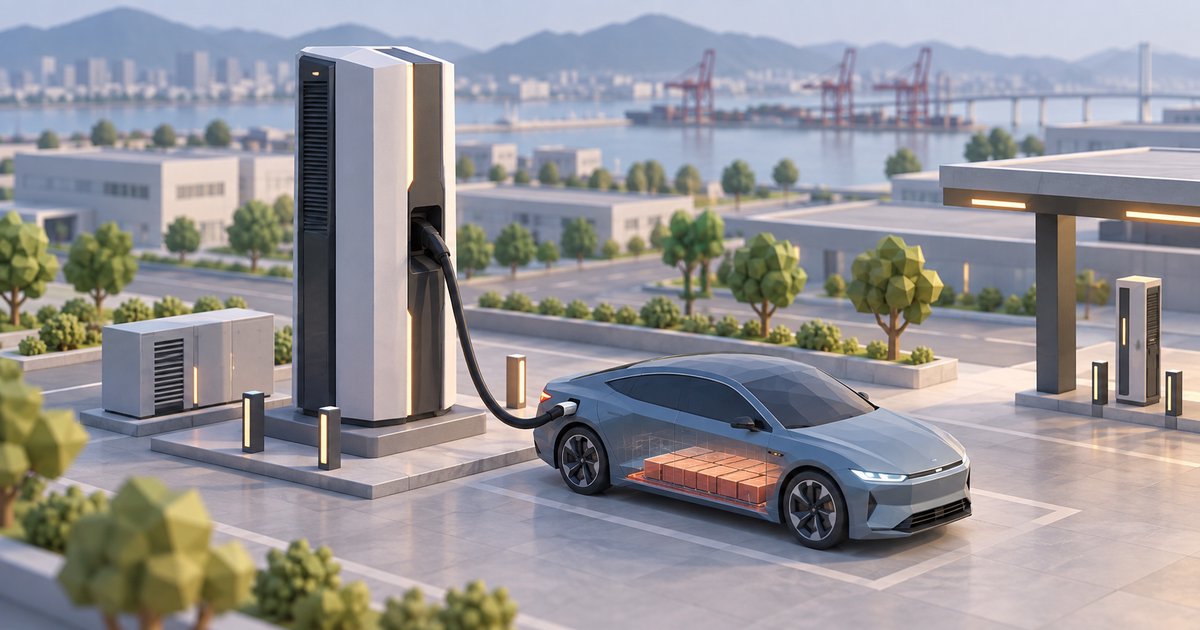
Geely launched what it calls the world's most powerful production EV charger in Ningbo on 23 September 2026: a fifth-generation Geely Smart Charging Station rated at a single-gun peak of 2,250 kW. That is half again as much as the 1,500 kW flash charger BYD unveiled in March, and nine times what a European Tesla can accept.
The number the launch did not lead with is the more useful one. In testing overseen by the China Automotive Technology and Research Centre, the quickest car Geely has — a Lynk & Co 10 on the group's new 12C battery — peaked at 1,093 kW. That is under half the station's rating, and it is essentially the same figure the same car recorded a month ago on Geely's existing 1,500 kW hardware.
What was announced
| Geely, 23 Sep 2026 | BYD flash charging | |
|---|---|---|
| Station peak, single gun | 2,250 kW | 1,500 kW |
| Peak a car actually drew | 1,093 kW (Lynk & Co 10) | — |
| 10–70% | 4 min 30 s | 5 min |
| 10–97% | 8 min 40 s | 9 min |
| Network target | 100,000+ guns by end-2027 | 20,000 flash stations in 2026 |
The battery is the other half of the launch. Geely's ultra-short blade cell — marketed as the Shendun Golden Battery, and rendered as "Aegis Golden Brick" in some translations — arrives in two formats: a 395 mm 12C cell for the Lynk & Co 10 and Zeekr 001, and a 370 mm 6C cell debuting in the Geely Galaxy E5. The 12C pack produced the 4 minute 30 second run from 10% to 70%, and reached 97% in 8 minutes 40 seconds at normal ambient temperatures.
Against BYD's second-generation Blade on its own flash charger, that is a lead of roughly thirty seconds to 70% and twenty seconds to 97%. Real, but far narrower than a 2,250 kW headline against 1,500 kW implies.
The cabinet is not the car
This is the same gap we described in August, when Geely was building 1,500 kW chargers its own cars could not fully use. The constraint then was the vehicle: Geely's cars run an 800-volt class architecture, and the Lynk & Co 10's pack measures 772.8 V. Raising the charger's ceiling from 1,500 kW to 2,250 kW does not change what a 772-volt car can pull, which is why the measured peak barely moved.
Geely said in August it was developing a 1,000-volt architecture to close that gap. No production timeline has been given, and nothing announced in Ningbo changes that.
Why a Tesla driver in Europe should care
Nothing here is on sale in Europe, and Geely has not said it will be. But Geely owns Volvo, Polestar, Zeekr and Lynk & Co, and is preparing to build its premium brands inside Volvo's European factories — so this technology has a route to European roads that most Chinese charging announcements do not.
The comparison worth holding on to is the delivered one, not the rated one. A European Tesla peaks at 250 kW. The fastest mainstream European network hardware, EnBW's 480 kW XCharge C7, already exceeds what any Tesla can take. Geely's 1,093 kW is more than four times a Tesla's peak — a real gap, and a smaller one than 2,250 against 250.