
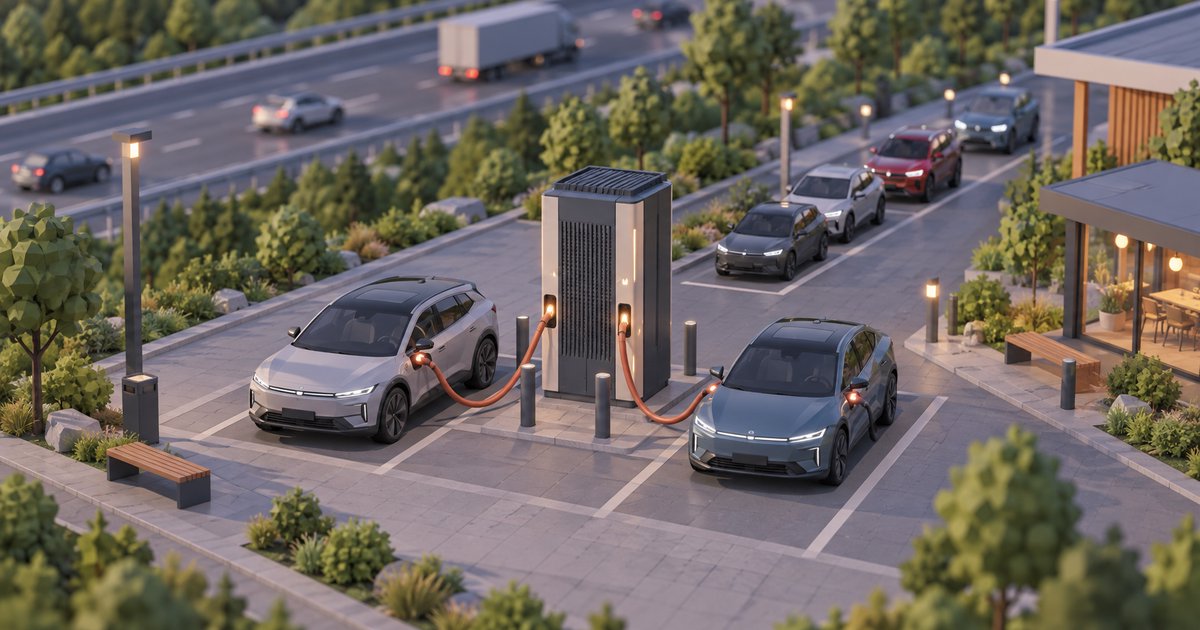
EnBW has started installing fast chargers rated at up to 480 kW across its German network — the highest figure on a mainstream European network, and a number no Tesla on the road can use. Both halves of that sentence matter, and the second one is the more interesting.
The hardware is the C7 from XCharge, a Chinese manufacturer that named EnBW as its anchor customer when it presented the cabinet in June 2026, following a partnership the two announced in February. EnBW says the units have been through tens of thousands of charging cycles in testing before going live.
Where it is running
The first C7s are in service at EnBW's flagship site at its Karlsruhe headquarters and at its fast-charging hub in Nettetal, close to the Dutch border. By the end of 2026 the company plans to equip what it calls a two-digit number of charging parks with the technology — so dozens of sites at most, against a German network that already runs to more than 9,000 fast-charging points.
"The new 480 kW charging systems from XCharge allow e-mobility users in the EnBW charging network to benefit from short charging times, advanced technology and high reliability," said Lars Jacobs, chief commercial officer and interim technical director of EnBW's e-mobility division.
EnBW's own illustration of the headline figure is that a suitable car can take on up to 640 km of range in 20 minutes. The qualifier is doing heavy lifting there: very few cars on European roads are suitable.
The number that matters is the second car
No Tesla can accept anything close to 480 kW. Peak charging rates on the current Model 3 and Model Y sit in the 250 kW range, and the limit is the car, not the post — a vehicle draws what its pack and thermal management allow, and then the curve tapers regardless of what the cabinet could supply.
So a German Tesla owner pulling into a C7 will not see a new number on the screen. What they may see is the old number holding up. These cabinets split their output between two connectors, and the practical effect of a large power budget is that two cars charging simultaneously can each run at their own maximum instead of being throttled to share a smaller one. On a 300 kW cabinet, two cars wanting 250 kW each cannot both have it. On a 480 kW cabinet, they can.
That is a real quality-of-life change on exactly the sites where it hurts most — the busy motorway hubs where the second stall is always taken. It is also a reminder that peak kilowatts have become a marketing number while power sharing is the thing that decides how long the queue actually takes.
The competitive frame
For Tesla, the relevance is that EnBW is the network its German customers use when they are not on a Supercharger, and the two are increasingly on the same forecourt — a charging park in Münster put EnBW and Tesla stalls on one site earlier this month. Tesla's V4 hardware is built for higher outputs than its cars currently request, which leaves both operators in the same position: the infrastructure has moved ahead of the fleet, and the cars will take years to catch up.
Whether 480 kW ever gets used as a single-car figure in Germany depends on vehicles that mostly are not sold there yet. Whether it shortens a real charging stop depends on whether someone else is plugged in next to you — which, increasingly, they are.