
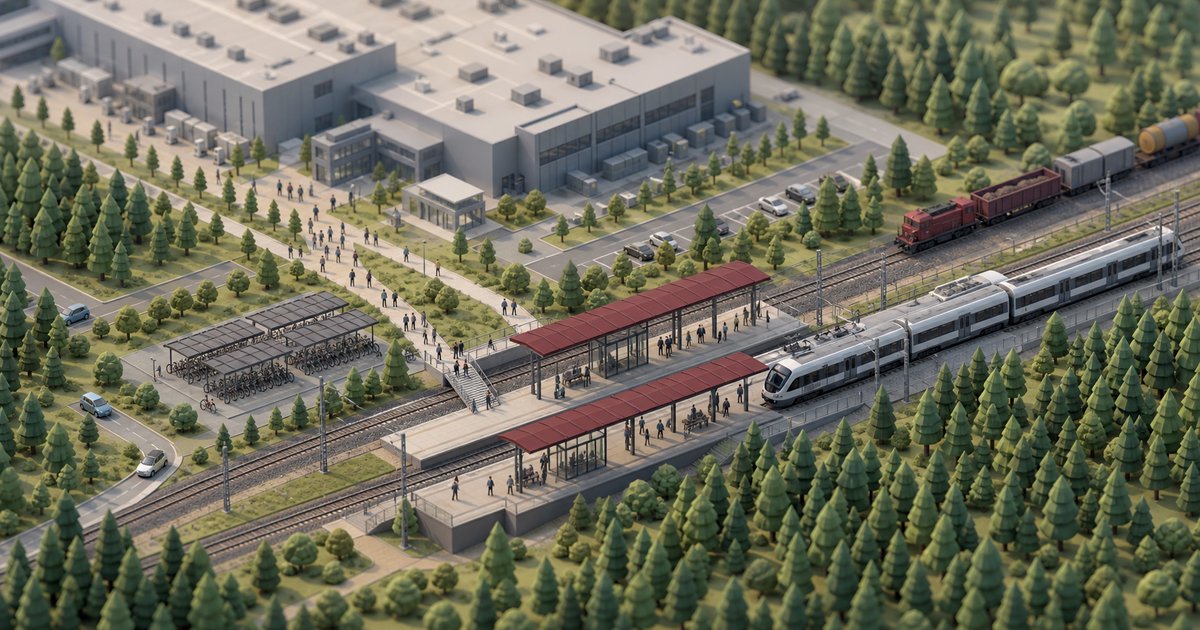
Tesla's German plant has spent four years with an awkward gap between the railway and the factory gate. That gap closed at the weekend: the rebuilt Fangschleuse station on the Berlin–Frankfurt (Oder) main line entered service after about two years of construction, sitting roughly two kilometres west of the stop it replaces and materially closer to the Grünheide site.
The old station is being dismantled. With it goes the shuttle train that the Niederbarnimer Eisenbahn (NEB) ran to bridge the last stretch to the plant — a service that existed only because the nearest platform was in the wrong place.
What actually opened
Trains began calling at the new station on Saturday evening, after a short delay to the planned opening. Deutsche Bahn expects the stop to handle up to 16,000 passengers a day. The layout is substantially bigger than what it replaces: five additional platform tracks, two passing tracks of 740 metres each, and platforms long enough for RE1 regional trains of over 200 metres.
According to regional reporting, the RE1 initially calls once an hour, with the service due to step up to two trains an hour from 25 August. That frequency is the part that matters most to the people using it — a factory running continuous shifts needs departures that line up with shift changes, not one train an hour.
Built for freight as well as commuters
The station is a passenger and freight facility, and the freight half is still under construction. The projected capacity is up to 24 freight trains a day, with the passing loops and a connection toward the Freienbrink industrial estate where the Tesla plant sits. Deutsche Bahn's own framing puts that in road terms: up to 2,400 lorries' worth of movements potentially shifted onto rail.
That is the strategic point. Grünheide's inbound and outbound logistics have leaned heavily on trucks, and a works rail connection changes the cost and emissions profile of running the plant — not immediately, but as the freight works complete.
The end of the Giga-Train
The NEB shuttle was a workaround, and workarounds have a cost. Ending it removes a transfer from the daily commute of thousands of Grünheide staff, which is the immediate, concrete win here. Tesla has separately pursued its own rail infrastructure on site; TeslAnt covered the planned new building and rail hub at Giga Berlin in June, and the plant's expansion toward 7,500 cars a week and 1,000 new jobs is what makes commuter capacity a live constraint rather than a nice-to-have.
Why European owners should care
This is not a product announcement, and nothing about your car changes. But Grünheide is the plant that builds Europe's Model Y, and its constraints are the ones that show up later as delivery timelines. A factory that can move staff by regional train and freight by rail is a factory with fewer bottlenecks between a ramp decision and cars leaving the site.
It is also a reminder of how much of Tesla's European capacity story is public infrastructure rather than Tesla's own capex. The station was built by the state railway, on the state railway's timetable — two years of it — and Tesla was a beneficiary, not the builder.