
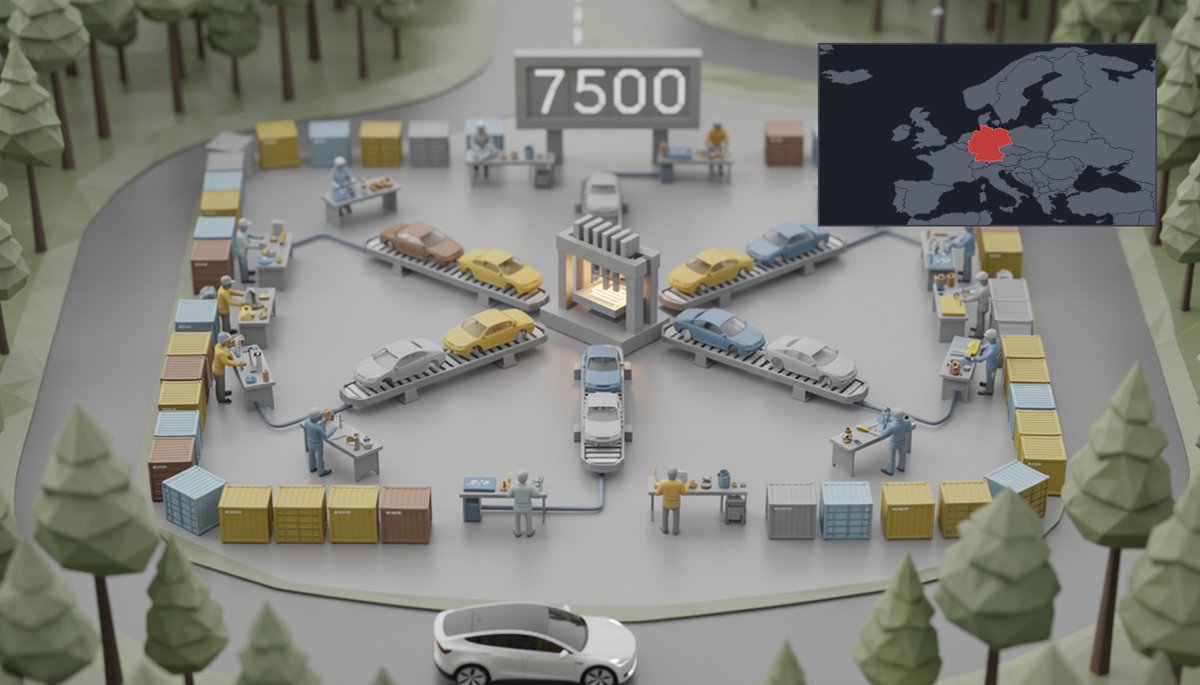
Tesla is stepping up production at Gigafactory Berlin-Brandenburg for the second time in months, this time targeting 7,500 vehicles a week by October and adding around 1,000 new assembly-line jobs to get there. Plant manager André Thierig confirmed the plan as the company races to keep pace with a sharp recovery in European demand.
The numbers behind the ramp
The new target builds directly on an earlier 2026 expansion. In April, Tesla announced a roughly 20% production increase that lifts weekly output from about 5,000 to 6,200 cars starting in July. The latest move pushes that figure further still, to 7,500 vehicles a week from October — a step that requires the extra 1,000 employees Thierig described.
Taken together with earlier hiring rounds, Tesla's announcements point to roughly 3,500 additional jobs at the site across the short and medium term. A chunk of that relates to the plant's battery operation: its cell factory is gearing up to produce 18 GWh of 4680 cells from 2027, work expected to add around 1,500 roles on its own.
Why the demand came back
The expansion is a direct response to a European turnaround that few predicted a year ago. After a bruising 2025, Tesla's registrations have climbed for several straight months, helped by the refreshed Model Y, regional purchase incentives, and stubbornly high fuel prices that keep nudging buyers toward electric. The Berlin plant, which recently passed its 750,000th vehicle, builds the Model Y in volume for the European market and is now also exporting the car to Canada.
Local production carries a strategic edge beyond headcount. Building the Model Y in Germany keeps it clear of the EU's tariffs on China-built EVs and shortens delivery times for buyers across Germany, France and the Nordics — an advantage that matters more as Chinese rivals push harder into Europe.
What it means for European owners
For shoppers, a higher production rate should translate into shorter waits and steadier availability of the refreshed Model Y, the configuration most European buyers are ordering. For the wider region, the ramp is a tangible vote of confidence: Tesla is committing capital and jobs to its only European car plant rather than trimming them, reversing the mood that hung over Grünheide through much of 2025.
The targets are ambitious, and Tesla has a history of stretch goals at Berlin that slipped in the past. But the direction is clear. With output climbing in two stages through October and a battery line ramping behind it, Giga Berlin is being positioned as the anchor of Tesla's European recovery rather than a question mark over it.
Update: 2026-06-27
On 26 June 2026, planning documents reported by Not a Tesla App showed that Tesla's next phase at Grünheide reaches well beyond the production ramp. A large new factory building, planned directly north of the current plant and roughly its equal in size, would nearly double the site's built footprint. The brochure also details a new and modernised rail connection to the Freienbrink freight transport centre (GVZ) to move parts and finished cars off the roads, a public pavilion in front of the Fangschleuse train station, and partial financing of state road L 386. The plans still have to clear permitting and public consultation.