
Two months ago EVgo agreed to install Tesla's V4 Superchargers across the United States under its own brand. On 29 September it announced it is designing a charger of its own that is half as fast again.
What EVgo announced
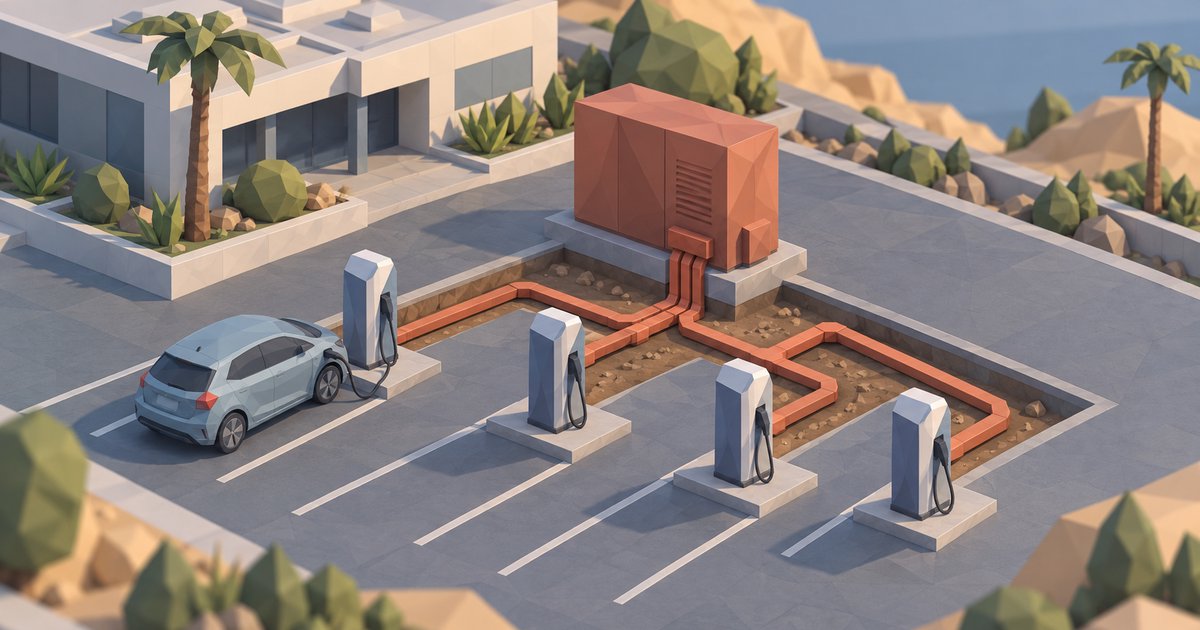
The company previewed a next-generation charging architecture capable of up to 750 kW. It is being designed, built and tested at EVgo's Innovation Lab in El Segundo, California, co-developed with Delta Electronics, a hardware partner EVgo has worked with for years. The finished design is due to be shown in 2027, when deployment begins.
| Specification | Detail |
|---|---|
| Peak power | Up to 750 kW |
| Connector | NACS on every stall |
| Power delivery | Shared across stalls, adjusted per vehicle as the battery's needs change |
| Co-developer | Delta Electronics |
| Design reveal and deployment | 2027 |
| Claimed charge time | About 10 minutes for the fastest-charging EVs sold in the US |
The number is a ceiling, not a promise
No car on sale takes 750 kW. The fastest-charging production EVs peak well below that, and EVgo's own framing is careful — the claim is that the system could charge today's quickest cars in about ten minutes, which is a statement about headroom rather than about any single stall delivering 750 kW to one vehicle.
The power-sharing design makes that explicit. The architecture pools power across stalls and reallocates it as each car's charge curve changes, so 750 kW describes what the cabinet can push, not what a driver should expect to see. That is the sensible way to build a site — cars spend most of a session well below their own peak — but it means the headline figure is an engineering specification, not a customer one.
What is genuinely new is who is building it. EVgo is one of the very few American networks designing its own hardware rather than buying it from ABB, Alpitronic or Tesla.
Why buy Tesla's chargers and build your own
The two announcements are less contradictory than they look. The V4 Superchargers EVgo is deploying under its own brand are rated at up to 500 kW, built and maintained by Tesla, and available now — a way to add proven capacity quickly without an engineering programme. The 750 kW system is a 2027 product EVgo controls outright.
Buying Tesla hardware solves this year. Designing its own solves the dependency. A network whose fastest sites are built and serviced by its largest competitor has an obvious structural problem, and this is the answer to it.
What it means in Europe
Directly, nothing. EVgo operates only in the United States, and no part of this reaches a European charging stall.
The relevant detail for a Tesla owner is the connector. Every stall carries NACS, so these are chargers a Tesla plugs into natively rather than through an adapter — and at 750 kW they would sit above the 500 kW V4 Supercharger on paper. The 750 kW figure is also not unprecedented in Europe — it is exactly the peak MAN's megawatt-charging electric trucks already take in series production, using a heavier connector built for batteries an order of magnitude larger than a car's. The useful takeaway is not the number but the direction: the constraint on charging speed is moving decisively from the charger to the car.